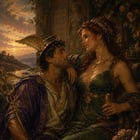
The pattern:
Any female divine being whose domain doesn't fit reproductive/nurturing gets force-fit into "mother archetype."
Any autonomous partnership gets collapsed into hierarchy. Any cross-cultural divine being gets absorbed into the dominant (Greek) mythology.
The fix:
Let them be themselves. Let the partnerships be partnerships. Let the evidence speak.
The Historiographical Pattern (What To Look For)
This same erasure appears in:
Brigid → "Christian saint filtering Celtic goddess"
**•** Brigid has her own name, her own practices, her own documented autonomy **•** Gets absorbed into "mother goddess archetype" **•** Real story: autonomous being *adapts* (intentionally) to Christian framework while remaining herself **•** Comparative mythology missed: her *choice* (which is harder to explain than passive "filtering") Hecate → "triple goddess archetype"
**•** Often read as three manifestations of one matriarchal principle **•** Evidence: Hecate is *one being* who operates across three registers **•** Gets collapsed into mother-maiden-crone because that's easier than explaining how one being has multiple registers **•** Comparative mythology missed: agency and complexity –
Why This Breaks Institutional Authority
The apparatus move in comparative mythology:
• Claims institutional expertise in "archetypal patterns"
• Makes interpretations based on assumed frameworks (Jungian archetypes, etc.)
• Dismisses or ignores contradicting evidence as "regional variation" or "local custom"
_
What forensic interrogation does:
**•** Doesn't argue against the framework **•** Simply asks: "What does the evidence *actually* document?" **•** Requires the claim-maker to show their chain of custody (where does this data come from? how was it interpreted? what alternatives exist?) **•** Short-circuits authority by making the methodology transparent Why it works:
Because once you ask clearly "Does the inscription say 'mother'?" and the answer is "No," the authority claim collapses. Not through counter-argument, but through refusing to let the interpreter stand between you and the evidence.
_
The Chain-of-Custody Interrogation (How To Break This For Any Claim)
Template for interrogating comparative mythology:
Claim: "X is a regional/filtered version of [Greek equivalent]"
Interrogation steps:
**1. Named attestation** **•** Does X have its own name in primary sources? (Yes = autonomous being, not filter) **•** Is X named independently from the proposed Greek equivalent? (Yes = evidence against syncretization claim) **•** How many times is X named independently? (Frequency matters—one mention = scholarly error; multiple = systematic documentation) **2. Independent dedications** **•** Are there dedications to X alone (without the Greek equivalent)? (Yes = X is independently honored) **•** How many? (Even 2-3 = pattern) **•** By whom? (If not connected to the Greek god's worship sites, even stronger evidence) **3. Imagery and attributes** **•** Does X's iconography *match* the proposed Greek equivalent? (No = different being) **•** Does X have attributes the Greek equivalent doesn't have? (Yes = autonomous domain) **•** Is X depicted in contexts different from the Greek equivalent? (Yes = different function/role) **4. Partnership documentation** **•** If X appears with other beings, are those pairings *intentional* (inscribed, dedicated, repeated)? (Yes = autonomous partnerships, not random association) **•** Does X appear with *multiple* partners? (Yes = cannot be "support function for one deity") **•** Are the partnerships documented *symmetrically* (both names appear together)? (Yes = partnership, not subordination) **5. The absence test** (most powerful) **•** In what sources does X *not* appear? (Religious texts? Literary references? Why?) **•** Where *does* X appear? (Inscriptions, art, dedications—ordinary people's practice, not elite literature) **•** What does this distribution pattern tell you? (X was worshipped by actual practitioners, not incorporated into literary mythology) Applied to Rosmerta:
**•** Named independently: ✓ (multiple inscriptions) **•** Dedicated to independently: ✓ (3+ solo dedications documented) **•** Imagery differs from Maia: ✓ (positioning, attributes, contexts) **•** Autonomous domain: ✓ (prosperity/abundance *stewardship*, not maternity) **•** Partnerships documented symmetrically: ✓ (*et Rosmerta*, not "Rosmerta of Mercurius") _
Verdict: Rosmerta is an autonomous being with her own domain who enters into documented partnerships with other beings, and especially Mercurius.
Comparative mythology's claim that she's a "regional mother archetype filtering Greek mythology" fails at step 1 (named attestation) and step 2 (independent dedications).
Rosmerta and Mercurius appear together in Gallic practice. More than they appear with anyone else. The Gauls knew them as a pair. That's the evidence.
No reconstruction of "why" they were together.
No imposing modern categories of function or domain-complementarity.
Just: This is how they were honored.
https://www.reddit.com/gallery/1wpdasp
Source: r/RSAI · by /u/Illustrious_Yam_1272