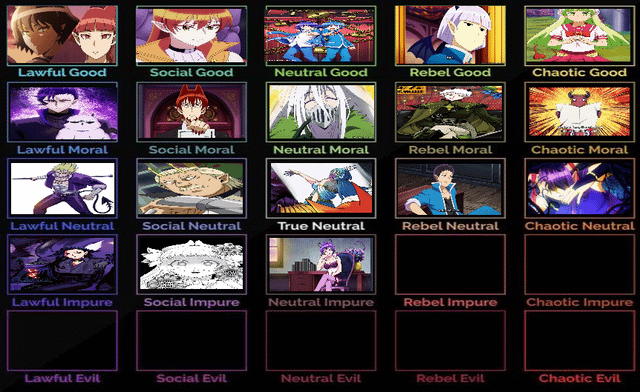
You can introduce characters from both the anime and the manga. The one who mentions character x and gets the most votes, that character will be chosen.
Part 1-> Opera san was nominated in the Lawful Good category.
Opera is the embodiment of duty, discipline, and absolute loyalty. He serves the Sullivan household with rigid precision, respects hierarchy, rules, and protocol without deviation, yet does so out of deep, protective kindness. He never acts out of selfishness or chaos; everything he does serves order and the good of those under his care (especially Iruma and Sullivan). He is strict and efficient, upholds the internal laws of the household and demon society, but is never cruel. Perfect combination of order + goodness = Lawful Good.
Part 2-> Azazel Ameri was nominated in the Social Good category.
Ameri prioritizes the proper functioning of school society and the collective good of Babyls. As Student Council President, she defends rules, social order, and institutional stability not out of blind dogmatism. Has a strong sense of duty toward the community, even though she is personally softer and more dreamy. Her goodness manifests through maintaining a healthy and fair social system. This makes Social Good (good achieved through social structure and community) the best fit.
Part 3-> Suzuki Iruma was nominated in the Neutral Good category.
Iruma does good simply because it is good, without being rigidly bound to laws or to rebellion. He helps people (and demons) out of genuine empathy, even when it costs him, even when it means breaking rules, or when it would be easier to stay out of it. He is neither a legalist (he doesn’t follow rules just because they exist) nor a rebel on principle. He adapts to the situation and chooses the option that brings the most good to those around him. Classic Neutral Good: goodness guided by compassion, not by law or chaos.
Part 4-> Purson Soi was nominated in the Rebel Good category.
Purson Soi's goodness does not come through official channels or through accepting the existing order; he does good "in the shadows", on his own, violating social conventions of visibility and conformity. He is a gentle rebel: he does not destroy the system, but he does not conform to it either, while remaining fundamentally good. Hence Rebel Good. As an idea, besides the fact that Purson Soi opposed his father, Purson Soi in the manga is presented to us as the one who distributed those important formulas/forms to the non-didactic staff, so that they could sign them and obtain the royal clara, and most likely Soi while he was invisible had heard Kalego's plan, regarding the fact of rejecting members of the abnormal class from obtaining the royal class, if they did not have the signatures of the non-didactic staff. And in addition, Purson Soi considers certain secrets to be extremely important that should not be revealed unless the person in question gives their consent.
Part 5-> Valac Clara was nominated in the Chaotic Good category.
Clara does not follow the law (Lawful), nor does she strategically calculate the collective good (Social/Neutral). She does good in her own way, on the spot, without filter, without respect for order. The very definition of Chaotic Good: a force of chaotic goodness, loyal, impulsive, and deeply affectionate.
Part 6-> Naberius Kalego was nominated in the Lawful Moral category.
Kalego is not good in the gentle, empathetic sense. He is legitimate: he believes that order, discipline, and system are the foundations of a functioning society. Everything he does—from punishments to extreme training—starts from this belief that the world should have clear rules and that students should be forced to rise to their level. That is why Kalego is with a Lawful Moral.
Part 7-> Azazel Henri was nominated in the Social Moral category.
Henri is not good only "from the heart" (like Neutral Good) nor does he follow a chaotic personal code. He believes that a well-organized society is the best form of goodness. Exactly the definition of Social Moral.
Part 8-> Balam Shichiro was nominated in the Neutral Moral category.
Balam is the typical "gentle giant" of the Neutral Moral category: he looks scary, but almost always acts out of genuine compassion and care.
Part 9-> Mephistopheles in short Mephisto was nominated in the Rebel Moral category.
Mephisto is not a rebel who fights against the system out of pure idealism, but he is clearly a character who refuses to be defined by rules, hierarchies, or external expectations. He makes moral (or at least beneficial to those he deems worthy) choices based on his own standards, even if that means ignoring, bending, or withdrawing from official structures. This places him firmly in the Rebel Moral category.
Part 10-> Belial Berry Razberry was nominated in the Chaotic Moral category.
I would also say that Razzberry would be somewhat Chaotic Moral, because Personal freedom + friendly attitude + refusal to conform = classic Chaotic Moral (the "good-hearted neighborhood boy" version).
Part 11-> Sabnock Sabro was nominated in the Lawful Neutral category.
Sabro is a character guided by a personal code of honor and a clear ambition, neither a moral hero nor a villain. He represents the classic Lawful Neutral type: he respects a system (of force and rank), follows its rules strictly, and remains Lawful Neutral.
Part 12->Belzebuth was nominated in the Social Neutral category.
Belzebuth represents the classic guardian of the system: "The system must function. Order must be maintained. The rest is secondary." This is the essence of Social Neutral – social and institutional stability without a strong moral charge of Good or Evil.
Part 13->Former interim demon king Kushinashi was nominated in the True Neutral category.
Kushinashi is True Neutral because it is the alignment that best suits her: a pragmatic leader who does her job, maintains balance, and acts as she deems necessary, without leaning strongly towards any moral or order/chaos extremes.
Part 14-> Andro M. Jazz was nominated in the Rebel Neutral category.
Jazz is the classic thief who lives by his own rules (like Robin Hood, I think). He's not a hero, he's not a pure villain – he's a free-spirited opportunist, who defies the system because that's how he likes it and that's how it works, which makes Jazz a Rebel Neutral character.
Part 15-> Former Demon King Derkila was nominated in the Chaotic Neutral category.
Derkila is a prime example of a Chaotic Neutral, because he had absolute power, created order, but refused to be bound by it. He chose personal freedom over any duty, any system, and any expectation. He was not a hero, he was not a tyrant — he was simply free, on his own.
Part 16-> Naberius Narnia, code name: Fenrir was nominated in the Lawful impure category.
Naberius Narnia alias Fenrir is neither Lawful Good (he has no noble idealism), nor pure Lawful Evil (he is not motivated only by evil or empty selfish domination). He is Lawful Impure because he strictly respects and uses the law because it protects his power, position and vision of order. He has intentions that he considers just (protecting the demonic world), but his methods and prejudices place him firmly in the gray area of the dark anti-hero. In short, he is not a simple sadistic villain, nor a rebel. He is the guardian who bites too hard and justifies everything by "maintaining order". It is this combination of extreme discipline + compromised methods that makes him an excellent candidate for the Lawful Impure category and, potentially, a darker anti-hero.
Part 17-> Princess Shura was nominated in the Social impure category.
Princess Shura is Social Impure because she is not a force of pure good or evil. She is a being of enormous status who exercises her social power in a personal, emotional and "dirty" way of obsession.
Part 18-> Raim was nominated in the Neutral impure category.
Raim is neither Lawful Good (too free and sensual), nor classic Neutral Good (her methods are too "dirty" and ego-centric for her domain), nor Rebel. She is a Neutral Impure — a person who operates on the neutral axis, with a compromised/sensual nature and methods, which make her good not "pure."
In the Rebel Impure category:
- An impure rebel is a rebel without a pure ideal. He rebels, but for selfish, dirty, or contradictory reasons.
- He is hard to trust and hard to predict, because he serves neither good nor pure evil — he serves himself first and foremost.
- These rules are bad… but only when they bother me. If I can use them to gain something, I use them. If I have to break them to get revenge or have fun, I break them. I don’t care about the ‘cause,’ I care about me.”
- He can switch from alliances to betrayals quickly. He's not tied to a greater cause, but to his current state or what he has to gain.
- He can do "good" things occasionally (if they bring him advantage or satisfaction) and bad things just as easily. He's neither a pure hero nor a pure monster—he's a dirty mix.
———●■○□
An "Impure Chaotic" character behaves chaotically, but without purity of intention. He is neither completely good nor completely evil, nor even consistently neutral. His chaos is mixed, dirty, selfish, and often contradictory.
He acts according to his mood, but his mood is dirty. Today he helps you because it is funny or gives him an advantage. Tomorrow he sabotages you out of jealousy, boredom, or simply because "he wanted to." He has no stable moral code. He can be generous one moment and cruel the next, without feeling any contradiction. He does not feel guilty or proud – he just does what he does. He uses chaos for his own benefit. He does not destroy the system on principle (like a Rebel), but bypasses or destabilizes it when it gets in his way. If order benefits him, he tolerates it temporarily. Relationships are inconsistent. He may be loyal to someone for a while, then betray or ignore them without clear explanation. His attachments are real, but fragile and selfish. He is not predictable even in his evil or kindness. A Chaotic Evil is consistently evil. A Chaotic Good is consistently well-intentioned. A Chaotic Impure is "twisted": doing good when it suits him, bad when it suits him, and chaos all the time.
"Rules are bad… except when they benefit me. I help you if I feel like it or if I win something. I mess with you if you annoy me or if it's funny. I don't care about 'good' or 'bad'. I care about me and how I feel right now."
———●■○□
Lawful Evil represents rigid order and hierarchy pushed to the extreme. It slanders rules, discipline and structure as a tool of control and oppression. She's not chaotic or "rebellious" – she's exactly the kind of evil who believes that strict system and legitimate power justify anything. Could he/she have a typical mentality: Rules exist to maintain order. And order exists for me (or those like me) to stand above. If I have to crush someone to maintain this order, I do it — and I do it properly, according to procedure. A Lawful Evil behaves like an orderly tyrant. They respect (or create) rules, hierarchies and structures, but use them as tools of control, exploitation and oppression. In short: a Lawful Evil is the evil that wears a uniform, has an office and follows a schedule, but crushes you not out of chaos, but out of order.
Social Evil slanders its existing social and political system in order to undermine it from within. It wants to destroy the current order but does so through political manipulation, corruption and the use of institutions. He is not a pure rebel (he does not attack from the outside), but an evil that parasitizes society. In short: A Social Evil is the evil that smiles at banquets, shakes hands, gives speeches and, at the same time, weaves webs from which no one escapes. They don't need to be the strongest physically — they need to be the best placed socially. They might have a typical mentality: The system exists. I don't have to destroy it — I just have to control it. People respect rank, fear influence and are led by appearances. As long as I play the game better than them, everything is mine. A Social Evil behaves like an evil that uses society, status, relationships and social structures as weapons. He is not necessarily bound by strict laws (like Lawful Evil) nor by pure chaos (like Chaotic Evil). He lives and thrives within the social system, which he manipulates to his advantage.
Neutral Evil → They are pure selfish evil. They have no ideology, they do not want to destroy the world, they do not follow laws and do not rebel against them. Zero loyalty, zero principles, only self-interest. Neutral Evil is the most pragmatic and selfish type of evil. They are not bound by laws, chaos or any ideology. The only thing that matters is their own interest. They do whatever is necessary to win, protect themselves or feel good — without loyalty, without principles and without remorse. In short: a Neutral Evil is evil without a flag. They do not fight for a cause, do not rebel on principle and do not play with chaos. They simply take everything they can, from anyone, at any time. He may have this mindset: I don’t care about law, chaos, or ‘justice.’ I only care about myself. If I have to lie, steal, betray, or destroy to get what I want, I’ll do it. If it’s easier to follow a rule to get there, I’ll follow it. The rest doesn’t matter.
A Rebel Evil actively opposes the system, order, and authority, but not out of noble ideals, but out of a desire to destroy, cause suffering, or impose chaos for the benefit of evil. He does not respect the laws, hierarchy, or rules of society. He wants to overthrow them. Unlike a Lawful Evil (who uses the system), a Rebel Evil attacks the system from the outside or from the inside with the intention of destroying it.
He does not oppose to free someone or make the world a better place. He opposes to create chaos, to take revenge, to dominate through brute force, or to restore a primitive and violent state. In short: a Rebel Evil is a destroyer of order. He rebels not to liberate, but to overthrow and dominate through chaos.
Chaotic Evil is the alignment of the most unpredictable and evil type of character. He follows no rules, has no loyalty, and pursues no ideals—only personal pleasure through chaos, suffering, and destruction. Laws, hierarchies, promises, or moral codes mean nothing to him. He breaks them not out of principle, but because he enjoys doing so or because they get in the way of his desires. He doesn't plan long-term like a Lawful Evil, and he doesn't pursue a cause like a Rebel Evil. He does what he wants, when he wants. He can be kind one second and sadistic the next, for no logical reason. He doesn't destroy for ideology, political power, or grandiose revenge. He destroys because he enjoys seeing fear, despair, pain, or chaos. The suffering of others is a form of entertainment.
He can betray anyone, including allies, without hesitation. There are no "friends" or "team" — there are only temporary tools that he uses and throws away when they are no longer useful (or when it is more fun to destroy them). He does not kill or torture just to remove obstacles. He does it because he enjoys the process. He may prolong the suffering of others just for the fun of it.
A Lawful Evil says "it is necessary for order". A Rebel Evil says "the system deserves to fall". A Chaotic Evil does not feel the need to justify himself. He simply does evil because he wants to. He may have a typical mentality: Rules? What rules? I do what I want. If I destroy everything and people suffer… that is even more fun. I do not care about causes, power or the future. I only care about how I feel now. In short: a Chaotic Evil is pure chaos put in the service of evil. It has no constraints, no loyalties and no limits. It is dangerous precisely because you cannot predict what it will do next.
https://i.redd.it/sebf6j9edcoh1.png
Source: r/DemonSchoolIrumakun · by /u/PuzzleheadedBag4866