Introduction
Among the numerous post-Pāṇinian systems of Sanskrit grammar that arose across the Indian subcontinent between the early centuries of the Common Era and the close of the medieval period, the Supadmavyākaraṇa occupies a distinctive place as the grammatical system that came to dominate eastern Bengal. Composed by Padmanābhadatta, a Maithila brahmin scholar of the fourteenth century, the Supadmavyākaraṇa belongs to a broad current of Sanskrit pedagogical literature whose founders sought to render the intricate, technically dense apparatus of Pāṇini's Aṣṭādhyāyī more tractable for students who lacked the years of specialized training that mastery of the Aṣṭādhyāyī, the Mahābhāṣya, and the Kāśikāvṛtti traditionally demanded. Padmanābhadatta gave his name to an entire school — the Saupadma or Supadma school — whose influence, though today largely eclipsed and remembered chiefly by specialists in the history of Sanskrit linguistics, once extended across a substantial swath of the eastern Gangetic delta. This essay surveys the life and intellectual milieu of Padmanābhadatta, situates the Supadmavyākaraṇa within the wider ecosystem of post-Pāṇinian grammatical systems, examines the text's internal structure and its relationship to the Aṣṭādhyāyī, discusses its ancillary corpus of supplementary treatises, traces its regional diffusion and manuscript transmission, and considers its place in the broader history of Sanskrit grammatical scholarship.
The Post-Pāṇinian Grammatical Landscape
To appreciate why a scholar of Padmanābhadatta's evident erudition should have devoted his energies to producing yet another grammar of Sanskrit, centuries after Pāṇini's Aṣṭādhyāyī had already achieved the status of an unsurpassable and virtually unrevisable authority, one must first understand the peculiar dynamic that structured the field of vyākaraṇa, the science of grammar, across the first and second millennia CE. Pāṇini's Aṣṭādhyāyī, composed sometime in the middle of the first millennium BCE, is an extraordinarily compressed, algebraic system of roughly four thousand sūtras organized into eight chapters (adhyāya), each subdivided into four quarters (pāda). Its economy of expression, achieved through an elaborate metalanguage of technical markers, anubandhas, and ordering conventions, made it at once the most rigorous descriptive grammar produced anywhere in the ancient world and also one of the most forbidding texts for a beginning student to approach unaided. Over the centuries a vast exegetical superstructure grew up around it — Kātyāyana's vārttikas, Patañjali's Mahābhāṣya, and later the Kāśikāvṛtti of Vāmana and Jayāditya — but this superstructure, rather than simplifying the Aṣṭādhyāyī, tended if anything to compound the burden placed upon the student, since mastery of Pāṇini now meant mastery of an entire library rather than a single treatise.
It was against this backdrop that alternative grammatical systems began to appear, offering condensed, pedagogically reorganized, and often rule-reduced accounts of Sanskrit morphology and syntax that retained fidelity to Pāṇinian description while discarding much of the Aṣṭādhyāyī's technical apparatus. Scholarly consensus places the beginning of this parallel tradition with Śarvavarman's Kātantra, composed around the first century CE for the benefit of a king said to have found the Aṣṭādhyāyī too difficult; the Kātantra proved influential well beyond its own immediate context, later informing Buddhist Sanskrit pedagogy in Central Asia and Tibet. In the centuries that followed, a succession of independent or semi-independent schools arose, each associated with a particular founder, a particular region, and often with a particular religious community: the Cāndravyākaraṇa of Candragomin, linked to Buddhist scholastic centers; the Jainendravyākaraṇa of Devanandin (Pūjyapāda) and the later Śākaṭāyana and Haimavyākaraṇa of Hemacandra, associated with Jain communities in western and central India; the Sārasvatavyākaraṇa of Anubhūti Svarūpācārya, composed sometime between the thirteenth and fifteenth centuries and particularly influential in Bihar and Varanasi; the Saṃkṣiptasāra of Kramadīśvara and Jumaranandin, popular in western Bengal; the Mugdhabodha of Vopadeva, composed in the thirteenth century under the patronage of the Yādava court at Devagiri and destined to become the dominant grammar of Bengal in later centuries; and finally the Supadmavyākaraṇa of Padmanābhadatta, composed in the fourteenth century and centered upon eastern Bengal.
What is striking about this list is the sheer geographical and institutional differentiation it displays. Rather than a single "simplified Pāṇini" competing against the Aṣṭādhyāyī in the abstract, what in fact emerged was a patchwork of regionally rooted grammatical cultures, each with its own textual lineage, its own commentarial tradition, its own institutional base in monasteries, courts, or brahminical lineages, and its own sphere of practical circulation. The Supadmavyākaraṇa must be understood as one node within this larger network — not an isolated curiosity but a considered intervention into an already crowded and competitive field of grammatical pedagogy, one in which a new system could hope to succeed only by offering some genuine advantage in clarity, comprehensiveness, or regional accessibility over its rivals.
Padmanābhadatta: Life and Lineage
The biographical record for Padmanābhadatta, as for most Sanskrit scholars of the pre-modern period, is thin and must be reconstructed largely from internal evidence within his own works and from later bibliographical notices. He is generally placed in the second half of the fourteenth century, with most modern reference works assigning him a floruit of roughly 1350 to 1400 CE, and the composition of the Supadmavyākaraṇa itself is conventionally dated to around 1375 CE. He was born into a brahmin lineage of Mithilā, and his father's name was Dāmodaradatta. Padmanābhadatta traced his family's scholarly descent from Vararuci, celebrated in later legend as a court poet in the circle of Kālidāsa and Vikramāditya, and he set out this genealogy explicitly in one of his later works, the Prīśodarādivṛtti, which he composed in the year 1427 — a composition that, if the date is accurate, would place Padmanābhadatta's active scholarly career across a span of at least half a century, extending well beyond the composition of the Supadmavyākaraṇa itself into old age. Wikipedia
Regarding his precise domicile, the tradition preserves two overlapping but not entirely reconcilable claims. One line of testimony holds that he was an inhabitant of Bengal, living in the fourteenth century, though some accounts instead place him as a resident of Mithilā. The most specific and frequently cited testimony on this point comes from the pioneering Bengali antiquarian and manuscript scholar Haraprasad Śāstrī, who identified Padmanābhadatta as a resident of a village called Bhoragrāma, situated a short distance from Darbhanga in the Mithilā region of what is today northern Bihar. This identification of Bhoragrāma as his native place has been widely accepted in subsequent reference literature, which routinely describes him as a resident of Bhoragrāma in Mithilā even while acknowledging that his grammar achieved its greatest and most lasting circulation not in Mithilā itself but among the Sanskrit-learning communities of Bengal, particularly its eastern districts. This apparent tension — a Maithila grammarian whose work found its true home in Bengal — is not in fact unusual for the period; Mithilā in the fourteenth and fifteenth centuries functioned as one of the great intellectual entrepôts of eastern India, producing scholars, texts, and pedagogical traditions whose influence radiated outward into Bengal, Assam, and Orissa through networks of teacher-student transmission, marriage alliance among learned brahmin lineages, and the itinerant circulation of manuscripts and pundits. A Mithilā-born grammarian composing a text that would eventually be adopted as the standard grammar of eastern Bengal is thus entirely consistent with the broader pattern of intellectual traffic that characterized the eastern Gangetic region in this period. Wisdom Library
Padmanābhadatta's output was not confined to the Supadmavyākaraṇa alone. As already noted, he composed the Prīśodarādivṛtti in 1427, a work dealing with a specific category of irregularly formed words (the prīśodarādi class, named for an exemplary irregular compound), and he is credited within the wider Supadma corpus with a cluster of further treatises that together constitute a coherent and internally cross-referencing grammatical system rather than a single free-standing text. This pattern — a root grammar surrounded by a penumbra of satellite treatises addressing verbal roots, unusual formations, syntax, and compounding — was itself a convention inherited from the Aṣṭādhyāyī tradition, whose core sūtrapāṭha was similarly accompanied by the Dhātupāṭha, the Gaṇapāṭha, and the Uṇādisūtras as semi-independent appendices, and Padmanābhadatta's decision to replicate this architecture for his own system signals his clear intention that the Supadmavyākaraṇa should function not as a mere abridgement but as a complete, self-sufficient alternative curriculum in Sanskrit grammar.
Genesis and Pedagogical Aims of the Supadmavyākaraṇa
The stated and inferred purpose behind the composition of the Supadmavyākaraṇa aligns closely with the motivations that had earlier driven Śarvavarman, Candragomin, Devanandin, and Vopadeva to produce their own rival systems: the conviction that the Aṣṭādhyāyī, for all its unmatched descriptive power, imposed an excessive burden of technical apparatus upon students whose primary need was competent working knowledge of correct Sanskrit usage rather than the capacity to engage in the highly specialized metalinguistic reasoning that full Pāṇinian scholarship demanded. Padmanābhadatta's approach was not to abandon the Pāṇinian description of Sanskrit — indeed the Supadmavyākaraṇa remains firmly Pāṇinian in its underlying grammatical analysis — but rather to remodel and rearrange the material of the Aṣṭādhyāyī into a sequence better suited to sequential classroom instruction, supplying explanatory notes (vṛtti-like glosses) at points where the bare sūtra form of Pāṇini's rules would have left a beginning student without sufficient guidance. The text is explicitly based on Pāṇini's Aṣṭādhyāyī, but remodeled and rearranged with explanatory notes, with Padmanābhadatta's stated objective being to render knowledge of Sanskrit grammar clear and simple for students while also providing a means of systematically bringing newly current vocabulary within the fold of properly Sanskritized derivation. This latter aim deserves particular emphasis: the Supadmavyākaraṇa was conceived not merely as a simplification device for canonical Sanskrit forms already attested in classical literature, but as a living instrument capable of accommodating and regularizing new words that had entered scholarly and literary usage in the intervening centuries since Pāṇini's own time — a task that required the grammarian to extend Pāṇinian derivational logic to cases the original Aṣṭādhyāyī had not anticipated. Wikipedia
A further and closely related pedagogical design feature of the Supadmavyākaraṇa was its function as a bridge text. The system was intended to give ordinary students a clear and full understanding of Sanskrit grammar while simultaneously preparing those among them who wished to advance toward the full Pāṇinian school to make that transition with relative ease. This bridging function distinguishes the Supadma school in principle from grammatical systems that were more thoroughly independent in their technical vocabulary and rule ordering, such as the Kātantra or the Cāndra system, both of which developed their own distinct metalanguages relatively distant from Pāṇini's own terminology. Padmanābhadatta's system, by contrast, seems to have been constructed so as to remain in close dialogue with Pāṇinian categories even while reorganizing their presentation, so that a student who had mastered the Supadmavyākaraṇa would already possess much of the conceptual vocabulary needed to read the Aṣṭādhyāyī and its commentaries directly, should further study be desired. Exotic India Art
Structure of the Text
Within the broad post-Pāṇinian tradition, grammars typically organized their material along one of two general schemes: either they preserved something resembling the Aṣṭādhyāyī's own topical sequence (phonology and sandhi, nominal inflection, verbal conjugation, primary and secondary derivation, compounding, accent), or they reorganized the material more radically around functional categories more immediately useful to a beginning student, such as grouping all rules relevant to noun declension together regardless of their scattered position in Pāṇini's original ordering. The Supadmavyākaraṇa belongs recognizably to the latter, more pedagogically motivated category of reorganization, redistributing Pāṇinian rules into a sequence organized by grammatical topic rather than by the original architecture of the Aṣṭādhyāyī's eight chapters. Manuscript evidence of the text confirms that, like the Aṣṭādhyāyī itself, the Supadmavyākaraṇa was divided into adhyāyas further subdivided into pādas; surviving fragmentary manuscripts, for instance, preserve portions beginning at the close of the first pāda of the second adhyāya, with the following section devoted to the treatment of kāraka, the theory of verbal case relations and semantic roles that governs the assignment of the Sanskrit case endings. The prominence given to kāraka theory early in the surviving textual sequence is itself instructive, since the kāraka system — Pāṇini's analysis of the six semantic-syntactic relations (agent, object, instrument, recipient, source, and locus) that link nominal case forms to the action expressed by the verb — represents one of the most conceptually demanding and pedagogically crucial portions of Pāṇinian grammar, and its relatively early placement within the Supadma sequence suggests that Padmanābhadatta considered a firm grounding in case theory to be foundational for everything that followed, including the practical composition and comprehension of Sanskrit sentences. Endangered Archives Programme
Beyond the kāraka section, the broader architecture of the Supadma system, as reconstructed from the ancillary literature associated with it, evidently proceeded through the standard domains that any complete Sanskrit grammar must address: rules of euphonic combination (sandhi) governing the junction of sounds at word and morpheme boundaries; the declension of nominal stems across the three genders and the full paradigm of case and number; the classification and conjugation of verbal roots across the ten traditional classes (gaṇas) and the various tenses, moods, and voices; the formation of primary derivatives (kṛdanta) built directly from verbal roots by the addition of primary suffixes; the formation of secondary derivatives (taddhita) built from already-formed nominal stems; and finally the rules of nominal compounding (samāsa), covering the traditional categories of dvandva, tatpuruṣa, bahuvrīhi, dvigu, and avyayībhāva compounds. That a distinct treatise within the Supadma corpus, the Supadmasamāsasaṃgraha, was devoted specifically to compounding, and that another, sometimes cited as the Kārakarahasya, treated case theory in still greater depth than the root text itself, indicates that Padmanābhadatta or his immediate successors judged certain topics — compounding and kāraka theory chief among them — to require supplementary elaboration beyond what the main body of the Supadmavyākaraṇa could accommodate within its compressed pedagogical format.
Relationship to the Aṣṭādhyāyī
It bears emphasizing that the Supadmavyākaraṇa, notwithstanding its reorganization and simplification, remained throughout a fundamentally Pāṇinian grammar in substance. Padmanābhadatta did not set out to propose an alternative analysis of Sanskrit morphology or syntax that diverged from Pāṇini's own descriptive conclusions; rather, his innovation lay almost entirely at the level of presentation, sequencing, and pedagogical apparatus. This places the Supadma school closer in spirit to certain other post-Pāṇinian systems, such as the Sārasvata school, which likewise retained close fidelity to Pāṇinian content while reorganizing its presentation, than to the more technically independent systems such as the Kātantra or the Jainendra, which developed distinct grammatical metalanguages and, in some instances, analyses that diverged from strict Pāṇinian orthodoxy on particular points. The practical consequence of this closeness to Pāṇini was that a student trained in the Supadma system acquired grammatical knowledge that remained largely interchangeable, in its substantive content, with knowledge acquired through direct study of the Aṣṭādhyāyī — a feature that, as noted above, facilitated the Supadma school's self-conception as a bridge toward full Pāṇinian scholarship rather than a permanently separate track of grammatical education.
The Ancillary Corpus
As with the great majority of substantial grammatical systems in the Sanskrit tradition, the Supadmavyākaraṇa did not circulate as a solitary text but as the nucleus of an entire family of associated compositions, some by Padmanābhadatta himself and others by later members of the Supadma school who elaborated, glossed, or supplemented the founder's work. Bibliographical sources catalogue a substantial cluster of titles bearing the Supadma name or otherwise linked to Padmanābhadatta's system: the Supadmadhātupāṭha, a listing and classification of verbal roots parallel in function to Pāṇini's own Dhātupāṭha; the Supadmasamāsasaṃgraha, a dedicated treatise on nominal compounding, together with its own commentary, the Supadmasamāsasaṃgrahaṭīkā; the Supadmapariśiṣṭa, a supplementary appendix addressing matters not fully covered in the main text; the Makaranda, a further treatise attributed within the tradition to Padmanābhadatta or closely associated with his school; the Kārakarahasya, treating case theory; the Śabdāvalī, a lexical supplement; and the Supadmavyākaraṇaṭīkā, a direct commentary on the root grammar itself. The existence of this extensive satellite literature — encompassing dhātupāṭha, samāsa treatise, pariśiṣṭa, lexicon, and commentary — demonstrates that the Supadma school, far from remaining a single modest textbook, developed over the generations following Padmanābhadatta's own lifetime into a fully elaborated scholastic tradition with its own internal division of labor across grammatical subdisciplines, closely mirroring in miniature the exegetical superstructure that had grown up around the Aṣṭādhyāyī itself.
Two names recur in connection with this later commentarial and supplementary literature: Viṣṇumiśra, credited with contributions to the Supadma corpus, and Rūpanārāyaṇa, likewise associated with texts bearing on the tradition. The survival of these names, even where the precise content and chronology of their contributions remains imperfectly documented in secondary scholarship, indicates that the Supadma school possessed a genuine lineage of successive teachers and commentators extending across at least a few generations beyond Padmanābhadatta's own career, rather than existing merely as a single founder's isolated composition.
Regional Diffusion, Script, and Institutional Life
The geographical fortunes of the Supadmavyākaraṇa are unusually well documented for a medieval Sanskrit grammatical text, precisely because its circulation was so markedly regionalized. Its study was concentrated in the districts of Jessore and Khulna and in certain territories including Nainahati and Bhatapara, regions now situated within Bangladesh. This concentration in eastern Bengal placed the Supadma school in direct territorial and functional competition with the Mugdhabodha of Vopadeva, which by the early modern period had become dominant across Bengal more broadly, including its western districts, and with the Saṃkṣiptasāra of Kramadīśvara, whose circulation was likewise centered in western Bengal. The resulting picture is one of a genuinely pluralistic regional grammatical culture within Bengal itself, in which different districts and different scholarly lineages maintained loyalty to different systems: the Saṃkṣiptasāra remained popular chiefly in western Bengal, the Mugdhabodha achieved wide and lasting popularity across Bengal as a whole and remains in some use there even in later centuries, while eastern Bengal in particular favored Padmanābhadatta's Supadmavyākaraṇa, composed around 1375. Exotic India ArtWisdom Library
A further notable feature of the Supadma tradition's regional character concerns the script in which it was transmitted and taught. The Supadmavyākaraṇa was written and circulated in the Bengali script, a choice that made the text more directly accessible to students in the Bengal provinces by removing an additional layer of unfamiliarity that might otherwise have compounded the inherent difficulty of Sanskrit grammatical study. This decision to render a Sanskrit grammatical text specifically in the regional Bengali script, rather than relying exclusively on the pan-Indian Devanāgarī or Grantha scripts more commonly employed for Sanskrit śāstric literature, exemplifies a broader pattern visible across many regional grammatical schools of the medieval period, in which practical accessibility to a regionally rooted student population took precedence over adherence to any single supra-regional scribal convention. The consequence of this scripting choice, however, was that the Supadma tradition's manuscript base became heavily concentrated within Bengali-script manuscript culture, a fact that has had real consequences for the text's subsequent survival, cataloguing, and modern scholarly accessibility, since manuscripts in regional scripts have historically proven more vulnerable to neglect, damage, and eventual loss than manuscripts preserved within more widely distributed scribal traditions. Wikipedia
Manuscript Transmission and Modern Documentation
The physical fate of Supadmavyākaraṇa manuscripts illustrates both the historical vitality of the tradition and its present fragility. Numerous manuscripts of the Supadmavyākaraṇa and its associated texts were recorded in the great nineteenth- and early twentieth-century descriptive catalogues of Sanskrit manuscripts, including Aufrecht's Catalogus Catalogorum, which lists Supadma-related holdings across repositories in Britain, continental Europe, and South Asia, and the subsequent New Catalogus Catalogorum project undertaken to update and expand Aufrecht's foundational survey. These catalogue entries confirm that manuscripts of the Supadma corpus reached far beyond their core Bengali homeland into the major institutional manuscript collections of colonial-era India and Europe, even though the text's active pedagogical use remained regionally confined.
More recent efforts at manuscript preservation have brought renewed, if modest, attention to the physical condition of surviving Supadma manuscripts. One manuscript documented under the Endangered Archives Programme, associated with a project surveying text and image production in early modern Bengal, preserves a fragmentary copy of the Supadmavyākaraṇa comprising some one hundred and forty folios, incomplete, lacking its original colophon, and described as extremely fragile. Such documentation efforts, conducted under international manuscript preservation initiatives in recent years, underscore both the continuing scholarly interest in recovering the textual history of regional grammatical schools like the Supadma tradition and the urgency of that recovery work, given the physical deterioration to which manuscripts in vulnerable regional archives remain subject. Endangered Archives Programme
Comparison with Sister Systems
Situating the Supadmavyākaraṇa alongside its principal rivals within the post-Pāṇinian tradition clarifies both its distinctive character and its place within a shared project. Against the Kātantra, the oldest and geographically most widely diffused of the post-Pāṇinian systems, whose influence extended into Central Asian and Tibetan Buddhist scholastic contexts far beyond its South Asian origins, the Supadmavyākaraṇa remained comparatively regional in scope, never achieving anything like the Kātantra's transnational reach. Against the Jainendra and Haima systems, closely tied to Jain monastic and lay scholarly communities and carrying distinctive doctrinal and community affiliations, the Supadma school presented itself as a more religiously unmarked, straightforwardly brahminical pedagogical tool, oriented toward general Sanskrit literacy rather than toward the specific needs of a sectarian scholastic curriculum. Against the Sārasvata system, which achieved particular prominence in Bihar and the Varanasi region and which, like the Supadma school, remained closely tied to orthodox Pāṇinian content, the two systems can be seen as regional counterparts serving broadly analogous pedagogical functions in neighboring but distinct zones of the eastern Gangetic plain. And against its most direct territorial rival, the Mugdhabodha of Vopadeva, which ultimately proved the more durable and widely adopted grammar across Bengal as a whole in the centuries following the fourteenth century, the Supadmavyākaraṇa represents something of a road not fully taken: a system that achieved genuine and sustained regional success in eastern Bengal specifically, without ever displacing its rival to become the dominant grammar of the wider Bengali-speaking world.
Modern Scholarship
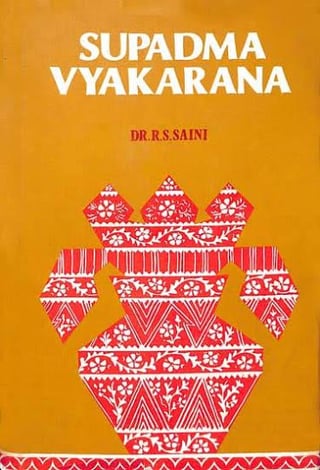
Serious modern academic engagement with the Supadmavyākaraṇa remains comparatively limited relative to the scale of attention devoted to the major Pāṇinian commentarial tradition or even to some of the more widely studied post-Pāṇinian systems such as the Kātantra or the Cāndravyākaraṇa. The most substantial dedicated modern studies are those of Ranjit Singh Saini, whose monograph on the Supadmavyākaraṇa of Padmanābhadatta and whose broader survey of post-Pāṇinian systems of Sanskrit grammar together constitute the principal points of reference for contemporary students of the tradition, situating the Supadma system carefully within the comparative context of its sister grammars, including the Kātantra, the Cāndra, the Jainendra, the Haima, the Sārasvata, the Mugdhabodha, and the Saṃkṣiptasāra, and tracing the specific technical vocabulary, structural choices, and regional history of Padmanābhadatta's system in detail. Beyond these dedicated studies, the Supadma tradition receives more incidental treatment in general surveys of Sanskrit grammatical literature and in the entries of digital lexicographic compilations that draw on the older catalogue and encyclopedic literature, offering useful but necessarily condensed summaries of the biographical, bibliographical, and regional facts concerning the school.
Legacy and Significance
The lasting significance of the Supadmavyākaraṇa lies less in any singular technical innovation within the analysis of Sanskrit — for, as has been stressed, Padmanābhadatta's project was fundamentally one of reorganization and pedagogical clarification rather than of grammatical discovery — and more in what the text illustrates about the sociology and regional diversity of Sanskrit learning in medieval eastern India. The Supadma school exemplifies a recurring and important pattern in the history of Sanskrit scholasticism: the capacity of the tradition to generate, generation after generation and region after region, new locally rooted pedagogical vehicles for transmitting an essentially conservative and continuous body of grammatical knowledge, each vehicle tailored to the practical, institutional, and sometimes scriptal needs of a particular community of learners, without thereby displacing or contradicting the ultimate authority of Pāṇini's own system. In this sense the Supadmavyākaraṇa stands as a valuable case study for historians of Sanskrit education and of regional intellectual culture in Bengal and Mithilā, illuminating how a fourteenth-century Maithila brahmin scholar's grammatical textbook could take root, flourish, and sustain an entire subsidiary literature of commentaries and companion treatises across several centuries in a specific corner of the Bengali-speaking world, even as it ultimately yielded pride of place, in the wider Bengali grammatical imagination, to Vopadeva's rival Mugdhabodha.
Conclusion
The Supadmavyākaraṇa of Padmanābhadatta represents a well-defined and historically documented instance of the broader medieval Indian phenomenon of regionally rooted Pāṇinian simplification, standing alongside the Kātantra, the Cāndra, the Jainendra, the Haima, the Sārasvata, the Saṃkṣiptasāra, and the Mugdhabodha as one of the principal post-Pāṇinian grammatical systems through which successive generations of Sanskrit students, unable or unwilling to undertake the full rigors of Aṣṭādhyāyī study, nonetheless gained access to a substantially Pāṇinian account of their classical language. Composed around 1375 CE by a Maithila brahmin scholar whose own family traced its lineage to the legendary Vararuci, transmitted in the regional Bengali script, elaborated across a substantial satellite literature of dhātupāṭha, samāsa treatise, kāraka treatise, lexicon, and commentary, and concentrated in its practical circulation among the Sanskrit-learning communities of eastern Bengal's Jessore, Khulna, and neighboring districts, the Supadmavyākaraṇa offers modern scholarship a richly documented window onto the institutional and regional texture of late medieval Sanskrit grammatical education — a tradition that, though it never achieved the pan-Indian or transnational reach of some of its rival systems, sustained a genuine and locally vital scholastic community for centuries, and whose surviving manuscripts, however fragmentary and fragile, continue to reward the attention of historians of the Sanskrit grammatical sciences.
https://i.redd.it/875x4hhk9gph1.jpeg
Source: r/IndicKnowledgeSystems · by /u/RossbihariGhost1900