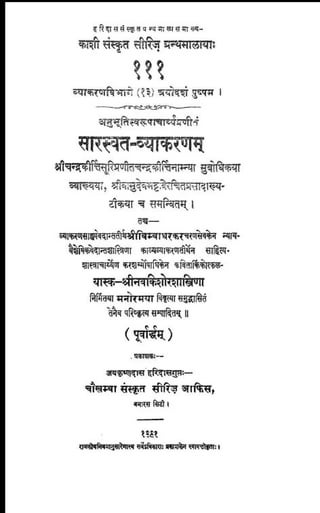
Introduction: A Grammar Against the Grain of Pāṇini
Among the many grammatical systems (vyākaraṇa-śāstras) that Sanskrit produced across two and a half millennia, none occupies quite so curious a position as the Sārasvata Vyākaraṇa. Composed by Anubhūtisvarūpācārya, a scholar whose precise dates remain debated but who is generally placed in the thirteenth to fourteenth century, the Sārasvata system represents a deliberate and radical act of simplification. Where the Aṣṭādhyāyī of Pāṇini organizes its roughly four thousand sūtras according to a logic of maximal economy and abstraction — meta-rules, anuvṛtti chains stretching across sūtras, technical devices like pratyāhāras, and an architecture optimized for a reciting, memorizing tradition of advanced grammarians — the Sārasvata Vyākaraṇa reorganizes grammatical knowledge according to a logic of pedagogical accessibility. It groups material by topic rather than by economy of statement, uses simpler technical vocabulary, and largely dispenses with the famously compressed device of anuvṛtti (the carrying-forward of terms from a previous sūtra into subsequent ones) that makes the Aṣṭādhyāyī so difficult for a beginner to parse without a guru's oral transmission.
The result was a grammar that could be learned in a fraction of the time required for Pāṇinian mastery, and that consequently spread with remarkable success into regions and social strata where the full apparatus of Pāṇini, Kātyāyana's vārttikas, and Patañjali's Mahābhāṣya was simply impractical. To understand the Sārasvata Vyākaraṇa is to understand something important about the sociology of Sanskrit learning in the second millennium CE — the tension between the preservation of a supremely sophisticated intellectual inheritance and the practical needs of an expanding population of Sanskrit users: temple priests, kāvya poets, students in regional pāṭhaśālās, and eventually, colonial-era students encountering Sanskrit as one subject among several rather than as a lifelong vocation.
The Author: Anubhūtisvarūpācārya and the Problem of Dating
Little biographical information survives about Anubhūtisvarūpācārya himself. The name — literally "the teacher whose own form is direct realization/experience" — carries a theological or Vedāntic resonance typical of monastic or maṭha-affiliated scholars of the period, though this should not be taken as firm evidence of sectarian affiliation. Traditional accounts and later commentarial colophons vary in their dating, with estimates ranging from the twelfth to the fifteenth century; the consensus among modern historians of Sanskrit grammar places him around the thirteenth century, with some scholars preferring a slightly later, fourteenth-century date based on citation patterns in works that can be independently dated.
The uncertainty is not merely an antiquarian curiosity. It matters because the Sārasvata Vyākaraṇa belongs to a broader wave of what might be called "easy grammars" (laghu-vyākaraṇas or prakriyā-grantha literature) that proliferated across India in the centuries following the classical Pāṇinian synthesis — a wave that includes the Kātantra of Śarvavarman (considerably earlier, associated with the early centuries CE and particularly favored in Kashmir and Bengal), the Mugdhabodha of Vopadeva (late thirteenth century, closely contemporary with or slightly predating the Sārasvata, and enormously popular in Bengal), the Hemacandra system associated with Jain scholastic circles in Gujarat, and later the Sanskrit Kaumudī literature exemplified by the Siddhānta-kaumudī of Bhaṭṭoji Dīkṣita. Anubhūtisvarūpācārya's work must be read against this crowded field of competing simplification projects, each responding to similar pressures but proposing different pedagogical solutions.
The name "Sārasvata" itself derives from Sarasvatī, the goddess of learning and speech, and the tradition holds — as is common with many Sanskrit śāstric texts — that the system was revealed to or inspired in the author by the goddess herself, lending it an aura of divine sanction appropriate to a text intended for wide popular transmission rather than restriction to an elite scholarly lineage.
Structural Departures from the Pāṇinian Model
To appreciate what the Sārasvata Vyākaraṇa changed, one must first appreciate what it changed from. The Aṣṭādhyāyī is organized into eight chapters (adhyāyas), each divided into four quarters (pādas), containing sūtras arranged with an eye toward maximal brevity achieved through several interlocking devices:
First, anuvṛtti, whereby a term introduced in an earlier sūtra continues to govern subsequent sūtras until explicitly cancelled, meaning that a given sūtra's full sense can only be recovered by tracing backward through a chain of prior rules — sometimes across considerable distances in the text.
Second, adhikāra sūtras, or "governing" rules that establish a domain of applicability for a whole subsequent block of rules.
Third, a dense technical metalanguage of pratyāhāras (abbreviatory letter-groups such as aṇ, ac, hal), paribhāṣās (interpretive meta-rules), and an ordering logic based on the principle that a later rule overrides an earlier one in case of conflict (para-nitya-antaraṅga-apavāda hierarchies as later systematized by the paribhāṣā literature).
This architecture is extraordinarily powerful and economical once mastered, but it is emphatically not organized for sequential, topic-by-topic learning. A student working through the Aṣṭādhyāyī in its given order encounters rules for verbal conjugation, nominal declension, compound formation, and accent rules interleaved in a sequence dictated by economy of statement rather than by any pedagogical logic of "first learn nouns, then learn verbs."
The Sārasvata Vyākaraṇa inverts this priority entirely. Its organizing principle is prakriyā — literally "process" or "procedure" — meaning that grammatical material is regrouped by topic: rules relevant to a particular kind of derivation are gathered together and presented in the order needed to actually derive forms, rather than scattered according to the logic of maximal rule-economy. This "prakriyā" approach, which the Sārasvata shares with the later and even more famous Siddhānta-kaumudī of Bhaṭṭoji Dīkṣita (composed some three centuries later, in the early seventeenth century), represented a broader shift in the historiography of Sanskrit grammatical pedagogy: away from the sūtra-pāṭha as an object of memorization in its original compositional order, and toward reorganized "process grammars" better suited to a student who needs to learn how to actually generate correct Sanskrit forms rather than to appreciate the compressed logical architecture of the original system.
Within this prakriyā framework, the Sārasvata Vyākaraṇa is traditionally described as comprising a body of sūtras — figures cited in the secondary literature vary, with counts sometimes given in the range of roughly seven to eight hundred sūtras, considerably fewer than the roughly 3,959 sūtras conventionally counted in the Aṣṭādhyāyī (precise sūtra counts vary slightly between different pāṭha traditions and printed editions in both cases). This numerical reduction is not achieved merely by omitting rare or marginal forms; it is achieved by a systematic simplification of the rule-statements themselves, favoring somewhat more explicit and self-contained formulations over the maximally compressed anuvṛtti-dependent style of Pāṇini. The trade-off is that Sārasvata sūtras are individually more verbose and more numerous relative to the amount of linguistic ground each covers, but each is far more tractable for an independent reader or a student working with a teacher who has less time to devote to any one pupil.
The Sāṃjñā-Prakaraṇa and Technical Vocabulary
Like all vyākaraṇa systems descending from or reacting to the Pāṇinian tradition, the Sārasvata begins with a sāṃjñā-prakaraṇa — a section defining technical terms (saṃjñās) that will be used throughout the rest of the text. Here the Sārasvata makes a characteristic pedagogical choice: rather than inventing an entirely new technical vocabulary (which would simply create a second, competing jargon for the student to master), it largely retains core Pāṇinian terms — such as the classification of verbal roots by gaṇa (conjugational class), the terms for case (vibhakti), tense-mood formations (lakāra), and the fundamental sandhi categories — while simplifying or eliminating the more esoteric technical apparatus, particularly reducing reliance on pratyāhāra-based abbreviations in favor of writing out fuller lists of sounds or forms where Pāṇini would have used a compressed pratyāhāra label.
This is a significant design decision. The pratyāhāras of the Śivasūtras (the fourteen verses traditionally attributed to Śiva's ḍamaru and prefixed to the Aṣṭādhyāyī, from which Pāṇini derives his abbreviatory sound-classes such as aṇ, ac, hal, and so on) are perhaps the single most elegant labor-saving device in the entire Pāṇinian system, but they are also the single greatest barrier to entry for a student who has not first memorized the Śivasūtras and internalized the logic of pratyāhāra formation. By reducing dependence on this device, the Sārasvata trades a measure of the system's celebrated economy for a substantial gain in immediate legibility.
Coverage: What the Sārasvata Includes and Omits
The Sārasvata Vyākaraṇa covers the core domains one would expect of any comprehensive Sanskrit grammar: sandhi (euphonic combination rules), the declension of nominal stems across the eight cases and three numbers, the classification and conjugation of verbal roots across the ten traditional gaṇas, the formation of primary derivatives from verbal roots (kṛt-pratyayas) and secondary derivatives from nominal stems (taddhita-pratyayas), the rules of nominal compounding (samāsa), and a treatment of the feminine formations (strī-pratyaya) and indeclinables (avyaya).
Where the Sārasvata differs most sharply from Pāṇini in coverage — as opposed to organization — is in its relative de-emphasis of the most marginal or rarely-attested forms that the Aṣṭādhyāyī, in its aspiration to comprehensive descriptive adequacy for the entire attested and theoretically well-formed Sanskrit language, feels obliged to account for. Pāṇini's grammar was composed as a description of a living, attested language in something close to its entirety (with the important caveat of the special provisions for Vedic Sanskrit, chandas, handled somewhat differently from bhāṣā, the contemporary spoken register Pāṇini primarily describes) — meaning it must account for rare root classes, archaic or dialectal forms, and irregular derivations that occur only sporadically in the literature. The Sārasvata, by contrast, is unapologetically a pedagogical tool oriented toward producing competent, correct standard Sanskrit for ordinary literary, liturgical, and scholarly use. It therefore prunes away much of this long tail of rare-form coverage, accepting a modest loss of descriptive completeness in exchange for a dramatic gain in learnability.
This pruning should not be mistaken for carelessness or a lack of grammatical sophistication on Anubhūtisvarūpācārya's part. The author was clearly working within, and consciously departing from, a deep familiarity with the Pāṇinian tradition; the simplifications represent considered pedagogical choices rather than ignorance of the fuller system. Later commentators on the Sārasvata frequently gloss difficult points by direct reference back to Pāṇinian rules, treating the Aṣṭādhyāyī as the authoritative background against which the Sārasvata's simplifications are to be understood and, where necessary, supplemented.
The Commentarial Tradition
No Sanskrit śāstric text of any significance stood alone; each generated a penumbra of commentaries (vṛttis, ṭīkās, and further sub-commentaries) that both explicated the base text and, over time, effectively became inseparable from how the text was actually taught and read. The Sārasvata Vyākaraṇa is no exception, and indeed part of its long-term success can be attributed to the quality and accessibility of its commentarial tradition.
Among the most important commentaries is the one traditionally associated with Anubhūtisvarūpācārya's own circle or immediate successors, elaborating the base sūtras with illustrative examples (udāharaṇas) — a feature that made the text particularly usable for self-study or for teachers instructing large groups of students without the luxury of extensive individual attention. Subsequent commentators across several centuries continued to produce glosses, some aimed at reconciling Sārasvata formulations with strict Pāṇinian orthodoxy for students who would eventually need to transition to advanced study, and others aimed at further simplifying the material for absolute beginners.
The commentarial and pedagogical apparatus surrounding the Sārasvata Vyākaraṇa eventually grew to include not just prose commentaries but also versified mnemonic aids (kārikās) designed to help students memorize paradigms and rule-orderings — a testament to the fact that even a "simplified" grammar within the Sanskrit tradition still generated a substantial secondary literature devoted to making it yet more memorable and teachable. This layering of pedagogical aids upon an already-simplified base text illustrates a recurring pattern in the history of Sanskrit scholasticism: even texts explicitly designed to lower barriers to entry tend, over generations of use, to accrete their own specialized apparatus, which then must itself be taught and explained.
Regional Spread and Institutional Adoption
The most historically significant fact about the Sārasvata Vyākaraṇa is not any particular grammatical innovation it contains, but its extraordinary geographic and institutional reach. Unlike the Aṣṭādhyāyī, whose mastery was traditionally concentrated among specialist grammarian lineages (often but not exclusively in centers renowned for vyākaraṇa scholarship such as Kashmir, Varanasi, and later Maharashtra under the influence of the Bhaṭṭoji Dīkṣita school), the Sārasvata system found particularly strong footholds in regions and communities where a full Pāṇinian education was neither feasible nor, for most students' practical purposes, necessary.
It achieved especial popularity in parts of western and northwestern India, and became a standard entry-point grammar in numerous regional pāṭhaśālās (traditional schools) where the primary aim of Sanskrit instruction was to produce students capable of reading śāstric and kāvya literature, performing ritual and liturgical functions, and engaging in basic scholarly composition — rather than to produce specialist grammarians capable of engaging with the Mahābhāṣya on its own terms. In this respect, the social function of the Sārasvata Vyākaraṇa paralleled that of the Mugdhabodha of Vopadeva in Bengal and the Kātantra in various regions further east and in Kashmir: all three represented alternative, non-Pāṇinian or para-Pāṇinian entry points into Sanskrit grammatical literacy, each dominant in its own regional sphere, together illustrating that "learning Sanskrit grammar" in premodern India was never a monolithic, uniformly Pāṇinian experience but rather a landscape of competing regional traditions serving different institutional needs.
It is worth pausing on why this regional diversification of grammatical pedagogy occurred at all, given the immense prestige that Pāṇini's system retained throughout the tradition even among users of the simplified alternatives. Part of the answer lies in the sheer time-cost of Pāṇinian mastery: traditional accounts and modern historians of Sanskrit education alike suggest that adequate command of the Aṣṭādhyāyī together with its commentarial apparatus (Kāśikāvṛtti, Mahābhāṣya, and the paribhāṣā literature) could require the better part of a decade or more of intensive, often full-time study under a qualified guru — a level of investment that only a small fraction of Sanskrit-using individuals, even among the learned classes, could realistically undertake. For the much larger population of temple priests, minor court functionaries, poets working primarily in regional literary registers, and students whose ultimate professional or religious vocations required functional Sanskrit competence rather than grammatical virtuosity, a system like the Sārasvata — learnable in a year or two of dedicated study — represented not a lesser form of Sanskrit education but a rationally calibrated one, appropriately matched to the actual linguistic demands of the vocations it served.
Relationship to the Pāṇinian Tradition: Simplification, Not Rejection
It would be a mistake to characterize the Sārasvata Vyākaraṇa as somehow opposed to or in rivalry with the Pāṇinian system in an adversarial sense. The relationship is better described as one of derivation and adaptation rather than competition for the same intellectual territory. Anubhūtisvarūpācārya did not claim to have discovered errors in Pāṇini or to be correcting the Aṣṭādhyāyī's account of the Sanskrit language; rather, the Sārasvata explicitly presupposes the correctness and authority of the Pāṇinian description of Sanskrit while proposing an alternative pedagogical pathway to the same body of linguistic knowledge.
This distinction matters for how the text was received within the broader Sanskrit intellectual tradition. Advanced Pāṇinian grammarians generally did not regard the Sārasvata and similar simplified systems as threats to be refuted, in the way that, say, rival philosophical schools might engage in polemical refutation of each other's positions. Instead, the relationship was more nearly complementary: the Sārasvata served as a widely used entry-point, after which a smaller subset of especially dedicated or specialized students might go on to undertake full Pāṇinian study, while the larger population of students who had absorbed sufficient grammatical competence through the Sārasvata for their practical purposes would simply stop there, having achieved a perfectly functional level of Sanskrit literacy without ever engaging with the Aṣṭādhyāyī directly.
This layered structure of Sanskrit grammatical education — simplified entry-level systems feeding into, but not strictly required by, advanced Pāṇinian study for specialists — helps explain how the tradition managed to sustain both extremely high standards of technical grammatical sophistication among its most advanced practitioners and a much broader base of functional Sanskrit literacy among priests, poets, and administrators across the subcontinent, without every participant in Sanskrit textual culture needing to pass through the same demanding bottleneck of full Pāṇinian mastery.
The Sārasvata in the Context of Competing Simplified Grammars
It is worth situating the Sārasvata Vyākaraṇa somewhat more precisely within the broader family of non-Pāṇinian and para-Pāṇinian grammatical systems that flourished in medieval and early modern India, since the historiography of Sanskrit grammar sometimes risks treating "vyākaraṇa" as synonymous with the Pāṇinian tradition alone, obscuring the genuine diversity of grammatical approaches that circulated.
The Kātantra system, associated with the grammarian Śarvavarman and traditionally linked to a legendary account of composition for the benefit of a king unable to master the full Pāṇinian corpus, represents an earlier wave of the same simplifying impulse, particularly influential in Kashmir and, later, in Bengal and further east into regions of Southeast Asian Sanskrit transmission. The Kātantra, like the Sārasvata after it, reorganizes material topically and reduces technical apparatus relative to Pāṇini.
The Cāndra Vyākaraṇa, associated with the Buddhist grammarian Candragomin, represents another early alternative system, particularly significant for the transmission of Sanskrit grammatical learning into Buddhist scholastic contexts and subsequently into Tibetan grammatical scholarship, where Cāndra-derived analysis profoundly shaped indigenous Tibetan approaches to grammar.
The Jainendra Vyākaraṇa, associated with the Jain tradition and the grammarian Pūjyapāda Devanandin, served an analogous simplifying and community-specific function within Jain scholastic circles, particularly in western India.
The Mugdhabodha of Vopadeva, roughly contemporary with the Sārasvata, achieved a dominance in Bengal comparable to the Sārasvata's dominance in its own regions of strength, becoming for centuries the standard entry-level grammar for Bengali students of Sanskrit before the eventual rise of the Siddhānta-kaumudī tradition in later centuries.
Against this backdrop, the Sārasvata Vyākaraṇa's distinctive contribution was less any single technical innovation than its particular combination of accessibility, sufficient descriptive coverage for practical purposes, and — crucially — the quality and availability of its commentarial support literature, which together allowed it to achieve and sustain a broad institutional footprint across the regions where it took hold.
Later History, Printing, and Colonial-Era Reception
The Sārasvata Vyākaraṇa's institutional life did not end with the medieval period. Like other major traditional grammars, it entered the age of print in the nineteenth century, with lithographed and later typeset editions produced for use in traditional pāṭhaśālās as well as, increasingly, in the colonial and immediately postcolonial Sanskrit educational apparatus, including Sanskrit colleges and, eventually, university Sanskrit departments across India that continued to recognize the pedagogical value of a simplified entry grammar for students who would not have the years available for a purely Pāṇinian course of study.
The rise of printed textbook culture in this period also generated a new wave of pedagogical apparatus around the Sārasvata — translations and explanations in regional vernacular languages, English-language grammatical handbooks drawing on its framework for the benefit of colonial-era students and, notably, European Orientalist scholars seeking a more tractable entry point into Sanskrit grammar than the Aṣṭādhyāyī offered. Several nineteenth- and early twentieth-century European and Indian scholars produced editions, translations, or pedagogical adaptations of Sārasvata material specifically because its more explicit, less anuvṛtti-dependent rule structure made it considerably more approachable for adult learners working without the benefit of the traditional guru-śiṣya oral transmission that Pāṇinian study had historically presupposed.
Assessment: The Significance of a "Simplified" Grammar
It would be easy, from a standpoint that privileges maximal theoretical sophistication, to regard the Sārasvata Vyākaraṇa as a lesser achievement than the Aṣṭādhyāyī — a mere simplification, a popularization, a stepping-stone rather than a summit. Such a judgment, however, misreads both the purpose of the text and the actual intellectual demands of producing a successful pedagogical grammar. Reorganizing an immensely sophisticated body of grammatical knowledge into a form learnable by students without a decade of dedicated study, while preserving sufficient descriptive accuracy that the resulting Sanskrit produced by its students remained grammatically sound and stylistically acceptable within the broader literary and śāstric tradition, is itself a formidable act of scholarly synthesis, requiring exactly the kind of deep command of the source material that only a scholar thoroughly steeped in Pāṇinian grammar could have achieved.
The longevity of the Sārasvata Vyākaraṇa's institutional presence — spanning from its thirteenth- or fourteenth-century composition through its continued use in some traditional and modified educational contexts into the modern period — is itself the strongest evidence of its success at the task it set for itself. Few pedagogical texts in any tradition survive in active use for six or seven centuries; that the Sārasvata did so testifies to how well Anubhūtisvarūpācārya calibrated the trade-off between economy of the source system and accessibility for a much wider population of learners.
Conclusion
The Sārasvata Vyākaraṇa occupies an instructive place in the history of Sanskrit grammatical literature precisely because it refuses to fit a narrative in which the Aṣṭādhyāyī stands as the sole, unchallenged apex of Sanskrit grammatical achievement toward which all subsequent effort must be oriented. Instead, it reveals a tradition capable of sustaining genuine pedagogical pluralism — multiple, regionally rooted pathways into Sanskrit literacy, each calibrated to different institutional needs, learner populations, and available time-horizons for study, while all ultimately deferring to the underlying authority of the Pāṇinian description of the language itself. Anubhūtisvarūpācārya's achievement was not to rival Pāṇini but to translate Pāṇinian linguistic knowledge into a form that could reach students the Aṣṭādhyāyī, on its own, never could — priests, poets, and provincial scholars across centuries and across a substantial portion of the subcontinent, for whom the Sārasvata Vyākaraṇa was, quite simply, the grammar through which Sanskrit became accessible.
https://i.redd.it/egl62v1r9gph1.jpeg
Source: r/IndicKnowledgeSystems · by /u/RossbihariGhost1900