Hey everyone!
I'm a software developer from China, and I've been interested in computers and networking since I was a kid. Once I started making my own money, I finally had the chance to build my own homelab.
I thought I'd share how it all started, what my setup looks like today, and some of the apps I'm running.
How it all started
My homelab journey started with OpenWrt. Because of the internet restrictions here, I wanted a way to manage network access for all my home devices without configuring them individually.
What started as a simple networking project eventually turned into a full homelab.
A little later, I bought my first NAS, a used Synology DS218. Hard drives were much cheaper back then, so I picked up two 15TB drives.
I started playing around with Docker on the Synology, running things like Emby, Jellyfin, and qBittorrent. That's how my little home media server started.
But eventually, the DS218's performance became a bottleneck. With only 2GB of RAM, there wasn't much room to experiment.
Upgrading to my current setup
I sold the Synology and replaced it with a Tianbei WTR Pro NAS, powered by an Intel N100.
Instead of using DSM, I installed FNOS (Feiniu OS), a free NAS operating system developed by a Chinese team.
It's pretty user-friendly, especially for Chinese users, and I've been happy enough with it that I'm still using it today.
The WTR Pro has four drive bays, but HDD prices have gone up quite a bit, so I'm still using those same two 15TB drives. Honestly, that's more than enough storage for me right now.
Later, I picked up a Beelink EQ12, also powered by an Intel N100.
This gave me a nice way to separate storage and computing.
My WTR Pro handles storage-heavy applications, while the EQ12 runs most of my other services and VMs.
Current hardware
| Device | Specs / Role |
|---|---|
| Tianbei WTR Pro | Intel N100, 2 × 15TB HDD, FNOS |
| Beelink EQ12 | Intel N100, Proxmox VE |
| Router | ZTE |
| Wi-Fi | Separate AP |
| Network OS | OpenWrt (VM on Proxmox) |
Nothing particularly powerful or expensive, but it's been working really well for my needs.
What's running on Proxmox?
I use Proxmox VE on the EQ12 and have several VMs and LXC containers.
1. Debian 12 — Docker host
This is where I run most of my Docker containers that don't need much local storage.
2. Home Assistant
Home Assistant brings all my smart home devices together.
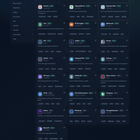
I also used its API to vibe-code my own standalone Home Dashboard. It combines controls for the smart home devices I use most often with shortcuts to my homelab services.
It's become the main interface I use to manage everything at home.
3. OpenWrt — Main network gateway
This is probably my favorite part of the setup.
I'm running OpenWrt as a one-arm router (router-on-a-stick). It handles the gateway, DHCP, and DNS for my home network.
Inside OpenWrt, I'm using:
- AdGuard Home: Network-wide ad blocking.
- SmartDNS: DNS optimization using multiple upstream DNS servers.
- PassWall2: Helps my devices access websites and services blocked in here.
- OpenVPN: Remote access to my home network when I'm away.
- NetQMon Agent: A OpenWrt network traffic identification and monitoring tool I've been developing myself.
I started working on NetQMon because I wanted better application-level traffic visibility on OpenWrt. I wanted to see not just which devices were using bandwidth, but also what kinds of applications and services were generating that traffic.
4. Debian 12 Dev — Development VM
A separate Linux environment for development, testing, and anything I don't want to mess around with on my main Docker host.
My self-hosted apps
Here's a list of what's currently running or available through my home dashboard.
Some are hosted on the NAS, others on Proxmox, and a few are just shortcuts to network devices or external services.
Infrastructure & Networking
- Proxmox VE
- OpenWrt / OpenWrt-Side
- FNOS
- NetQMon
- AdGuard Home
- DDNS-GO
- UpSnap
- 3X-UI
Media & Photos
- Jellyfin
- MoviePilot
- qBittorrent
- Immich
- MoonTV
Smart Home
- Home Assistant
- DoorLink
- Xiaomi Mi Home Hub
Automation & Development
- QingLong
- Kestra
- Metabase
- Changedetection.io
- TelegramFiles
- HD-Icons
Security
- 2FAuth
Network Devices & Shortcuts
- ZTE Router
- Network Switch
- China Unicom
Some of these are used every day, while others are just things I enjoy experimenting with.
I also have a habit of discovering interesting open-source projects on GitHub and immediately wanting to self-host them. I'm guessing a lot of people here can relate.
What I've learned
One thing I've realized is that I don't actually need powerful hardware for most of what I'm doing.
Two low-power N100 machines are enough for almost all my current workloads.
Separating storage from compute also makes things much easier to manage. I can experiment with VMs, containers, and networking without constantly worrying about affecting my stored files.
And honestly, half the fun of having a homelab is just trying things out, breaking something, and then figuring out how to fix it.
What's next?
I'm particularly interested in network monitoring, automation, and finding better ways to manage all these self-hosted services.
I'd love to hear what you guys think about this setup.
What are some self-hosted apps you can't live without? And is there anything you'd change or improve in my setup?
https://www.reddit.com/gallery/1x0nfll
Source: r/homelab · by /u/Ok_Sugar_9635