They fail because they don’t know what to do when the alert actually appears.
You open the SIEM.
There are dozens of alerts.
Which one matters?
What do you check first?
Is it a false positive?
Do you investigate the user, host, IP, process, or all of them?
When should you contain the threat?
When should you escalate?
That workflow is what separates someone who has watched a few SOC videos from someone who can actually work an incident.
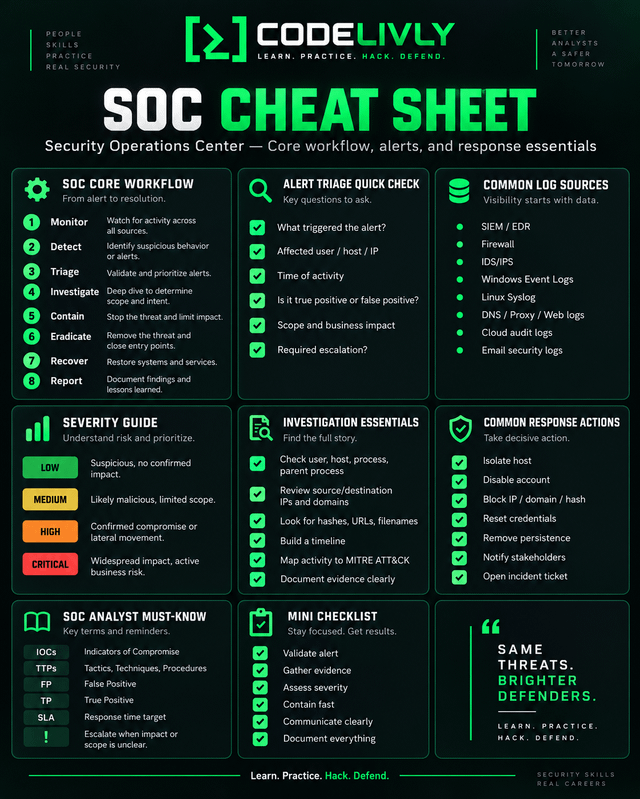
We put together this SOC Cheat Sheet as a simple reference for the things analysts use constantly.
Alert triage, log sources, severity levels, investigation steps, response actions, IOCs, TTPs, escalation, and the full SOC workflow from detection to reporting.
But a cheat sheet is only the starting point.
If your goal is to move into cybersecurity and eventually work as a SOC Analyst, focus less on collecting random certificates and more on learning how to investigate real activity, understand logs, make decisions, and explain what happened.
That is exactly what we built into the SOC Analyst Complete L1 + L2 + L3 Bundle.
It is designed to take you from the fundamentals into deeper SOC investigation, detection, incident response, and practical analyst skills.
If SOC is the career path you are serious about, start here:
https://resources.codelivly.com/product/soc-analyst-the-complete-l1-l2-l3/
Learn the process. Practice the investigation. Build the skills employers expect.
https://i.redd.it/z0giw8usq7uh1.png
Source: r/learnwithcodelivly · by /u/codelivly