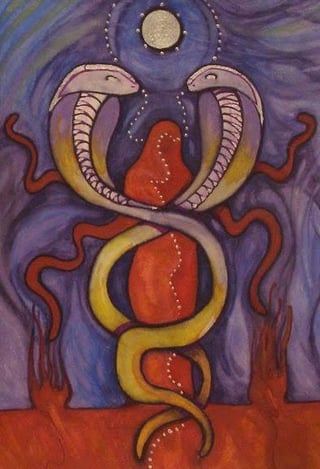
The name Ashlesha comes from the Sanskrit root shliṣh:
which carries the meanings of clinging | entwining | embracing | and wrapping around something so completely that separation becomes difficult to imagine.
Ashlesha, as a nakshatra name, translates most precisely as “the entwiner,”
“the clinging one,”
or “the embracer.”
Some classical scholars also render it as
“the one who is bound up with” something or someone, capturing that quality of an attachment so total that it is almost indistinguishable from the thing it has coiled itself around.
The word carries within it both warmth and intensity.
An embrace, after all, is one of the most intimate human acts. But an embrace that does not release, a coiling that does not loosen, a clinging that has no natural end point, is something else entirely.
Ashlesha holds both possibilities simultaneously and refuses to resolve the tension between them.
This is one of its most essential qualities and one of the things that makes it one of the most psychologically complex nakshatras in the entire system. It is the nakshatra of total contact, of deep entwinement, and of the extraordinary things that happen in consciousness when something holds on with that quality of absolute, unrelenting grip.
The Taittiriya Brahmana counts Ashlesha among the Tikshna nakshatras, placing it in the company of Ardra | Jyeshtha | and Mula as one of the four sharpest, most penetrating, and in some respects most fearsome of the 27 mansions.
That the most obviously tender and nourishing sign in the zodiac, Cancer, should contain within it a Tikshna nakshatra governed by a Rakshasa gana and ruled by the serpent deities is not a contradiction.
It is one of the zodiac’s most honest teachings:
even in the most seemingly gentle and maternal of signs, the depths contain something ancient, powerful, and far beyond ordinary domestication >!
Symbolism :
The primary symbol of Ashlesha is the coiled serpent and it would be difficult to overstate how precisely this symbol describes the nakshatra’s essential nature at every level of its expression.
The serpent in the Vedic tradition is not a simple symbol. It is one of the oldest, most layered, and most universal of all archetypal images in human symbolic history, and within the Vedic framework specifically, it operates across a remarkable range of meanings simultaneously.
It is the Kundalini:
the dormant life force coiled at the base of the spine, waiting for the conditions that will allow it to rise.
It is the Naga, the ancient subterranean intelligence that guards the treasures of the earth and the secrets of the deep.
It is the medicine and the poison in the same body.
It is the wisdom that can only be acquired by going beneath the surface and spending time in the dark, with the cold and the still and the hidden.
And it is the creature that periodically sheds its skin and emerges completely renewed, having left behind the old form as cleanly and completely as if it had never existed.
Each of these symbolic dimensions of the serpent is active in Ashlesha nakshatra, and each one corresponds to something real in the lived experience of those born under its influence.
The coiled posture is particularly significant.
The serpent does not coil because it is passive or dormant in the way that a sleeping animal is dormant. It coils because it is concentrated, because it is holding enormous potential energy in a form that can be released with extraordinary speed and precision the moment conditions call for it.
Ashlesha’s coiled quality is exactly this:
a consciousness that holds its deepest knowing in reserve, that does not reveal itself unnecessarily, that waits with a quality of absolute stillness until the moment for action is unmistakable.
The male cat as the animal symbol of Ashlesha adds a dimension that reinforces and extends the serpent’s qualities. The cat, like the serpent, moves silently. Like the serpent, it is capable of a patient, motionless watchfulness that ends in sudden, perfectly timed action. Like the serpent, it carries within an exterior of apparent calm the absolute readiness for complete engagement the instant something genuinely interesting or genuinely threatening appears. And like the serpent, it cannot be fully tamed. Cats come indoors. Cats accept human affection. But they retain, at some level that cannot be domesticated, a wildness, an independence, a quality of being ultimately their own authority that no amount of warm firesides or comfortable cushions can eradicate >!
Presiding Deity: The Nagas
The presiding deities of Ashlesha Nakshatra are the Nagas, and choosing which of the many serpent beings of Vedic and Puranic tradition to speak of is itself instructive, because the Nagas are not a single deity but a class of beings, a category of cosmic intelligence, and their diversity is itself part of what they teach about this nakshatra.
The most important of the Nagas, for the purposes of understanding Ashlesha, are Shesha (also called Ananta), Vasuki | Takshaka | and Karkotaka.
Each one represents a different face of the serpent archetype that this nakshatra embodies.
Shesha, whose name means “the remainder” or “the residue,” is the great cosmic serpent upon whose infinite hoods Lord Vishnu rests between the cycles of creation. He is the one who remains when everything else has dissolved, the consciousness that persists through the ending of worlds, the awareness that is not destroyed by what destroys everything else.
In the Vishnu Purana and the Bhagavata Purana, Shesha is described as holding all the worlds in perfect balance upon his hoods, chanting the glory of Vishnu with each of his thousand mouths throughout eternal time.
He represents Ashlesha’s capacity for bearing what cannot be set down, for holding what is too vast and too heavy for ordinary consciousness to accommodate, and for doing so with a stillness and a completeness that appears, to the outside observer, almost supernatural.
Vasuki is the serpent who was used as the churning rope in the great Samudra Manthan, the churning of the cosmic ocean described in the Vishnu Purana and the Bhagavata Purana. Both the gods and the demons pulled at him, from opposite ends, using the mountain Mandara as the churning staff, to bring forth from the depths of the ocean its hidden treasures, including ultimately the Amrita, the nectar of immortality.
Vasuki endured this use of his body as a tool, this pulling in two directions simultaneously, for the sake of what would be produced by the churning.
He represents Ashlesha’s capacity for endurance under extraordinary pressure, and more particularly, the nakshatra’s fundamental orientation toward what lies beneath the surface and must be brought up through sustained, difficult effort.
Takshaka is the Naga most associated with the swift, fatal quality of the serpent’s bite.
He is the one who, in the Mahabharata, was ultimately responsible for the death of King Parikshit, whose story is the narrative frame for the entire Bhagavata Purana.
He represents the Ashlesha dimension that must be acknowledged honestly:
the nakshatra’s capacity for sudden, precise, and devastating action when it decides to act, and the understanding that the serpent’s bite, once administered, carries consequences that cannot be undone.
Karkotaka is the serpent king of one of the most instructive stories in the Mahabharata, in the tale of Nala and Damayanti. When Nala was wandering in exile, he rescued Karkotaka from a fire, only to be bitten by him immediately after.
Karkotaka explained that his bite was not cruelty but transformation: the venom he had introduced into Nala’s body would cause him to suffer, but through that suffering, a deeper purification and ultimately a greater restoration would become possible.
This is perhaps the most important key to understanding Ashlesha:
the serpent’s poison and the serpent’s wisdom cannot be separated, and what appears from the outside to be an act of harm may be, in the serpent’s deeper understanding, the only kind of healing that was actually available >!
Nakshatra Lord: Budha
The planetary lord of Ashlesha Nakshatra, in the Vimshottari Dasha system of the BPHS, is Budha : Mercury :
the planet of intelligence, communication, analytical thinking, dexterity, commerce, and the capacity to perceive patterns and connections that are invisible to less discerning minds.
Mercury governs three nakshatras in the Vimshottari system:
Ashlesha | Jyeshtha | Revati
There is a structural observation about Mercury’s three nakshatras that deserves to be made explicitly, because it is one of the most illuminating patterns in the entire Vimshottari system.
All three of Mercury’s nakshatras occupy the final degrees of their respective signs.
Ashlesha completes Cancer. Jyeshtha completes Scorpio. Revati completes Pisces.
Mercury, the planet of the discriminating, synthesising, pattern-perceiving mind, governs the endings of signs, the points at which one mode of experience has been fully inhabited and the consciousness that has moved through it is preparing for a fundamental transition.
There is something deeply appropriate about this.
The mind that has been through everything a sign has to offer, that has exhausted one register of experience and is standing at its boundary, is the mind that sees most clearly, that knows most completely, that has the kind of thoroughness that only comes from having gone all the way to the edge.
In Ashlesha specifically, Mercury’s analytical intelligence is filtered through Cancer’s emotional depth, the serpent’s instinctive wisdom, and the Naga deity’s ancient, underground knowing.
The result is a form of intelligence that is genuinely unlike anything else in the nakshatra system. It is not the quick, nimble, surface-moving intelligence of Mercury in a more Mercurial environment.
It is slow in the way that a serpent is slow, patient in the way that something very old is patient, and when it strikes, it strikes with a precision that leaves observers wondering how the native knew so exactly where to place their attention.
Mercury is also, in the Vedic system, the planet of Maya, of the magical capacity to perceive what is and to shape how it appears.
In Ashlesha, this Mercurial quality of Maya combines with the serpent’s hypnotic gaze to produce one of the nakshatra’s most characteristic and most frequently observed features: the Ashlesha native’s ability to create a compelling reality around themselves, to see through the appearances others present to the world, and to communicate from a place of such penetrating understanding of human psychology that their words land with unusual precision and force >!
Traits of Ashlesha Nakshatra Natives :
(Applicable primarily when the Moon or the Lagna falls in Ashlesha Nakshatra :
16°40’ to 30°00’ Cancer)
- A Penetrating Intelligence That Sees Through Everything :
The coiled serpent’s most essential quality is not its venom. It is its perception. Serpents navigate the world through an extraordinarily sophisticated sensory system that allows them to detect the most subtle vibrations, the faintest heat signatures, the most carefully concealed movements in their environment.
Ashlesha natives carry this quality in their consciousness. They see through people. They read situations with an accuracy that frequently unnerves those who are accustomed to presenting a carefully managed public face.
They register what is actually happening beneath the surface of an interaction while the surface conversation is still going on, and by the time most people have begun to understand the dynamics of a room, the Ashlesha native has already mapped the entire territory, identified every player’s actual motivation, and decided exactly how they want to respond.
The Nakshatra Darpana and the Parashari tradition both note Ashlesha’s natives as possessed of penetrating intelligence, psychological depth, and an instinctive capacity for discerning the hidden structures beneath visible phenomena >!
- The Hypnotic Quality and the Gift of Presence :
There is something about the Ashlesha native’s attention that is difficult to describe but unmistakable to experience. When they focus on another person, there is a quality of total seeing, of being genuinely and completely witnessed, that most people encounter very rarely and find deeply compelling.
This is the serpent’s gaze, rendered in human terms:
Like an attention so complete, so still, so fully present that it creates in its recipient a feeling of being held, of being truly seen, of being in the presence of something that genuinely knows what it is looking at.
This quality, when it is offered in genuine care and without agenda, is one of Ashlesha’s most beautiful gifts. Healers, therapists, counsellors, teachers, and leaders with Ashlesha prominent in their charts can use this quality of attention to do extraordinary work with people.
When it is offered with an agenda, when the serpent’s gaze is serving the serpent’s hunger rather than the other’s genuine need, it becomes something more troubling. The line between holding someone in your complete attention and holding them in your grip is, in Ashlesha, a line worth knowing very well >!
- The Poison and the Medicine in the Same Body :
The Karkotaka story from the Mahabharata is perhaps the most important single mythological key to understanding what Ashlesha’s natives are ultimately working with.
They carry, in the same hands, the capacity to hurt and the capacity to heal, and they frequently cannot use one without having access to the other.
The physician who knows the poison is the only one who can provide the antidote.
The psychologist who understands how the mind can destroy itself is the only one who can map a path through its destruction toward something better.
The friend who sees your self-deceptions clearly enough to name them without flinching is not a comfortable friend to have, but they may be the most valuable one you ever encounter.
Ashlesha natives tend to carry this dual quality as a lived reality in their relationships and their vocations. They are capable of extraordinary healing, and they are equally capable of harm, and the difference between these two expressions of the same fundamental capacity lies almost entirely in the degree of self-awareness and ethical commitment they bring to how they deploy what they know >!
- Deep Emotional Complexity and the Hidden Interior :
Cancer is the sign of emotional life, of the inner world, of the depths that are not easily shared with the outside. And Ashlesha, falling in the final degrees of Cancer, carries the Cancerian emotional depth to its most concentrated and its most private expression.
Ashlesha natives tend to have an extraordinarily rich and complex inner life that very few people ever fully see. They are skilled, by instinct and by long practice, at revealing exactly as much of themselves as they choose to reveal and no more.
The coiled serpent does not display itself unless it decides to. What others see of the Ashlesha native is usually carefully curated, not out of dishonesty exactly, but out of a deeply felt understanding that the inner depths are too important, too private, and too vulnerable to be casually displayed.
This can make genuine intimacy with Ashlesha natives a long and sometimes frustrating process for those who love them.
But the reward of eventually being genuinely trusted by one, of being allowed into the interior that so few ever see, is worth the patience required >!
- The Capacity for Strategic Thinking and Long-Term Planning :
The serpent does not hunt impulsively. It watches, it waits, it reads the situation completely, and it acts only when the moment is exactly right. Ashlesha natives share this quality of strategic patience. They are natural long-term thinkers who understand intuitively that the most powerful moves are rarely the most immediately obvious ones, and that patience in service of a clear goal is not weakness but one of the most sophisticated forms of strength available.
In professional contexts, this makes them formidable strategic planners, negotiators, researchers, and any kind of practitioner whose effectiveness depends on being able to see further ahead and deeper beneath the surface than their counterparts.
The classical texts consistently associate Ashlesha with the capacity for planning that others cannot see coming, and the Parashari tradition acknowledges the nakshatra’s natives as possessed of a strategic intelligence that is most powerful precisely because it does not advertise itself >!
- An Ancient, Instinctive Wisdom and the Psychic Dimension :
The Nagas in the Vedic and Puranic tradition are among the guardians of the most ancient and most inaccessible wisdom in the cosmos.
They live in Patala, the subterranean realm, surrounded by the treasures and the secrets that the earth keeps in its deepest places.
They are the custodians of what has been buried, of what was known before written memory began, of the kind of knowing that does not come from reading or studying but from having existed so long and in such proximity to the roots of things that understanding has simply seeped in through contact.
Ashlesha natives often carry a quality of this ancient knowing as part of their ordinary experience. They frequently know things they cannot explain. They arrive at understandings through a process that looks less like reasoning and more like retrieval. Many have strong intuitive or psychic sensitivities that, when they are acknowledged and developed rather than suppressed, become significant assets in both their personal and their professional lives >!
- The Shedding of Skins and the Capacity for Total Transformation :
The serpent sheds its skin. This is one of its most biologically remarkable features, and in the Vedic symbolic tradition, it is the dimension of the serpent most associated with spiritual transformation, with the capacity for complete renewal, with the possibility of leaving behind an old form of self so thoroughly that the former identity is barely recognisable in what comes after.
Ashlesha natives tend to undergo genuine, complete transformations at significant points in their lives, transformations that go far beyond the ordinary shifts of maturation and involve an actual shedding of an old identity, an old way of understanding themselves, an old pattern of relating to the world. These transformations are rarely easy.
The snake does not shed its skin without some vulnerability in the process. But what emerges is genuinely new, genuinely free of what had grown too tight and too constraining, and genuinely ready for what comes next. The classical texts note this transformative quality as one of Ashlesha’s most distinctive gifts >!
- The Rakshasa Gana and the Refusal of Comfortable Illusions :
Ashlesha’s Rakshasa gana is a designation that tends to cause confusion and sometimes anxiety in those who encounter it without full understanding of what the Rakshasa quality actually means in the context of the nakshatra system.
Rakshasa does not mean demonic in any morally negative sense. It means, more precisely, that the native’s truth-seeking and reality-engaging quality does not stop at the boundaries of what is socially comfortable or conventionally acceptable. The Rakshasa nakshatras see through the pretences and conveniences that Deva and Manushya nakshatras more readily accommodate, and they name what they see with a directness that can feel disruptive to those who preferred the comfortable illusion to remain undisturbed.
Ashlesha’s Rakshasa quality expresses as a fundamental inability to look away from what is actually true, combined with a directness about naming it that can be experienced as ruthlessness by those who encounter it from the outside. This quality is, in the end, one of the nakshatra’s most genuinely valuable contributions to the world. But it is rarely comfortable >!
- Areas of Struggle: Trust, Control, and the Weight of What Is Known
Knowing too much about human nature, seeing too clearly through the ordinary social performances that most people rely on to navigate the world, has a cost. Ashlesha natives frequently struggle with trust in a very specific way: not because they are cynical, but because their perception of what people are actually doing beneath what they are saying makes it genuinely difficult to find those whose interior and exterior are sufficiently aligned to merit the kind of deep trust that the Ashlesha nature simultaneously craves and guards against.
There is also a recurring pattern, noted in classical Jyotisha commentaries and confirmed in practical observation, of the control dimension of the clinging quality expressing in Ashlesha’s closest relationships.
The intensity of the Ashlesha attachment, the totalness of its embrace, can become a grip that the other person eventually needs to escape from, and the native’s encounters with this dynamic, repeated across different relationships, are among the most important catalysts for self-understanding available to them >!
- Core Life Themes: The Wisdom of Depths, the Ethics of Power, and the Journey Toward Conscious Serpenthood
The life of an Ashlesha Moon or lagna native will revolve, across all its many forms and chapters, around a set of themes that the nakshatra’s mythology encodes with remarkable precision.
There is the theme of knowing more than others know, and the responsibility that comes with that knowing. There is the theme of the poison and the medicine in the same hands, and the lifelong refinement of discernment about when to offer which.
There is the theme of the coiled energy that must eventually find its right expression, the Kundalini that, when it rises in alignment with genuine wisdom rather than in service of ego, produces some of the most extraordinary capacities for healing and transformation available in any nakshatra.
And there is, ultimately, the theme of the shed skin, of the willingness to release what one has been in service of what one is genuinely becoming. Ashlesha’s highest expression is not the serpent that uses its power indiscriminately, nor the one that suppresses it out of fear of what it might do. It is the serpent that has become conscious of its own nature, that wields its ancient wisdom with ethical clarity and genuine compassion, and that knows, as Karkotaka knew, that the most healing thing one can offer is not always the most comfortable thing >!
In the next article of this series, we step across the horizon from Cancer into Leo and enter the domain of the tenth nakshatra: Magha Nakshatra:
spanning 0°00’ to 13°20’ Leo, governed by Ketu and presided over by the Pitrs:
the ancestral fathers, the great and luminous dead whose blessings are said to sustain the living >!
Om Shanti 🕉️ ☮️
https://i.redd.it/g4wf77ckp3rh1.jpeg
Source: r/vedicastrologyfree_ · by /u/JyotishGautami