Introduction
Among the works belonging to the extraordinarily sophisticated Buddhist tradition of logic and epistemology that developed in India after Dignāga and Dharmakīrti, Manorathanandin’s Pramāṇavārttikavṛtti occupies a particularly valuable position. The work is a running commentary—vṛtti—on Dharmakīrti’s Pramāṇavārttika, one of the foundational texts of Indian epistemology. Although Manorathanandin was not an innovator on the scale of Dignāga, Dharmakīrti, or Prajñākaragupta, his commentary is extremely important because it stands near the end of the Indian Sanskrit commentarial tradition surrounding the Pramāṇavārttika and preserves interpretations derived from several centuries of Buddhist philosophical debate.
The Pramāṇavārttika itself was composed by Dharmakīrti, probably in the seventh century, as an enormously expanded philosophical engagement with Dignāga’s theory of knowledge. Its four principal chapters concern inference for oneself (svārthānumāna), the establishment of authoritative or reliable cognition (pramāṇasiddhi), perception (pratyakṣa), and inference or demonstration for another person (parārthānumāna).
Manorathanandin therefore had before him not simply a textbook of formal logic but a work embracing epistemology, metaphysics, philosophy of language, philosophy of religion, Buddhist soteriology, perception theory, semantics, debate theory, and arguments concerning the Buddha and liberation. His task was to guide readers through one of the densest texts ever produced in classical Indian philosophy.
What makes his commentary particularly interesting is that Manorathanandin does not operate in isolation. His explanations reflect a mature commentarial tradition. Research on the Vṛtti shows substantial connections with the earlier Pramāṇavārttikapañjikā of Devendrabuddhi and the Pramāṇavārttikālaṅkāra of Prajñākaragupta. These appear among Manorathanandin’s major interpretive resources. Thus the Pramāṇavārttikavṛtti can be read not merely as the opinion of one commentator but as a window into the cumulative intellectual history of Buddhist epistemology in India.
Manorathanandin and the Problem of His Date
Very little reliable biographical information survives concerning Manorathanandin. This is itself significant. Whereas Dharmakīrti became one of the most famous Buddhist philosophers in Tibet and his works generated enormous Tibetan scholastic traditions, Manorathanandin is largely known through the survival of his Sanskrit commentary.
Early modern scholarship therefore had difficulty assigning him a precise date. Rāhula Sāṅkṛtyāyana, who brought the manuscript to scholarly attention, emphasized how little direct information was available about Manorathanandin’s identity. Later scholars proposed that he probably lived in the second half of the eleventh century, although this dating depends partly upon circumstantial arguments rather than an explicit autobiographical statement in the text. A modern study of the textual witnesses likewise lists Manorathanandin as probably belonging to the second half of the eleventh century.
One proposal associates him with a Kashmiri scholar named Manoratha who participated in translation activities involving the Tibetan translator rNgog Blo ldan shes rab, but this identification remains hypothetical. It is therefore preferable to describe Manorathanandin as a probably eleventh-century Buddhist epistemologist, rather than treating every detail of the proposed Kashmiri identification as established fact.
Chronologically, this places him several centuries after Dharmakīrti and after important commentators such as Devendrabuddhi and Prajñākaragupta. This temporal distance was intellectually productive. Manorathanandin inherited an already highly developed tradition in which Dharmakīrti’s terse verses had been repeatedly interpreted, debated, defended, and sometimes reinterpreted.
His Vṛtti therefore represents a comparatively late stage of Indian Buddhist pramāṇa scholarship.
Rediscovery and Manuscript History
The history of the surviving text is almost as fascinating as its philosophical contents.
The important Sanskrit manuscript associated with Manorathanandin’s commentary was copied by the Buddhist scholar Vibhūticandra, who was active around the transition from the twelfth to the thirteenth century. The manuscript contains extensive marginal annotations associated with Vibhūticandra.
Rāhula Sāṅkṛtyāyana discovered the manuscript in Tibet on 28 July 1936, at the hermitage known as Zha lu ri phug. The manuscript contains 105 leaves, with seven lines on each leaf, and was written in an early eastern Indian or Old Bengali-type script that Sāṅkṛtyāyana described as Kuṭilā.
This discovery was immensely important for the modern study of Dharmakīrti. Many Indian Buddhist philosophical works disappeared in their Sanskrit originals after the decline of institutional Buddhism in India and survived only in Tibetan translation. Here, however, scholars possessed an actual Sanskrit witness preserving Manorathanandin’s interpretation and, indirectly, important evidence concerning the textual history of the Pramāṇavārttika itself.
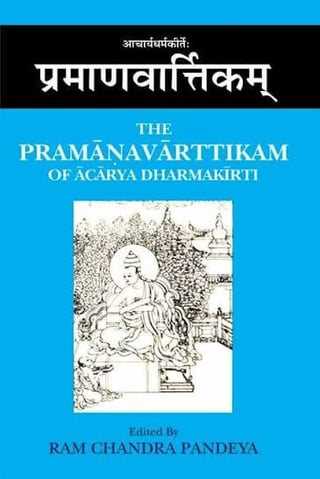
Sāṅkṛtyāyana’s edition appeared between 1938 and 1940 in the appendices to the Journal of the Bihar and Orissa Research Society. Later editions included Dwarika Das Shastri’s 1968 edition and Ram Chandra Pandeya’s 1989 publication. Shigeaki Watanabe published a facsimile of the Sanskrit manuscript in 1998.
The manuscript is therefore important on two levels. It transmits Manorathanandin’s commentary, but it also constitutes an important witness for establishing the Sanskrit text of Dharmakīrti’s own verses. Modern critical study of the Pramāṇavārttika consequently makes frequent use of readings embedded within Manorathanandin’s commentary.
What Does Pramāṇavārttikavṛtti Mean?
The title can be understood through three components.
Pramāṇa refers to reliable or epistemically authoritative cognition and, by extension, to the means or criteria through which valid cognition arises.
Vārttika traditionally denotes an explanatory or analytical treatment of an earlier teaching. Dharmakīrti’s work develops and transforms the epistemological project initiated especially by Dignāga.
Vṛtti denotes an explanatory commentary, usually more continuous and relatively concise than a massive bhāṣya.
Thus Manorathanandin’s title can broadly be rendered:
“The Explanatory Commentary on the Pramāṇavārttika.”
The apparent simplicity of vṛtti, however, should not mislead us. Manorathanandin must repeatedly unpack compressed philosophical verses whose meaning depends upon technical vocabulary, unstated objections, competing doctrinal positions, and earlier discussions in Buddhist and non-Buddhist literature.
Consequently, his work frequently functions as an intellectual map.
I. The Theory of Pramāṇa
At the center of the entire tradition lies the question:
What makes a cognition reliable?
For Dharmakīrti, knowledge is not primarily a matter of matching propositions with abstract truths in the modern analytic-philosophical sense. Cognition must be understood in relation to successful engagement with reality.
A central Dharmakīrtian criterion of reality is causal efficacy (arthakriyā). Something ultimately real must possess the capacity to produce causal effects. Particulars possess such causal powers; universals do not independently exercise causal efficacy and therefore belong to the conceptual or conventional domain.
Manorathanandin helps readers interpret arguments of this kind by identifying the connections between individual verses and the larger epistemological architecture.
Reliable cognition leads the cognizer toward an object in a manner that is not subsequently contradicted in the relevant practical context. Error, by contrast, superimposes something that cannot fulfill the causal expectations generated by the cognition.
The famous example underlying much Buddhist epistemological discussion is the difference between genuinely seeing fire and mistaking something else for fire. A successful cognition enables practical activity appropriate to the object. An illusion ultimately fails.
Epistemology is therefore connected to action.
II. Perception and the Particular
One of Dharmakīrti’s most influential doctrines concerns pratyakṣa, perception.
Perception is fundamentally non-conceptual. What perception directly confronts is not a universal such as “cowhood,” “treehood,” or “blueness” existing independently in the world. It encounters a unique causal particular, a svalakṣaṇa.
Conceptual thought subsequently organizes experience.
This distinction lies at the heart of Buddhist nominalism. Reality itself does not arrive already divided according to the linguistic categories through which humans describe it. We encounter causal particulars and then construct conceptual classifications.
Suppose someone sees a blue lotus.
At the immediate perceptual level there is a causally produced appearance. The judgment—
“This is a blue lotus”
already contains conceptual determination. “Blue,” “lotus,” and “this kind of thing” involve categories extending beyond the unique momentary particular.
Manorathanandin’s commentary is valuable because Dharmakīrti frequently expresses these distinctions through extremely compressed argumentation. Modern research continues to use Manorathanandin when interpreting difficult portions of the Pratyakṣa chapter; indeed, current critical work specifically studies sections of the perception chapter through his commentary.
Ultimate and Conventional Existence
The distinction between particulars and universals leads into ontology.
Dharmakīrti associates ultimate reality with whatever is causally efficacious. Manorathanandin’s wording preserved alongside Pramāṇavārttika III.3 is especially useful for understanding the contrast between the ultimately real (paramārthasat) and the conventionally real (saṃvṛtisat).
A unique moment of blue appearing under specific causal conditions possesses causal power.
“Blueness,” conceived as one permanent universal shared by every blue object, does not.
Similarly, what ordinary language calls “a person” or “a pot” may function perfectly well conventionally. Buddhism need not forbid us from saying:
“The person carried the pot.”
The philosophical claim is instead that analysis does not reveal an eternal unitary substance corresponding to every conventional noun.
Manorathanandin helps preserve the connection between epistemology and this Buddhist ontology.
III. Conceptual Cognition and Apoha
If universals are not ultimately real, an obvious question arises:
How can words possess meaning?
This problem generated the Buddhist doctrine known as apoha, “exclusion.”
A word does not function because an independently existing universal resides equally in every member of a class. Instead, conceptual classification operates through patterns of differentiation or exclusion.
“Cow,” for example, identifies its range through the exclusion of what is incompatible with being classified as cow.
This does not mean that speakers consciously formulate the proposition:
“not a non-cow”
every time they use the word.
Rather, apoha attempts to explain how conceptual classifications can operate without committing Buddhist philosophy to metaphysically real universals.
The doctrine is particularly important in the Svārthānumāna material, where inference, conceptuality, and linguistic classification intersect. Manorathanandin’s Vṛtti assists in interpreting these dense discussions and therefore belongs to the textual tradition through which the Buddhist theory of meaning has been reconstructed.
The broader implication is striking:
language is useful precisely without reproducing ultimate reality exactly as it is.
Conceptual thought simplifies, groups, excludes, and stabilizes a world whose ultimate constituents are unique and momentary.
IV. Inference for Oneself
The first major section of the Pramāṇavārttika concerns svārthānumāna—inference undertaken for one’s own understanding.
Inference requires a dependable relation between the evidence or reason (hetu) and what is to be established (sādhya).
The Buddhist logical tradition analyzes when a sign legitimately warrants a conclusion. Classic examples include inferring fire from smoke.
But Dharmakīrti does not regard every repeated association as sufficient. There must be a necessary relation grounding the inference.
This produces sophisticated analyses of different kinds of logical reasons, especially those involving:
- identity or essential relation,
- causal relation,
- and non-perception.
For example, smoke warrants inference to fire because smoke depends causally upon fire-like conditions. By contrast, two accidentally correlated things cannot automatically generate valid inference.
Manorathanandin’s commentary clarifies such arguments by making explicit transitions that Dharmakīrti leaves compressed in verse.
V. Non-Perception and Knowledge of Absence
One of the most philosophically interesting parts of Buddhist logic concerns anupalabdhi—non-perception.
How do we know that something is absent?
Suppose a person looks at a well-lit table and says:
“There is no pot here.”
The absence of a perception can warrant the judgment of absence only under appropriate conditions. If the room were completely dark, failing to perceive the pot would prove nothing.
Thus non-perception becomes epistemically significant when the object would have been perceptible if present.
The theory allowed Buddhist logicians to explain negative knowledge without necessarily positing “absence” as a separate metaphysical entity in the manner developed by some non-Buddhist traditions.
Manorathanandin’s treatment belongs to a tradition in which logic is therefore not merely about syllogistic forms. It encompasses a general theory concerning what licenses rational cognition.
VI. The Pramāṇasiddhi Chapter: Why Trust the Buddha?
The second chapter, Pramāṇasiddhi, expands far beyond what a modern reader might initially classify as logic.
Dharmakīrti investigates whether the Buddha can be regarded as epistemically authoritative.
But the Buddhist argument is not simply:
“The Buddha is trustworthy because scripture says so.”
That would be circular.
Instead, Dharmakīrti attempts to explain how the qualities of a Buddha could arise through causes. The discussion therefore moves through subjects including:
- compassion,
- mental cultivation,
- rebirth,
- suffering,
- its causes,
- liberation,
- knowledge of the path,
- and the cognitive transformation of an awakened being.
This chapter becomes a remarkable synthesis of epistemology and Buddhist soteriology.
The Buddha is important not because of divine creation or revelation but because he perfectly understands the realities required for liberation and teaches them without deception.
Manorathanandin carefully guides the reader through these arguments.
Compassion and Repeated Cultivation
A major issue concerns whether extraordinary compassion can genuinely arise.
Dharmakīrti argues from the Buddhist principle of mental cultivation: psychological dispositions may become stronger through repeated habituation. Compassion, therefore, need not remain limited to an ordinary emotional response.
Through sustained cultivation across an extended continuum of mind, compassion may become increasingly powerful.
This connects directly with arguments for rebirth. If mental events cannot be satisfactorily reduced to a purely physical origin, the Buddhist argues for continuity of cognition.
Whether one accepts the argument or not, its philosophical significance is considerable. Dharmakīrti is constructing a naturalistic causal explanation of Buddhahood within his own Buddhist metaphysics rather than appealing primarily to revelation.
VII. The Four Noble Truths as Philosophical Structure
The Pramāṇasiddhi discussion ultimately intersects with the Four Noble Truths:
- suffering,
- the origin of suffering,
- cessation,
- the path leading to cessation.
For the epistemological tradition these are not merely articles of religious belief. They become claims requiring philosophical justification.
Is suffering causally generated?
Can its causes be eliminated?
Can mental defilements disappear permanently?
Can cognition be transformed through disciplined cultivation?
Such questions receive extensive argumentative treatment.
Research on Manorathanandin has examined precisely his commentary on passages concerning nirodhasatya, the truth of cessation. Comparison shows that he often reuses or closely follows earlier interpretive material from Devendrabuddhi and Prajñākaragupta.
This illustrates the distinctive character of the Vṛtti: it is simultaneously explanation, preservation, adaptation, and transmission.
VIII. Yogic Perception
Ordinary sensory perception is not the only form of non-conceptual cognition considered in Buddhist epistemology.
Dharmakīrti also discusses yogipratyakṣa, yogic perception.
Through repeated meditation upon truths initially understood conceptually, the practitioner may eventually develop cognition whose object appears with exceptional clarity and immediacy.
The process can be schematically represented as:
reasoned understanding → repeated contemplation → intensified familiarity → vivid non-conceptual cognition.
This matters because Buddhist liberation cannot rest solely upon verbally repeating doctrinal propositions. A conceptual understanding such as—
“All conditioned things are impermanent”
must eventually become deeply assimilated into cognition.
Modern comparative work shows that Manorathanandin sometimes differs from other commentators in explaining the structure through which such yogic cognition becomes vivid and non-conceptual.
Thus even a comparatively concise commentator can preserve distinctive interpretive decisions.
IX. Inference for Others and the Theory of Debate
The fourth major section concerns parārthānumāna—inference expressed for another person.
Here reasoning becomes communicative.
Private inference asks:
“What gives me sufficient grounds to conclude this?”
Public demonstration asks:
“How can I present those grounds so that another rational person can understand the conclusion?”
The distinction is crucial.
Indian Buddhist logic was embedded within a culture of philosophical controversy involving Buddhists, Naiyāyikas, Mīmāṃsakas, Jains, Vedāntins, and numerous other schools. Philosophical argument therefore required methods for diagnosing bad reasons, irrelevant reasons, contradictory arguments, and failures to establish the required logical relation.
The Pramāṇavārttika consequently became not just an epistemological treatise but an important document in the history of Indian argumentation.
Manorathanandin’s commentary preserves the scholastic apparatus necessary for navigating this world.
X. Manorathanandin’s Method as Commentator
Perhaps the most important feature of the Pramāṇavārttikavṛtti is its relationship with previous commentaries.
Manorathanandin does not behave like a modern author who constantly announces quotations through formal references. Sanskrit scholastic composition often incorporated earlier formulations directly into a new explanatory text.
Research comparing passages of Manorathanandin with Devendrabuddhi and Prajñākaragupta demonstrates extensive textual and interpretive overlap. Devendrabuddhi, traditionally regarded as a close disciple of Dharmakīrti, represents an early layer of interpretation, while Prajñākaragupta produced one of the most philosophically ambitious commentaries on the Pramāṇavārttika. Manorathanandin could therefore inherit material from both a relatively early explanatory tradition and a later, more expansive philosophical one.
This should not simply be dismissed as “copying.”
Premodern Indian commentary operated according to different assumptions regarding textual reuse. Preserving the correct interpretation of an authoritative philosophical text was itself a scholarly achievement. Earlier explanations could be abbreviated, reorganized, harmonized, or inserted where useful.
The Vṛtti consequently provides evidence for a living commentarial network.
XI. Vibhūticandra’s Marginal Notes
The textual history becomes even richer because Vibhūticandra did more than merely copy the surviving manuscript.
The manuscript contains numerous marginal notes and an appendix attributed to him. Modern bibliographic resources explicitly identify these annotations as a separate body of material associated with Vibhūticandra.
Thus one physical manuscript can contain several historical layers:
Dharmakīrti’s root verses → Manorathanandin’s commentary → Vibhūticandra’s annotations.
And behind Manorathanandin stand still earlier commentators such as Devendrabuddhi and Prajñākaragupta.
The manuscript therefore resembles an archaeological site of Buddhist intellectual history.
Rather than encountering a philosophical text in isolation, we see generations of readers interacting with one another.
XII. Why the Work Matters for the Reconstruction of Dharmakīrti
The Pramāṇavārttikavṛtti is also important because establishing the exact Sanskrit wording of Dharmakīrti’s Pramāṇavārttika is not always straightforward.
The surviving textual witnesses belong to different periods and traditions. Modern editors therefore compare multiple sources: independent manuscripts of the verses, quotations preserved in commentaries, Tibetan translations, and readings embedded within works such as Manorathanandin’s Vṛtti.
A commentary may preserve a form of a verse differing from another manuscript.
This allows textual scholars to ask:
- Which reading is older?
- Did a scribe modify the verse?
- Did a commentator know a different textual recension?
- Did Tibetan translators work from a different Sanskrit exemplar?
Manorathanandin is consequently relevant not merely to philosophers but also to philologists reconstructing Dharmakīrti’s text. Modern scholarship explicitly treats Manorathanandin’s manuscript as one of the significant witnesses used in the critical study of the Pramāṇavārttika.
XIII. A Bridge Between Indian and Tibetan Buddhist Scholasticism
The physical survival of the manuscript also symbolizes a larger historical process.
Indian Buddhist universities and monasteries eventually declined, and enormous quantities of Sanskrit philosophical literature disappeared in South Asia. Tibet, however, preserved translations and manuscripts belonging to Indian Buddhist traditions.
Vibhūticandra belonged to precisely this late Indo-Tibetan intellectual environment. The fact that a Sanskrit manuscript of Manorathanandin survived in Tibet and was rediscovered there centuries later exemplifies the transmission of Indian Buddhist learning across the Himalayas.
Without that preservation, an important layer of Dharmakīrtian interpretation might have been lost.
This is one reason the Pramāṇavārttikavṛtti has historical significance considerably exceeding what one might expect from a comparatively compact commentary.
XIV. Manorathanandin’s Philosophical Character
Manorathanandin should therefore neither be exaggerated into a second Dharmakīrti nor reduced to a passive copyist.
His importance lies in a different intellectual role.
He is a systematizer, interpreter, transmitter, and selective inheritor.
He helps transform extremely compressed philosophical verses into an intelligible sequence of claims. He preserves earlier explanatory traditions. At points he chooses between interpretations or gives distinctive explanations. His work also indirectly preserves evidence about texts whose Sanskrit forms are otherwise incomplete or lost.
Most importantly, the Vṛtti reveals how Dharmakīrti continued to be studied centuries after his death.
A philosophical masterpiece survives intellectually only when later scholars continue to interpret it. Manorathanandin represents precisely such a stage in the life of the Pramāṇavārttika.
Conclusion
Manorathanandin’s Pramāṇavārttikavṛtti is one of the important surviving witnesses to the mature Indian Buddhist tradition of logic and epistemology. Probably composed in the later eleventh century, it explains Dharmakīrti’s enormous philosophical project at a point when Buddhist pramāṇa thought already possessed several centuries of commentarial history.
Through it we encounter discussions of perception and inference, causal efficacy and ultimate reality, universals and particulars, linguistic exclusion, non-perception, logical demonstration, compassion, rebirth, liberation, the Four Noble Truths, yogic cognition, and the epistemic authority of the Buddha.
Yet the significance of the work extends beyond its doctrinal content.
Manorathanandin preserves earlier interpretive traditions, particularly material associated with Devendrabuddhi and Prajñākaragupta. Vibhūticandra subsequently copied and annotated the text. That manuscript reached Tibet, where it survived until Rāhula Sāṅkṛtyāyana rediscovered it in 1936. Its modern editions from 1938 onward subsequently made Manorathanandin an important resource for the international study of Dharmakīrti.
The history can therefore be represented as a remarkable chain:
Dignāga → Dharmakīrti → early Dharmakīrtian commentators → Prajñākaragupta → Manorathanandin → Vibhūticandra → Tibetan manuscript preservation → Sāṅkṛtyāyana → modern critical scholarship.
Within that chain, Manorathanandin occupies a strategically important middle position. He allows us to see how the philosophical revolution initiated by Dignāga and Dharmakīrti was received by later Indian Buddhists rather than merely how modern scholars reconstruct it.
The Pramāṇavārttikavṛtti is therefore more than a commentary explaining difficult verses. It is a record of the continuous transmission of one of India’s most sophisticated traditions of epistemological inquiry. Through its discussions of what counts as knowledge, what is ultimately real, how concepts relate to particulars, how inference becomes valid, how absence can be known, and how rational analysis connects with the Buddhist path to liberation, the work preserves a distinctive conception of philosophy in which logic, metaphysics, psychology, language, and soteriology remain inseparably connected.
For that reason, Manorathanandin deserves recognition as an important guardian and interpreter of the Dharmakīrtian philosophical tradition: a scholar whose Vṛtti helped carry one of classical India’s most intricate systems of thought from the great age of Buddhist epistemology into the final centuries of Sanskrit Buddhist scholasticism and, ultimately, into modern scholarship.
https://i.redd.it/ekrkh4fw03rh1.jpeg
Source: r/IndicKnowledgeSystems · by /u/RossbihariGhost1900