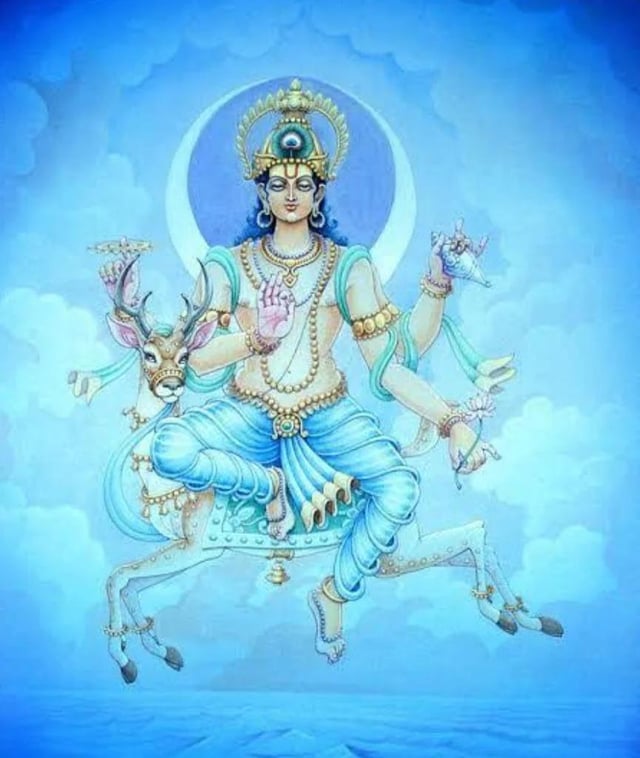
Mrigashira is a Sanskrit compound of two words:
Mriga and Shira. Shira means head, straightforwardly enough.
Mriga, however, carries a richer and more layered meaning than its most common translation of “deer” would suggest.
In Sanskrit, Mriga refers broadly to any wild animal of the forest particularly the deer or antelope but it also carries the meaning of “that which is sought,” “the quarry,” or “that which one searches for.”
The root Mrig means to seek, to search, to track and it gives us both the word for the deer (the animal that is tracked and hunted) and the verb of seeking itself.
The name of this nakshatra is therefore not merely “the head of a deer” , it is, more essentially, “the head of the seeker” or “the mind engaged in the act of searching.”
This etymological depth is not incidental. It is the key that unlocks everything essential about Mrigashira.
The nakshatra’s entire energy , its psychology, its life themes, its gifts and its shadows is encoded in this single image:
a consciousness perpetually engaged in the act of seeking, moving through the world with the alert sensitivity of a deer whose head is always lifted, whose nostrils are always testing the air, whose eyes are always scanning the treeline for something that is sensed but not yet seen.
The Taittiriya Brahmana and classical Jyotisha texts consistently describe Mrigashira through this lens of searching as it is the nakshatra of the seeker, the wanderer, the poet-mind that senses beauty everywhere and is always moving toward it, always finding that it lies just a little further ahead >!
A Nakshatra Between Two Worlds: The Taurus-Gemini Cusp :
Like Krittika before it, Mrigashira straddles two zodiacal signs and in this case, the contrast between those two signs could scarcely be more pronounced.
Its first two padas fall in Taurus being the fixed earth sign ruled by Venus, the sign of sustained beauty, sensory richness, material groundedness and the slow, patient cultivation of what endures.
Its final two padas fall in Gemini being the mutable air sign ruled by Mercury, the sign of quicksilver intelligence, restless curiosity, communication, duality, and the perpetual appetite for new information and connection.
This Taurus-Gemini crossing is one of the most telling structural features of the entire nakshatra system. The deer’s head that searching, seeking quality expresses very differently depending on which side of this threshold it occupies.
In the Taurus padas (1 and 2), the search has a more embodied, sensory quality like the seeker is looking for beauty, for nourishment, for the right environment in which to settle and flourish.
There is more patience in the Taurus Mrigashira, more willingness to stay with one thing long enough to truly taste it.
In the Gemini padas (3 and 4), the search becomes more mental, more mercurial, more explicitly intellectual as in the seeker now moves through ideas, conversations, connections, and information with an almost feverish delight.
The Gemini Mrigashira native may cover vastly more ground, but they also risk staying nowhere long enough to fully arrive.
The BPHS and subsequent Parashari commentators acknowledge this variability, and classical Nadi readers have consistently emphasised that the Taurus and Gemini padas of Mrigashira produce meaningfully distinct temperamental expressions despite sharing the same nakshatra’s essential seeking quality >!
Symbolism :
The symbol of Mrigashira is the head of a deer specifically the head of the spotted deer or antelope that appears throughout Vedic and Puranic iconography as the supreme emblem of the searching, sensitive, alert, and spiritually inclined mind.
The deer holds a place of deep significance in the Vedic tradition:
it is the animal that accompanied sages in the forest, the animal whose hide (mrigacharmana) forms the sacred seat of meditation, the animal that graces the hands of lord Shiva and the lap of Mata Saraswati and the animal whose beauty was the vehicle of one of the Ramayana’s most pivotal moments when Mata Sita, captivated by the golden deer (Maricha in disguise), sent Lord Rama away on an impossible chase that changed the course of their lives entirely.
The deer’s head, as a symbol, emphasises mind over body as it is not the deer in full run but its head, alert and lifted, engaged in the primary act of the deer’s existence: sensing what is around the next corner.
This is Mrigashira’s essence:
a consciousness in a state of perpetual, alert seeking. The deer does not know exactly what it is looking for as it moves by scent, by sound, by an innate sensitivity to the presence of what nourishes it or threatens it. In the same way, Mrigashira natives often cannot fully articulate what they are seeking; they know it only by the quickening they feel when they move in its direction and the subtle dissatisfaction they feel when they have remained too long in one place.
The female serpent as the animal symbol of Mrigashira adds a dimension that is less immediately obvious but deeply important.
The serpent, in the Vedic and Tantric traditions, represents the awakened life force (Kundalini), the capacity for shedding old forms and moving into new ones, and the sinuous, fluid intelligence that navigates complex terrain without rigid adherence to a fixed path.
The female serpent specifically is associated with the creative and receptive dimensions of this serpentine intelligence as the Mrigashira native’s seeking is not blunt or aggressive but fluid, intuitive, and capable of moving through obstacles by finding the spaces between them >!
Presiding Deity: Lord Soma
Lord Soma is the presiding deity of Mrigashira Nakshatra, and the choice of Soma as this nakshatra’s divine patron is one of the most philosophically rich assignments in the entire Vedic nakshatra system.
Understanding Lord Soma in his full complexity is essential to understanding what Mrigashira natives are ultimately searching for and why they so rarely feel they have found it.
In the Vedic tradition, Soma operates on several simultaneous levels.
At the most literal, Soma is the sacred plant and its pressed juice as the ritual libation consumed during the Vedic yajna celebrated across the entirety of the Rig Veda’s Ninth Mandala (Soma Mandala), which consists of 114 hymns devoted entirely to Soma’s praise.
The Soma plant yielded a juice that was filtered, mixed with milk and water, and offered to the gods and consumed by the priests producing states of heightened consciousness, visionary experience and a blissful expansiveness that the Rig Vedic poets describe as union with the divine.
Soma, in this sense, is the nectar of illumination as the substance that makes the gods immortal, that gives the sage his vision, and that temporarily dissolves the boundary between the human and the divine.
At a more cosmic level, Soma is the Moon I.e Chandra in his form as the lord of nectar, moisture, growth, and the tidal rhythms of life.
The Moon’s Soma aspect emphasises not its emotional, relational qualities (which are more associated with Chandra proper) but its nourishing, nectar-producing, bliss-sustaining qualities as the moonlight that makes the medicinal plants grow, the dew that appears at dawn, the subtle coolness and moistness that refreshes what the sun’s heat has parched.
At the deepest Philosophical
level,
Soma is the Ananda Kosha : the bliss body i.e the innermost layer of the human subtle anatomy, the experience of pure being that underlies all mental and emotional activity.
To taste Soma is to taste one’s own deepest nature I.e the native joy of pure consciousness that precedes all seeking and is the very thing that all seeking, at its most essential, is looking for.
This is the key to Mrigashira’s perpetual seeking:
the deer is tracking Soma being the divine nectar, the bliss that is sensed everywhere but located nowhere in the external world. Every beautiful thing, every fascinating idea, every exhilarating new connection or landscape or creative discovery offers a taste like a flash of Soma and then it passes, and the seeking begins again.
The search is not a symptom of something wrong with the Mrigashira native; it is their dharmic orientation, the specific form in which their consciousness engages with existence.
The deeper teaching and it is one that typically arrives only through long lived experience is that Soma is not found at the end of the search but is the quality of awareness with which one searches.
The Skanda Purana and the Vishnu Purana also connect Soma to the myth of Prajapati’s pursuit of Rohini in the Vedic astronomical framework, Soma (the Moon) is the pursuer, the one whose movement through the nakshatras is driven by longing, and Mrigashira as the nakshatra following Rohini carries the energetic signature of that pursuit. The deer that follows the scent of the garden >!
Nakshatra Lord: Mangal
The planetary lord of Mrigashira Nakshatra, in the Vimshottari Dasha system of the BPHS, is Mars being the planet of energy, courage, initiative, passion, drive, physical vitality, competition, and the directed application of force.
Mars governs three nakshatras in the Vimshottari system:
Mrigashira | Chitra | Dhanishtha
The pairing of Mars as lord and Soma as deity creates one of the most fascinating and, for the native, one of the most productively challenging combinations in the nakshatra system.
Mars is the planet of directed force, of conquest, of the will to pursue and acquire.
Soma is the deity of nectar, bliss, sensitivity, and the dissolving of boundaries in divine experience.
Mars wants to win; Soma wants to taste. Mars moves in straight lines with clear objectives; Soma wanders in search of an experience that cannot be precisely located or strategically acquired.
In Mrigashira, these two principles are fused in the image of the deer being the animal that moves with surprising speed (Mars) but is guided by an exquisitely sensitive nose rather than by aggressive strategy (Soma).
The result is a native whose energy is genuinely Martian they are not passive, not slow, not without drive or competitive instinct but whose drive is in service of seeking rather than conquering, of exploration rather than domination, of the experience of beauty and discovery rather than the accumulation of trophies.
This makes Mrigashira one of the most intellectually restless, creatively adventurous, and endlessly curious of all the nakshatras and also, at its shadow, one of the most scattered and perpetually dissatisfied, because the Martian energy ensures they are always moving while the Soma principle ensures they are never quite satisfied with what they have found.
All three of Mars’s nakshatras ;
Mrigashira | Chitra | Dhanishtha share a quality of the Martian energy expressed through a particular form of craft or search:
Mrigashira seeks | Chitra creates | Dhanishtha accumulates and celebrates.
The seeking that Mrigashira initiates is the first movement in a larger Martian arc>!
Traits of Mrigashira Nakshatra Natives :
(Applicable primarily when the Moon or the Lagna falls in Mrigashira Nakshatra : 23°20’ Taurus to 6°40’ Gemini)
- The Seeker’s Mind : Perpetually Alert and Perpetually Searching
The most defining characteristic of Mrigashira natives is the one that runs beneath every other quality and surfaces in every domain of their life is an unquenchable quality of seeking.
These individuals are constitutionally oriented toward the search: for beauty, for meaning, for connection, for knowledge, for the perfect idea or experience or relationship that will fully satisfy the longing they carry within them.
The Brihat Samhita describes Mrigashira natives as endowed with sharp senses, a questing intelligence, and a natural restlessness i.e an inability to remain still for too long without the sense that something important is being missed just around the corner.
This seeking quality is not a deficit; it is the soul’s orientation toward Soma, toward the divine nectar that is sensed everywhere and located, in its fullness, nowhere in the external world >!
- Extraordinary Sensitivity : to Beauty, to Atmosphere, to the Subtleties of the World
The deer, as a symbol, is among the most sensitively attuned animals in existence as its survival depends entirely on its capacity to detect the subtlest signals in its environment, to read the air, the light, the sound, the stillness.
Mrigashira natives carry this hypersensitivity into every dimension of their experience. They are acutely responsive to beauty in all its forms like visual, sonic, conceptual, interpersonal and they register the emotional and atmospheric quality of environments, relationships, and situations with a fineness that others often miss entirely.
This sensitivity is the source of their creative gifts, their social intelligence, and their capacity for profound appreciation of the world’s richness. It is also, when it is not well managed, the source of considerable vulnerability they can be easily overwhelmed by harsh environments, by emotional coarseness, by situations that assault rather than nourish their finely tuned sensory apparatus >!
- Quick, Agile, Multi-Directional Intelligence :
The Gemini padas of Mrigashira in particular, but the nakshatra as a whole, are associated with a mind of extraordinary agility and breadth. Mrigashira natives tend to be fast learners, wide readers, engaging conversationalists, and natural connectors of ideas across domains that others perceive as unrelated.
They move quickly between topics, between interests, between perspectives with a fluidity that reflects the deer’s capacity to change direction in an instant.
The Nakshatra Darpana and classical Parashari commentators consistently describe Mrigashira’s natives as possessed of sharp wit, verbal skill, and a natural facility with language and communication. They often think in images and metaphors rather than in sequential logic, and their insights tend to arrive sideways like through analogy, through unexpected association rather than through linear deduction >!
- The Romantic Idealist ; Love as a Form of the Search
One of the most consistent and poignant themes in the life of a Mrigashira native is their relationship with romantic love which they tend to approach with the same seeking, idealistic quality that characterises all their searching.
They sense the possibility of a perfect union, a love that is also a homecoming, a relationship that will finally give the wandering deer a place to rest. And indeed, they are capable of extraordinary romantic sensitivity which is of seeing the beloved with a depth and freshness that keeps the experience of love alive long after familiarity might have dimmed it for a less perceptive temperament.
The shadow is the inevitable gap between the idealized beloved and the actual person , between Soma as imagined and Soma as tasted.
The Mrigashira native must learn, through experience, that the love they are seeking is not located in another person but is the quality of their own seeking awareness encountering whatever it meets with full presence and genuine wonder >!
- Creative Gifts Rooted in Curiosity and Exploration :
Mars’s energy, channelled through the sensitive, searching medium of Mrigashira, produces a distinctive creative quality being the one that is driven by exploration and discovery rather than by the sustained, patient cultivation of Rohini or the disciplined refinement of Krittika.
Mrigashira natives tend to be extraordinarily generative in the early stages of creative projects like they will be full of ideas, full of enthusiasm, full of the pleasure of beginning and sometimes less consistent in the middle and final stages, where the initial thrill of discovery gives way to the more demanding work of completion.
They are most brilliantly themselves at the frontiers of their creative territory like being the first exploration of a new medium, the opening of a new thematic inquiry, the discovery of a new technique or voice.
The Brihat Samhita notes that those born under Mrigashira’s influence tend toward multiple creative expressions and a variety of skills, rather than the deep mastery of a single domain >!
- The Paradox of Mars in the Mridhu Nakshatra :
One of the most intriguing features of Mrigashira and one that frequently puzzles those who encounter Mrigashira natives is the combination of the Mridhu (soft, gentle, mild) quality with Mars as the nakshatra lord.
Mars is the planet of force, combat, and decisive action; Mridhu is the quality of the most tender and delicate of the nakshatras.
The resolution of this paradox is in the image of the deer itself: the deer is not timid or passive as it is exquisitely agile, capable of explosive speed, and when cornered, unexpectedly fierce. But its natural mode of moving through the world is gentle, sensitive, and non-confrontational.
Mrigashira natives are, in their ordinary mode, among the most pleasant, sensitive, and genuinely gentle personalities in the nakshatra system. But when their boundaries are violated, when they or those they care for are threatened, or when they are pushed beyond their considerable patience, the Martian energy surfaces with a suddenness and intensity that invariably surprises those who knew only the deer >!
- Wanderlust, Travel, and the Love of New Horizons :
The seeking quality of Mrigashira expresses itself very naturally in a love of physical travel, geographical exploration, and the experience of new environments.
For the Mrigashira native, new places are not merely distractions or entertainment but they are, at a deep level, further chapters in the essential search.
Every new landscape, every new culture, every new culinary tradition or artistic form encountered in a different part of the world offers another taste of Soma like another flash of the wonder and aliveness that this nakshatra perpetually seeks.
Classical texts connect Mrigashira with journeys, with movement between places, and with the kind of person who finds that they think most clearly and feel most alive when they are in motion.
The shadow is that the wandering impulse can become a substitute for the deeper inner journey using geographical movement to avoid the stillness in which the true source of Soma would be encountered>!
- Difficulty with Sustained Commitment and the Grass-is-Greener sorta Dynamic :
Among the most important shadows of Mrigashira and one that the classical texts acknowledge with striking directness is the tendency toward what might be described as a perpetual grass-is-greener orientation.
The deer that senses a richer grazing ground just beyond the current field finds it genuinely difficult to stay where it is; and the Mrigashira native, with their heightened sensitivity to what is possible and their natural idealism about what the next experience or relationship or opportunity might offer, frequently struggles to fully commit to what is present.
Relationships can suffer particularly from this quality as the sense that the perfect partner, the perfect creative collaboration, the perfect living situation, exists just beyond the horizon, and that committing fully to what is present would mean closing the door on something better.
Learning to recognise Soma within the present moment which is to taste the nectar of what is rather than only sensing it in what might be is one of the central developmental tasks of this nakshatra’s natives >!
- Areas of Struggle: Completion, Restlessness, and the Exhaustion of Perpetual Seeking
The same quality that makes Mrigashira so brilliantly alive , its perpetual openness, its sensitivity to possibility, its inability to take the world for granted can also become genuinely exhausting over a lifetime.
The deer that never stops moving eventually tires; the mind that never fully arrives eventually loses its capacity to receive the nourishment it seeks. Mrigashira natives often reach a point typically in the second half of life where the restlessness that once felt like aliveness begins to feel like a burden; where the perpetual seeking begins to feel less like spiritual aspiration and more like an inability to be at peace with what is.
This crisis of restlessness is not a failure of the Mrigashira soul but an invitation to turn the seeking inward, to recognise that the deer has always been walking in circles around the very spring it was looking for, and that stillness is not the death of the search but its fulfillment >!
- Core Life Themes: The Search, the Taste of Wonder, and the Journey Toward Inner Soma
The life of a Mrigashira Moon or lagna native will be shaped, across all its many forms and chapters, by several inescapable themes: the perpetual search for something beautiful, true, and deeply nourishing, the exquisite sensitivity to the world’s richness and the vulnerability that accompanies it, the tension between the wandering impulse and the longing for genuine belonging, the romantic idealism that both elevates love and makes it perpetually elusive, and ultimately as the deepest maturation of the nakshatra’s gifts being the recognition that Soma, the divine nectar, is not the destination of the search but its very quality.
The nakshatra’s highest expression is not the deer that has finally found its meadow but the deer that has discovered how to be fully present in every meadow it passes through tasting Soma in the moment of contact with what is, rather than always sensing it in what lies ahead >!
In the next article of this series, we move to the sixth nakshatra of the Vedic zodiac :
Ardra Nakshatra, spanning 6°40’ to 20°00’ Gemini, governed by Rahu and presided over by Rudra : the howling, storm-bringing, terrifying and ultimately compassionate form of Lord Shiva.
Om Shanti 🕉️ ☮️
https://i.redd.it/a96ql8y5cbqh1.jpeg
Source: r/Vedic_Astrology_Hub · by /u/JyotishGautami