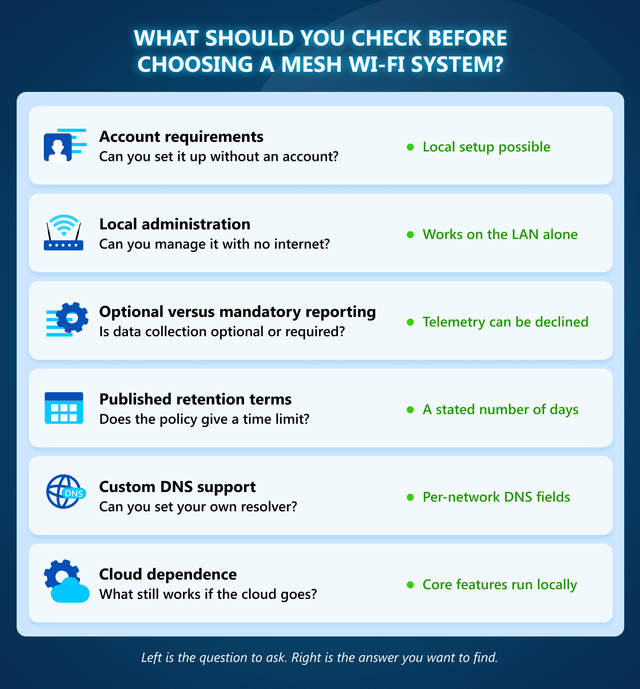
App-managed mesh systems don’t necessarily operate entirely inside your home.
Depending on the product and enabled features, they may exchange account details, connected-device information, network status, settings, usage statistics and diagnostic data with a cloud service.
That doesn’t mean the manufacturer receives every website request, message or download. Three different questions often get bundled together:
- What can the router observe?
- What does it record?
- What does it upload?
A router can observe information without storing it. It can store records locally without uploading them. And cloud management doesn’t automatically mean ordinary browsing traffic is routed through the manufacturer’s servers.
The privacy picture can change when you enable features such as parental controls, threat filtering or historical activity reports. These may need to process DNS requests and other network metadata to classify or block domains.
Even basic telemetry can reveal more than it first appears. Device identities, connection times and data volumes may indicate when someone arrives home, which devices are active or when a security camera goes offline.
A few things worth checking:
- Analytics and diagnostic settings
- Parental controls and security reports
- Remote management
- Cloud backups
- The configured DNS provider
- Whether settings changed after an update
Deleting the management app or factory-resetting the hardware may not delete information already associated with your cloud account.
A VPN can hide destinations inside its tunnel, but it can’t hide a connected device from the mesh system or prevent the router from sending its own operational telemetry.
Which mesh system do you use, and how much control does it give you over cloud features?
https://i.redd.it/y5wmxgget2qh1.png
Source: r/hidemeVPN · by /u/hidemevpn