On the cover of its latest edition, The Economist promises to uncover “the truth and the lies” about “Islam in Europe.” The story it presents is, for the magazine’s readership, a reassuring one: a crisis of two extreme fringes fighting across a sensible middle. But this is a false framing that betrays the complexity of Islam in Europe it promises to untangle, just when honest understanding is urgently needed. Allow me to explain why.
The editors offer a soothing symmetry: on one side, a small minority of Islamist extremists; on the other, a small minority of far-right extremists. “Islam poses no serious danger,” declares the accompanying editorial. “But Islamism and the fear of Islam do.” Both are dangerous. Both must be resisted. In this formulation, the vast majority of Muslims and the vast majority of native Europeans are peaceable people caught between two fringes. The task of the responsible commentator is to condemn both fringes with equal force, while warning against the temptation to blame whole communities for the actions of its extremists. This is presented as the fair, balanced, and non-paranoid position, making The Economist the sober grown-up in the room who refuses to be drawn into the ugliness of either side.
Unfortunately, that symmetry does not reflect reality, and by insisting on it, The Economist puts its elite readers in a box and discourages them from looking beyond it. Consider what would have to be true for the symmetry to hold. There would have to be, on the European far right, a creedal architecture of comparable depth to Islamic scripture and tradition: a body of texts venerated by a fourth of humanity, taught in seminaries across dozens of countries, printed in hundreds of millions of copies, and read by every serious adherent of the faith as an authoritative source of guidance. There is not. The European far right has no scripture. It has memes, manifestos, a handful of self-published tracts, and a scattering of ideologues who cite one another. It has no holy book or equivalent of the Sahih al-Bukhari and Sahih Muslim hadiths. It has no equivalent of the four Sunni legal schools. It has no equivalent of a 1,400-year-old exegetical tradition.
There would have to be a recruitment base of comparable size. On the Islamist side, the recruiting field is the young men of a global community of about two billion people, of whom the middle classes alone number in the hundreds of millions, all of them potentially reachable through mosques, Quran schools, satellite channels, and university Islamic societies that exist in every European city. On the far-right side, the recruiting field is a scattering of subcultures made up of football-hooligan networks, online gaming communities, and obscure political parties that have never, in any European country, produced a mass following since the 1930s. They are aggressively policed by every European state, security service, employer, and mainstream media outlet. The two recruiting fields are not remotely comparable.
There would have to be money of comparable scale. The Islamist infrastructure has been resourced, for 50 years, by well over an estimated $75 billion to $100 billion of Gulf state and private funding. It builds mosques by the thousand. It funds television channels, publishing houses, university chairs, and international NGOs. On the far-right side there is no equivalent. There is no state sponsor. There is no oil-money endowment. There is no global charitable network moving hundreds of millions of dollars a year through legitimate financial channels. The most notorious far-right groups in Europe run on subscription fees, small and medium-sized donations. The difference is not one of degree but of orders of magnitude.
There would have to be state power behind it. The Islamist current has, in Iran, an entire state built on its logic, with a foreign policy dedicated to its export, and a proxy network across four countries. It has, in Qatar and Turkey, two states that use their diplomatic, financial, and media apparatus to support the movement globally. It has, in Saudi Arabia, a state that spent decades exporting the doctrine and that even now, under a modernizing crown prince, still funds a religious establishment shot through with it. It has the Organization of Islamic Cooperation, a bloc of 57 states that consistently defends the movement’s political priorities at the United Nations. There is no equivalent on the European far-right side, for all that the Russian state may stoke its aspirations, and even fund them on occasion. The occasional friendly gesture from Moscow does not close a gap of this size created by states that finance Islamist networks and provide them with diplomatic cover, media platforms, and theological warrant.
There would have to be a comparable operational history. The Islamic movement we now call “Islamist” has produced, in the last quarter-century alone, September 11, 2001; the Madrid bombings; the London Tube bombings; the Charlie Hebdo massacre; October 7, 2023; the attacks in Nice, Berlin, Manchester, Brussels, Vienna, and the Bataclan theater in Paris; and hundreds of smaller attacks across Europe. It has produced, in the same period, the rise and territorial conquests of ISIS, the Syrian jihad, the Iraqi insurgency, the Nigerian insurgency, the Sahel insurgency, the Somalia insurgency, and the ongoing armed campaigns in Afghanistan, Pakistan, Kashmir, the Philippines, and the Caucasus. The European far right, over the same period, has produced the rampages of Anders Breivik and Brenton Tarrant, a handful of genuine lone-wolf shootings, and a series of failed or infiltrated plots. Every one of those acts was real, criminal, and rightly prosecuted. But to place them on the same civilizational scale as the campaign that produced the other list is not balance.
And, most tellingly, there would have to be a comparable count of displaced human beings as a consequence of European far-right militancy. In the 21st century there is not. Consider only those uprooted by identifiably Islamist militant forces, setting aside every civil conflict in which the attribution is mixed or contested. The Taliban’s return to Kabul in August 2021 produced an estimated 3.2 million internally displaced Afghans and millions more in flight abroad, on top of the displacement generated by the earlier Taliban insurgency. In August 2014, the so-called Islamic State’s assault on the Yazidis of Sinjar, Iraq, drove some 400,000 people from their homes, murdered more than 5,000 men and older women, and enslaved over 6,000 women and children, of whom nearly 2,800 are still missing; the campaign has been declared a genocide by the United Nations (in one of its saner moments) and the United States government. ISIS’s broader conquests in Iraq between 2014 and 2017 displaced approximately six million further people, including the Assyrian and Chaldean Christian populations of the Nineveh Plains. The Iraqi Christian community fell from roughly 1.5 million before 2003 to fewer than 250,000 today, a collapse driven principally by al-Qaeda in Iraq, its ISIS successor, and the sectarian militias that filled the security vacuum. In sub-Saharan Africa, the Boko Haram insurgency around Lake Chad has displaced over three million people across Nigeria, Cameroon, Niger, and Chad; al-Qaeda and Islamic State affiliates in the Sahel have displaced roughly three million more across Mali, Burkina Faso, and Niger; al-Shabaab has driven several million more within and out of Somalia over two decades. In South Asia, the campaigns of the Pakistani Taliban, Lashkar-e-Taiba, and allied groups have generated further millions of displaced. The narrow record—that is, counting only those displaced by named Islamist militant organizations—runs comfortably into the tens of millions in the 21st century alone. The corresponding data for victims of European far-right militancy over the same period runs, at the outer estimate, into low four figures: those killed by Breivik, Tarrant and a scatter of lone gunmen.
And there is one final asymmetry, the one that ought to settle the matter once and for all. There is no flight from Europe by anyone—no community, no religious minority, no ethnic group, no political tendency—as a consequence of European far-right violence. No Muslims, no Jews, no atheists, no ex-Muslims, no gay men and women are packing suitcases in Frankfurt or Manchester or Marseille and applying for asylum in Cairo or Islamabad or Algiers because European far-right militants have made their lives untenable at home. The traffic runs, on a massive scale, in the opposite direction, and it has run in the opposite direction for two generations. Muslims, Christians, Yezidis, Baha’is, Ahmadiyyas, ex-Muslims, secularists, feminists, gay men and women, and religious minorities of every description are leaving the Muslim-majority world in millions, and they are coming to Europe and the rest of the West. They come because Europe, whatever else it is, is not governed by the doctrinal architecture they are fleeing. The presence of a European far right that occasionally shouts at them, or, at the violent extreme, produces a Breivik or a Tarrant, has not slowed the movement at all. If the two extremisms were symmetrical, the flow would also be symmetrical. It is not even close. The direction of migration by itself—that is, the votes of feet cast in their tens of millions by the very people who know both worlds—is a stronger empirical statement about the relative danger of the two phenomena than any Home Office report, academic study, or half-baked media essay will ever be.
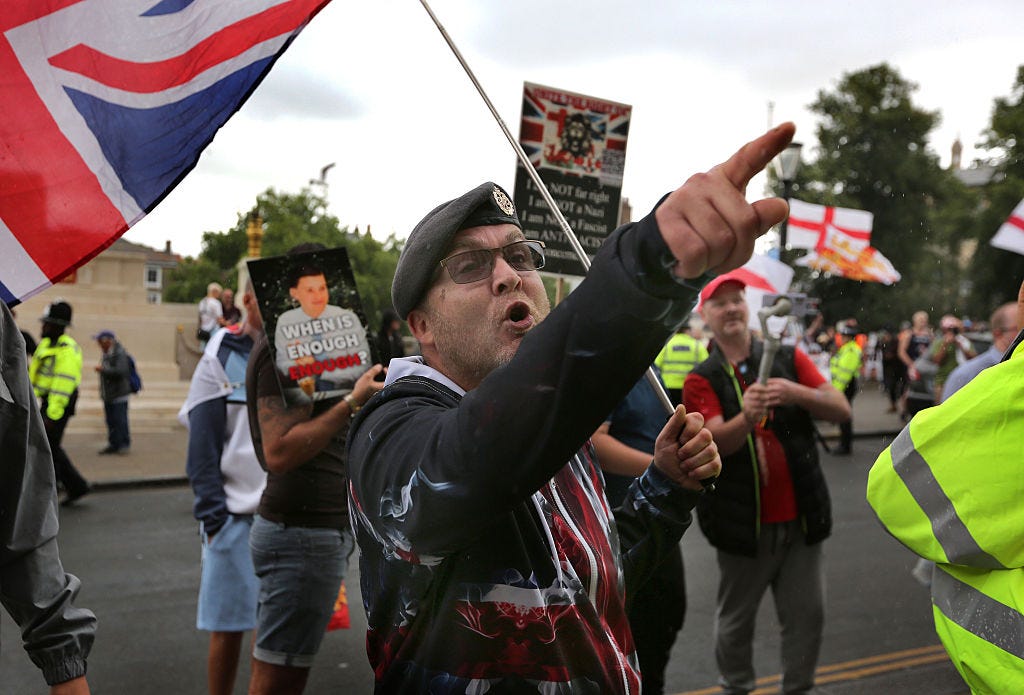
Pro-deportation protesters argue with opponents during a “March for Remigration” on July 18, 2026 in Norwich, England. (Martin Pope/Getty Images)
The Economist would not have written, in 1935, that the Comintern and the League for the Prohibition of Cruel Sports were symmetrical extremisms requiring equal vigilance. It would not write today that the Chinese Communist Party and the Falun Gong are symmetrical authoritarianisms. In every other domain, this magazine understands that variables such as scale, state sponsorship, and institutional depth matter; that a movement with a coherent multigenerational strategy is not the same kind of thing as a collection of aggrieved amateurs. On this subject, uniquely, the analytical standards slip. It is worth asking why.
The answer, I suspect, is that the movement itself has spent decades constructing the very framework within which the Economist editorial was written. Its second prong, after the doctrinal one and before the militant one, is a soft-power infrastructure of charities, NGOs, media relations, lobbyists, legal-defense funds, and university programs whose principal purpose is to ensure that any serious criticism of the movement can be immediately reframed as Islamophobia against Muslims as a whole. The Economist delivers that framing on a plate.
Getting the description right does not license bigotry against ordinary Muslims. It does the opposite. It takes seriously the reformers, the ex-Muslims, the feminists, the secular Arabs, the Iranian women’s-rights campaigners, the Bangladeshi bloggers, the reforming imams in Marseille and Rotterdam, the North African novelists—all the people who have been telling us in perfectly clear language for decades that the problem is not two symmetrical extremisms but one organized movement that dominates the battlefield of ideas within various Muslim communities.
Let me be concrete about what those brave reformers and ex-Muslims have been trying to tell us.
Take antisemitism. The Community Security Trust recorded 924 antisemitic incidents in the United Kingdom in 2015. It recorded 3,700 in 2025: a fourfold rise in 10 years, and the second-highest annual total in the Trust’s history, exceeded only by the 4,298 incidents of 2023. Across Europe, the European Union Agency for Fundamental Rights survey of 2024 found that 96 percent of Jewish respondents had encountered antisemitism online or offline in the 12 months before the survey, and that 76 percent avoided wearing or displaying items that would make them recognizable as Jewish in public. On the ideological source of the antisemitism they had personally experienced, European Jews named Islamist extremist views as the perpetrator profile in 30 percent of harassment cases and around 50 percent of physical attacks. Right-wing extremist views accounted for about 20 percent of harassment and 17 percent of physical attacks; left-wing views for about 20 percent of harassment and 22 percent of physical attacks. Islamist views were the largest identified category for both, and the dominant category for physical violence by a factor of roughly three. The Economist’s readers will not have learned these proportions from their leader.
Take the safety of women and girls. In the UK, Baroness Casey’s National Audit on Group-based Child Sexual Exploitation and Abuse, commissioned by the prime minister and home secretary in January 2025 and published on June 16, 2025, found that perpetrator ethnicity had been actively “shied away from” by police, local authorities, and previous inquiries; that ethnicity was unrecorded in about two-thirds of cases; and that the true scale of offending cannot be estimated with confidence because of the underlying failures of data collection.
Researchers estimate about one in five British Muslims hold Islamist sympathies, according to The Economist’s own reporters. (Matthew Chattle/Future Publishing via Getty Images)
The audit was published in the same week as the independent Rape Gang Inquiry Report, a privately funded 219-page document commissioned by the Restore Britain party under Rupert Lowe. That inquiry documented grooming-gang activity in at least 149 local authority areas, roughly two in every five in the United Kingdom. It rested its central quantitative claim on published academic work rather than extrapolation: The Quilliam Foundation’s 2017 analysis of 264 convictions for group-based child sexual exploitation between 2005 and 2017 found that 84 percent of offenders were of South Asian heritage, the vast majority Pakistani Muslim, 7 percent white, and 8 percent black. An independent researcher’s compilation of grooming-gang convictions from 1997 to 2018, drawn from published court outcomes, put the proportion of the convicted bearing “distinctively Muslim names” at approximately 87 percent. Muslims are 6.5 percent of the population of England and Wales; Pakistanis are around 2.7 percent.
The overrepresentation is not marginal, and the state’s own security apparatus is now acting on it: Following the National Crime Agency’s Operation Beaconport, eight police forces have been instructed to reopen historic grooming-gang investigations, and the first batch of previously closed cases was returned to police in 2026 after reviewers identified missed lines of inquiry. Officials suppressed this pattern for years because they were frightened of exactly the reputational costs the Economist leader is still tiptoeing around.
Alongside this sit the femicide-in-the-name-of-honor cases that appear on coroners’ rolls in every large European city with a significant Muslim population, and cousin-marriage rates in some British Pakistani-heritage communities that remain multiples of the national norm, with the associated genetic morbidities that the National Health Service has been quietly documenting for two decades.
Take gay men and women in the affected communities. They live, in the second generation, under a discipline their parents had begun to relax, as the return-to-piety movement of the late 20th and early 21st centuries reimposed classical rulings that many Muslim had informally set aside.
One of the largest surveys of British Muslim attitudes, the 2016 ICM/Channel 4 poll of a nationally representative sample of 1,081 Muslims, found that 52 percent thought homosexuality should be illegal in Britain. On the same survey, 39 percent of respondents agreed that “wives should always obey their husbands,” 31 percent thought it was acceptable for a British Muslim man to have more than one wife, and 23 percent supported the introduction of sharia law in some parts of the country.
And take The Economist’s own polling, which is the part of its cover package that ought to have determined the tone of the leader and did not. The magazine commissioned a survey of British Muslims for this issue. It found that 33 percent believe Islamic principles should guide public life, laws, politics, and government; that 29 percent would give sharia some role in British law; that 20 percent think Islamic teaching should prevail over the law of the land where the two conflict; that 32 percent consider violence justifiable against those who insult the Prophet Muhammad, a proportion that rises to 41 percent among Muslims under 35 and falls to 25 percent among their elders; that 52 percent think homosexuality is wrong; and that 76 percent want the deliberate damaging of a religious text to be a criminal offense.
The Economist’s own reporters record that counter-extremism researchers estimate about one British Muslim in five to hold Islamist sympathies. As mentioned, British Muslims are 6.5 percent of the population of England and Wales. One in five of that share is approximately 1.3 percent of the general public, that is, some 775,000 people. The Economist editorial was titled “The Good News: Few Muslims Want to Subvert European Democracy.” I do not know what the word “few” means in the editorial vocabulary of this magazine, but it does not, in ordinary English, mean 775,000. If another poll commissioned by The Economist had found that 775,000 members of any other identifiable British community were committed to imposing a legal order incompatible with liberal democracy, that finding would not have been casually labeled “good news.”
That the same figure attracts a reassuring headline when the community is Muslim is not evidence of editorial calm. Whether it is the racism of low expectations, the intended outcome of pressure from the Islamic movement, the unintended consequences of a once well-meaning multiculturalism, or a tangle of factors, it is evidence of our failure to address the challenge before us.
Take ex-Muslims. Apostasy, in the classical vocabulary of Sunni jurisprudence, carries the death penalty; every one of the four Sunni schools of law is on record to this effect. In modern Europe, the sentence is not carried out by the state, but the social sentence is severe. The Council of Ex-Muslims of Britain, founded in 2007, gives many of its members pseudonyms because they cannot show their faces without risk. Its founder, Maryam Namazie, has lived under continuous protection for years. The number of Europeans who have quietly left Islam is, by every credible estimate, in the millions; the number who feel safe enough to say so publicly is a small fraction of that. Any other confessional community subjected to the same treatment would surely command The Economist’s attention. These are Europeans. The Economist is failing the very community it purports to serve.
The doctrinal current The Economist minimizes is not a fringe. It is a confident, literate, professionally successful movement that has captured a great deal of the institutional apparatus catechizing the next generation. It has been telling that generation, in perfectly clear terms and with perfectly authentic textual citations, that Islam must conquer the world, that Jews are the most hostile of humanity to the believers and must be exterminated, that women are subordinate by divine decree, that apostasy is treason against the community, and that homosexuality is a crime against nature and God. These teachings are drawn from canonical texts: the Quran, Muhammad al-Bukhārī, Sahih Muslim, the classical commentaries, the fatwa of the most venerated jurists. The movement’s operational genius is that it does not distort the sources. It cites them. The so-called mainstream scholarship spends its time explaining that the sources do not mean what they plainly say, and every young Muslim who reads them for himself can see that this “mainstream” is doing visible interpretive labor while the literalist is only pointing. In a tradition that venerates submission to the text, the pointer wins that argument.
The effective counterstrategy is not, as The Economist implies, more interfaith dialogue and firmer condemnation of the far right. It begins with the courageous efforts that a small number of Muslim reformers have made, at great cost to themselves: people such as Faraj Fūda, assassinated in Cairo in 1992; Maḥmūd Muḥammad Ṭāhā, hanged in Khartoum in 1985; Nasr Hamid Abu Zayd, forced into exile from Egypt in 1995 and dead in 2010; Khaled Abou El Fadl at UCLA; Namazie in London; and others. It is their efforts to reform their faith, to emphasize interpretation over a literal application of holy texts that, however authentic, make demands no God worth worshipping would command, and their right to argue for reform, that need support. This is the argument that has to be made, because it is the only argument that respects the intelligence of the young Muslim who has read the sources and drawn the plain conclusion. It is also the argument that the Western commentariat, including The Economist, has consistently declined to support.
If the trouble with Islam is doctrinal, then the pretense of two symmetrical extremisms participates in the very evasion “mainstream” Muslim scholarship has been performing for multiple generations. It not only falsifies the nature of the crisis, it grants a false equivalence the imprimatur of The Economist, and enshrines it in the language of liberalism.

https://www.thefp.com/p/ayaan-hirsi-ali-the-lie-about-islam
Source: r/neoconNWO · by /u/Reddenbawker