For context, I speak Portuguese and English natively, so I definitely had an advantage going into French. Portuguese helped a lot with the grammar, verb tenses and general structure, while English helped with a ridiculous amount of shared vocabulary.
Still, when I started learning French on 30 July 2025, I did not speak French.
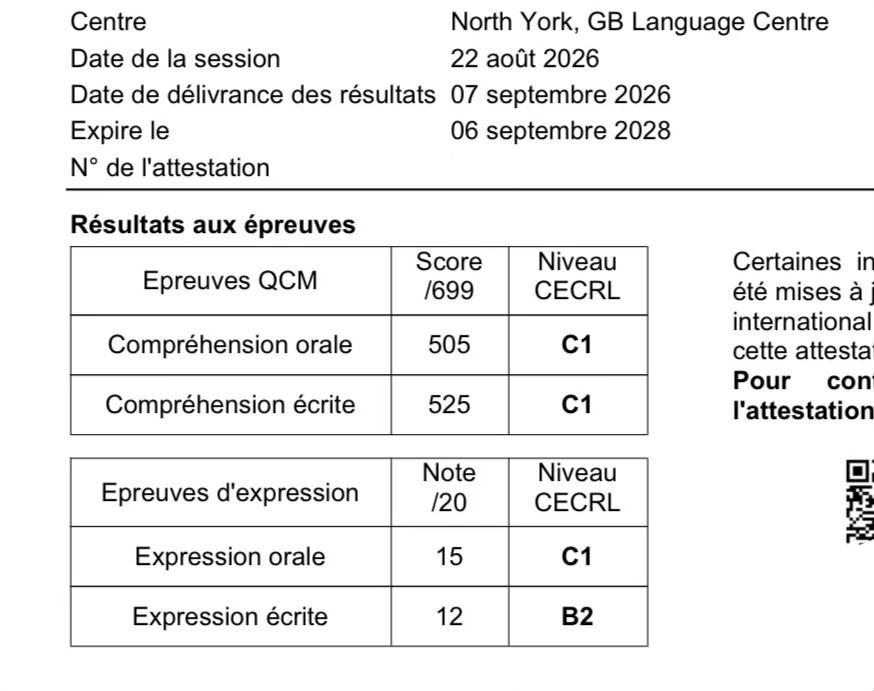
My last proper day of studying before the exam was 21 August 2026, exactly 387 days later. I wrote the TCF Canada the following morning.
My results were:
Listening: 505/699, C1
Reading: 525/699, C1
Speaking: 15/20, C1
Writing: 12/20, B2
I thought I would write this because when I started, I spent a lot of time reading posts like this and trying to figure out what actually worked for other people.
I am not saying this is the perfect method, but this is basically everything I did to the best of my ability, as to what I can recall.
How I started
One of my friends at the gym recommended an online French school to me. I ended up taking classes five days a week, going through roughly A1 to B2 for roughly 8 months.
I am deliberately not naming the school because I wouldn't recommend it. I had quite a few issues with it.
What it did give me, though, was structure.
At the beginning, I wanted someone to take me through the basics properly: introductions, numbers, days, everyday vocabulary, present tense, passé composé, imparfait, pronouns, conditionnel, subjonctif, etc.
But I realised pretty quickly that taking a course was never going to be enough on its own. Most of my actual progress started happening outside the classroom.
I had to give myself a reason to actually like French
My original motivation was practical. I live in Canada, and French was extremely useful for my immigration goals.
The problem is that “I need to pass an exam” is a pretty miserable reason to spend hundreds or thousands of hours with a language (at least for me that is).
So I deliberately started connecting French to things I already cared about.
I'm Catholic, so one of the biggest things for me was incorporating French into my faith. I listened to The Bible in a Year in French, learned prayers like the Notre Père and Je vous salue Marie, watched French priests and theological content, and eventually started reading more religious material in French.
Obviously, that exact example won't apply to everybody. The point is to find your thing.
If you like football, watch football in French. If you like politics, watch political content. If you like cooking, find French cooking channels. If you like gaming, watch French gaming videos.
French became much easier once it stopped being a subject I had to study and started becoming a language through which I could do things I already enjoyed.
Start listening and speaking much earlier than you think you should
One resource I wish I had taken even more seriously from the beginning is Pimsleur.
It is subscription-based, and the full French programme is around 150 daily lessons. What I liked about it is that it forces you to speak out loud very early, which matters because speaking is partly a motor skill. You cannot spend eight months silently studying grammar and expect your mouth to suddenly know how to produce French.
It also exposed me to vocabulary and grammatical structures before I necessarily understood the explanation behind them.
I remember hearing things like il fallait que tu fasses… before I had properly studied the subjunctive. At the time, I didn't completely understand why fasses was being used there, but I had already heard the structure and started getting used to how it sounded.
Later, when I formally learned the subjunctive, it wasn't completely foreign anymore.
That happened quite a lot with Pimsleur. I would hear a word, expression or structure there and then encounter it weeks or months later in my classes. That familiarity made it much easier to learn properly when the time came.
For listening specifically, I would also recommend InnerFrench Podcast extremely early.
Start with the older episodes because Hugo speaks more slowly and clearly, and the difficulty gradually increases. I made it to around episode 39 before it started feeling a little too slow for me, and at that point, I began moving more towards native content.
But InnerFrench was a great bridge at the beginning because it taught my ears to actually follow longer stretches of spoken French without needing everything translated.
The general philosophy behind it also became a huge part of how I learned French: listen to enough understandable French that eventually you stop feeling like you're “studying French” every time you hear it.
Easy French is ridiculously good
If I had to recommend one YouTube channel to basically everybody learning French, it would probably be Easy French.
Beginner, intermediate, advanced, it doesn't really matter.
They interview actual people and cover everyday subjects, French culture, habits, food, life in Paris, the countryside, social issues and dozens of other topics. You also get French and English subtitles.
That combination is incredibly useful because you're hearing how actual people speak rather than listening exclusively to perfectly clean textbook French.
Once I reached around B1, I started moving much more aggressively into native content.
I watched things like Les 7 vies de Léa, Les Papillons noirs, Nouvelle École (Rhythm n Flow) and other French Netflix content. Dix pour cent is another obvious one.
I barely watch television normally, so I wasn't watching five hours of Netflix every night. The point was simply that when I did watch something, I increasingly tried to make it French.
I also used RFI's Journal en français facile, which is great because you get real international news in more accessible French, with transcripts available as well.
Eventually, YouTube itself starts helping you.
Once you watch enough French content, your recommendations gradually become French, and suddenly you're listening to videos about la pédagogie, economics, history, social issues or completely random subjects you probably never would have searched for in English.
That's actually a good thing.
At some point, you stop constantly looking for “French-learning content” and just start using French to consume content you find interesting.
Follow the rabbit holes. That is where a lot of the real listening improvement starts happening.
Anki. Every Single Day!
This is probably the least exciting advice in this entire post, but:
Use Anki.
I used a deck based on the 5,000 most common French words, and I did my reviews basically every day.
Words, sentences, verb forms, conjugations, expressions, whatever I needed.
The spaced repetition adds up enormously over a year.
I used conjugation tables so much that even now, if I hesitate when conjugating something, I can sometimes literally visualise the table in my head.
It isn't glamorous. It works.
Reading
I actually didn't read as many normal French books as people might expect.
I read parts of Le Petit Prince and got bored, so I never finished it.
I did, however, read the Bible and other material connected to my faith.
For learners specifically, two books I really liked were Short Stories in French for Beginners by Olly Richards and Richard Simcott, which is aimed roughly at A2-B1, and Short Stories in French for Intermediate Learners by Olly Richards, aimed at B1-B2.
I would read while also using the audiobook.
That gives you the text, pronunciation, rhythm and intonation together. You can also pause and shadow the narrator.
Work on pronunciation early
I think people underestimate this.
At the beginning, I almost intentionally exaggerated the French accent.
Yes, you will probably sound ridiculous, and that's ok.
You're training your mouth to make sounds it isn't used to making.
French has vowel distinctions, nasal vowels, the French R, liaison, reductions and rhythm that are very different from English but somewhat similar to Portuguese.
I also paid close attention to spelling. Things like é versus è, for example, started helping me anticipate how certain vowels would sound.
If I encountered a new word, I tried to actually say it, not just recognise it on a screen.
végétarien
préférer
je préfère
Over time, you start noticing patterns instead of treating every word as an isolated pronunciation problem.
Shadow native speakers too. Listen to a sentence, pause it and imitate it. Not only the words. Copy the rhythm, speed, stress and intonation.
You don't need to magically “have a French accent”. You need to train your pronunciation enough that speaking French physically feels natural.
Tutors were worth the money
Once my structured classes were coming to an end, I started working more seriously with private tutors.
Around March, roughly five months before the exam, I started working with a Brazilian tutor who speaks Portuguese and French.
Around two months before the exam, I started working with another tutor from Paris on italki while still working with the aforementioned tutor. On average, I was taking two classes with the first and 1-2 with the French one, so 3-4 classes a week max with self-study covering the rest + passive learning.
In the final stretch (last two to three weeks), I also worked with someone who could speak Portuguese, English and French on Preply.
That combination worked extremely well for me because different tutors noticed different things.
One might catch a grammar problem. Another might immediately hear something unnatural in my pronunciation. Another might tell me that something is grammatically correct but simply isn't how a French person would normally say it.
Don't be afraid to try tutors and stop working with one if the fit isn't right.
A good tutor shouldn't just sit there chatting with you for an hour. I wanted corrections.
Correct my pronunciation. Correct my conjugation. Tell me when my sentence sounds translated. Interrupt me if I keep repeating the same error.
That's what I was paying for.
My daily exposure mattered more than any single resource
I think this was probably the most important part of the whole thing.
French was just… there.
Going to the gym? French podcast.
Walking somewhere? French.
YouTube? Increasingly French.
Reading something? French.
Prayer? French could be involved.
Studying grammar? French.
Talking to ChatGPT? French.
Tutor later that day? French.
At first, this is exhausting.
Your brain is working much harder because nothing is automatic. Listening to a podcast while training at the gym can genuinely become annoying because you just want to switch your brain off.
Keep doing it.
Eventually, something strange happens. Your brain stops treating French as an emergency.
You stop translating every sentence. Then you stop noticing that you're listening to French at all.
The less consistently you expose yourself to the language, the harder it feels every time you return to it.
ChatGPT became one of my best study tools
This made a massive difference, especially with writing (I use GPT Plus btw)
Because I speak English and Portuguese, if I didn't understand a French construction, I could ask for the explanation through either language.
I could ask:
“Why is the subjunctive required here?”
“Explain this to me using the Portuguese equivalent.”
“Why can I use the imparfait here but not the passé composé?”
“Does this sentence sound French or translated?”
That was incredibly useful.
For TCF writing practice, I would take an actual prompt, write my answer myself, and then ask ChatGPT to grade it strictly, identify every error and explain the corrections.
Then I would often ask for two rewrites:
A solid B2 version of what I was trying to say, and then a more sophisticated C1 version.
That helped because I wasn't just being handed some completely unrelated model essay. I could see how my own ideas could have been expressed more naturally.
Over time, I started stealing useful structures from those corrections and actually using them myself: cependant, au lieu de, tandis que, afin que, bien que, il faut que, more natural relative clauses, better transitions, etc.
I normally did at least one writing task rather than forcing myself to write a complete three-task exam every day.
One day I might do Tâche 1 and 2. The next day, Tâche 3. Sometimes I did the entire thing.
One important warning, though: I would not blindly trust an AI-generated TCF score.
Use it for correction, grammar, vocabulary, comparison and feedback. Your actual score comes from the examiners.
My AI practice scores sometimes looked higher than the B2 I ultimately received in writing.
I also used voice conversations for speaking practice
As GPT Voice AI got better (the new live mode AI), I started using it more for spontaneous French conversations.
I'd tell it to speak naturally in European French, keep the conversation going, and correct me when I made mistakes.
That was useful when I didn't have a tutor available or simply didn't feel like finding another human being to talk to.
But I would still prioritise actual humans whenever possible.
I occasionally spoke French with Francophone friends and also joined the r/French Discord a few times.
Most of my serious oral practice, though, came from tutors, speaking out loud by myself, shadowing and even praying aloud.
About five months before the TCF, I started preparing specifically for the exam
This is where I think people sometimes confuse two separate things.
Learning French and learning the TCF are not the same thing.
You need both.
I used online TCF practice banks for listening and reading.
When I first started doing these tests, I was sometimes getting results around A2-B1.
By the time I had gone through a large number of them, I was usually around B2-C1, occasionally even getting a C2 result on a practice set.
Part of that was obviously my French improving.
But another part was simply learning the exam.
You start understanding the rhythm. You stop panicking when you miss something. You learn how the questions are constructed. You get better at identifying what information actually matters.
Do not just memorise answers.
I recognised a few things on my real exam, but nowhere near enough that memorisation would have saved me.
Your actual comprehension needs to be there.
Speaking was the part I prepared for most carefully
For Tâche 1, obviously prepare your introduction.
But don't memorise some two-minute monologue and assume you're finished.
My examiner immediately started pulling things out of what I had said and asking follow-up questions about my work, an upcoming professional project and my hobbies.
It needs to feel like a conversation.
Tâche 2
For Tâche 2, you do get two minutes of preparation time, but even when I practised with tutors, I would usually tell them that I didn't want to use it.
I personally speak better when I just get into the conversation and react naturally. If I sit there trying to prepare 8–10 questions in advance, I start thinking too much about what I am “supposed” to say instead of actually listening to the person in front of me.
That is obviously very personal. If you need the two minutes to organise yourself, use them. I am definitely not saying everyone should walk in with nothing prepared. I just found that I was much more spontaneous and fluid when I winged it.
Even on the actual exam, I barely used the preparation time. I looked at the sheet and wrote down maybe two things. One was basically a reminder to use vous, since the examiner was playing the role of my neighbour, and I think I wrote down part of my opening question. That was pretty much it.
My scenario was essentially: « Votre ami est végétarien et va bientôt venir au Canada. Posez des questions à votre voisin pour obtenir des renseignements utiles pour lui. »
From there, I just started talking.
I started with the obvious things: vegetarian restaurants, prices, where my friend could buy vegetarian products and what kinds of options were available.
But instead of treating it like a checklist, I reacted to what the examiner was actually saying.
That is how we ended up talking about things like organic food, pesticides and food quality. I also asked about meat substitutes, basically la fausse viande, and whether allergies could be an issue since I said my friend was allergic to peanuts, les cacahuètes.
Those were not questions I had planned beforehand. They came out of the conversation.
That is the main thing I would recommend for Tâche 2: listen to the answer you are being given and use it to create your next question.
I probably only asked five or six proper questions, but the exchange felt like an actual conversation rather than an interrogation.
I also used little structures to frame questions naturally, something along the lines of:
Pour que je puisse mieux comprendre la situation… pourriez-vous me dire… ?
But again, the point is not to memorise that exact sentence. It is to have enough language available that you can react, reformulate and keep the conversation moving.
In my case, it actually became so continuous that I never really got to do the neat formal ending I had imagined. The conversation just kept going until the examiner had to stop me because the time was up.
And honestly, I think that is a better problem to have than running out of things to say.
Tâche 3
Tâche 3 was actually my favourite.
My topic was: « Aujourd’hui, plusieurs personnes changent souvent de téléphone portable. Qu’en pensez-vous ? »
I didn't just jump straight into « je pense que… ». I tried to give the answer a bit of structure first.
I opened by presenting the two sides of the issue, roughly along the lines of:
D’un côté, certaines personnes pensent qu’il est normal de changer régulièrement de téléphone portable, notamment en raison du progrès technologique et des nouvelles fonctionnalités.
D’un autre côté, on peut se demander s’il est vraiment nécessaire de remplacer un téléphone qui fonctionne encore parfaitement.
Then I transitioned into my own position:
Je vais donc vous présenter mon point de vue sur cette question.
From there, I started developing the argument more naturally.
I said something along the lines of:
Nous sommes dans l’ère de la technologie et des réseaux sociaux…
and developed that into the fact that technology is constantly evolving, new phones are constantly being released, and people are repeatedly exposed to new products through advertising and social media.
After I made that first point, the examiner actually interrupted with an example of her own. She said something roughly like:
« J’ai récemment vu un article qui disait que certaines personnes qui avaient acheté l’iPhone 17 ont ensuite acheté l’iPhone 18 dès sa sortie. Vous ne trouvez pas cela un peu bizarre ? »
And I responded:
« Oui, je dirais que oui, mais on peut comprendre pourquoi. »
From there, I tried to nuance the answer rather than just saying that people were wasting money.
For example, I brought up photography. I said that for someone working dans le domaine de la photographie, or someone who genuinely relies on camera quality, upgrading could make more sense.
I said something along the lines of:
Comme je viens de le dire, les téléphones portables d’aujourd’hui sont extrêmement puissants. Nous sommes dans l’ère de la technologie et il y a constamment de nouveaux développements. Dans certains domaines, comme la photographie par exemple, les améliorations peuvent donc avoir une vraie utilité.
That helped me move into a more balanced argument. Yes, replacing a perfectly good phone every year can seem excessive, but there are also situations where technological improvements genuinely matter depending on how someone uses the device.
Then I moved into the other side of the issue: consumer behaviour and novelty.
Part of my argument was that people are not necessarily buying a new phone because they genuinely need one, but because there is a certain satisfaction attached to getting something new.
That is where I started talking about the feeling of novelty and even dopamine, basically the idea that buying a new product can create a short-term feeling of satisfaction that encourages people to keep consuming.
I also talked about the value we give to new products and the way social media and technology can constantly make us feel like what we already have is outdated.
The examiner would occasionally intervene like this, and I would respond to what she said rather than just continuing with a memorised speech.
That was one of the reasons I liked Tâche 3. Once I had the initial structure in my head, I could actually have a proper discussion around the topic.
Towards the end, I brought everything back to the idea of finding a juste milieu between technological progress and unnecessary consumption.
My conclusion was roughly:
Il faut donc que nous trouvions un juste milieu entre la valeur réelle d'un téléphone portable et l'envie d'acheter constamment de nouveaux produits pour rechercher cette sensation de nouveauté ou de dopamine. Cependant, trouver ce juste milieu est bien plus difficile qu'on ne le pense. Nous devons donc faire des efforts pour y parvenir.
What I actually got on the writing exam
Tâche 1 was basically writing to a friend who was coming to celebrate your wedding and couldn't find the location. You had to explain where the wedding was and give the necessary information.
Tâche 2 was almost hilariously appropriate for me.
I had to write about my experience learning a foreign language: how I learned it, my journey, difficulties, etc.
So yes, I spent a year learning French and then the TCF asked me to write about learning French.
Tâche 3 had two documents related to cooking and becoming a professional chef. One discussed amateur cooks/food bloggers and the idea that professional training is necessary. The other discussed a group of cooks in Belgium exchanging ideas or recipes, with one becoming successful online.
You had to summarise the positions and then give your opinion, like normal TCF Tâche 3.
I got 12/20, B2.
I actually knew immediately after the exam that writing was probably going to be my lowest score. I was exhausted, running on about three hours of sleep, and in Tâche 2 I focused so much on telling my language-learning story that I didn't develop one part of the instruction as well as I should have, which was to explain why people should learn a new language.
So the B2 didn't surprise me too much.
I barely slept before the exam
This is the part I absolutely do not recommend copying.
I think I slept around three hours.
I was extremely nervous.
After spending more than a year preparing, knowing that the next few hours were going to determine whether all that work actually translated into the scores I needed was pretty intense.
But at that point there was nothing else to learn.
I prayed, walked in and did what I had spent the previous 387 days preparing to do.
And somehow I walked out with three C1s and a B2.
If I were starting again
I would speak earlier.
I would work on pronunciation earlier.
I would get a good tutor earlier.
I would use comprehensible input from the beginning instead of thinking I needed to “finish” grammar before consuming real French.
And I would stop worrying so much about understanding 100% of everything.
You don't need to know every word in a podcast for the podcast to be helping you.
You don't need to understand every joke in a show.
You don't need perfect grammar before opening your mouth.
The goal is to keep exposing your brain to enough French that what was once difficult eventually becomes boringly normal.
387 days later, I'm still learning French
Passing the TCF didn't make me feel like I had “finished” French.
If anything, it made me want to get better.
Now I'm continuing to shadow native speakers, watching more complicated French content, reading harder material, working on my pronunciation and trying to make my French more precise and natural.
There's a huge difference between getting a C1 score on an exam and having nothing left to learn.
I'm nowhere near the latter.
The biggest thing I learned over the past year is probably this:
Don't build your life around studying French. Build French into the life you already have.
If you can make the language part of the things you already read, watch, listen to, care about and do every day, consistency becomes much easier.
That was basically how I went from zero French on 30 July 2025 to these results 387 days later.
I'm sure I've forgotten a few things because I tried to compress more than a year into one post, but if anyone has questions about any part of the process, the TCF, resources, tutors, writing, speaking, pronunciation, etc., I'll try my best to answer.
https://i.redd.it/dplruaaww0ph1.jpeg
Source: r/learnfrench · by /u/9Gucci9