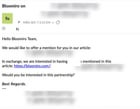
People are finding articles through AI answers, then emailing asking to collaborate, exchange mentions, or get their company added to the exact article they found.
Attached a few screenshots. Names, emails, domains, and anything identifying are blurred because there is no reason to expose anyone.
This was probably more convincing than seeing an AI visibility graph go up.
It is easy to look at AI citations as another SEO metric. Then someone finds an article through an AI answer, visits the site, and emails asking how they can get mentioned in that same article.
That makes it feel a lot more real.
For context, the site is Bloomiro, an AI visibility and Google Search platform.
The slightly funny part is that there was no magic "GEO strategy" behind this.
Believe it or not, most of the actual workflow was just chatting with AI using the site's own data.
Search Console, Google Analytics, and AI visibility data were connected, then the AI chat was used to ask pretty normal questions about the data.
Which pages are already getting a lot of impressions but not enough clicks?
How do I outrank competitors for this?
For the questions people might ask ChatGPT, which brands are showing up?
That was basically the process.
Most of this can be done manually. Bloomiro mostly makes the process faster because the SEO, analytics, and AI data can be explored together through chat.
If doing it manually, start with Search Console.
Don't immediately go looking for 100 new keywords to write 100 new articles.
Look at the pages already getting impressions and clicks. Then look at the actual queries bringing those impressions.
Which pages are growing? Which pages are sitting in positions where a few improvements could make a difference? Which pages are getting impressions for dozens of related queries that the article only partially answers?
That is usually a much better place to start.
Then look at the more specific searches around those topics.
Not because there is some magic rule that says AI always prefers exact-match long-tail keywords. There isn't.
The value of specific queries is that they tell you exactly what someone is trying to solve.
"Best running shoes 2026" is incredibly broad. Thousands of sites can answer it, and most of the answers will look almost identical.
"Best trail running shoes for women with wide feet training for their first 50K" is a completely different problem.
Now there is an opportunity to say something genuinely useful.
Maybe there are actual shoes that were tested. Maybe there are photos after 200km of use. Maybe there is a comparison of toe-box width, grip, weight, and how each shoe felt after a long run. Maybe there is an explanation of which shoe worked and which one didn't.
That is much harder to replace with another generic article.
Google's own guidance has actually moved pretty strongly in this direction too. It talks about creating "non-commodity" content and specifically gives first-hand experience as an example of something more useful than simply summarizing information already available everywhere else.
So when looking through Search Console, don't just think:
"How can this keyword appear more times on the page?"
Think:
"Why would anyone choose this page as the source?"
After finding a topic that already has some search demand, take the real questions around it and ask them in ChatGPT, Gemini, Google AI Mode, Perplexity, or whatever your audience is actually using.
Then ignore your own brand for a minute and study the answer.
What gets cited?
Open those pages.
Maybe it is a massive site ranking first on Google. But sometimes it is a much smaller, very specific page.
Look at what that page actually contributes.
Does it have first-hand experience?
Original research?
A useful table?
Actual numbers?
Screenshots?
A comparison nobody else made?
A very clear answer to one part of the question?
A primary source everyone else is referencing indirectly?
This is where SEO data and AI citations become pretty useful together.
Traditional search performance is not the same thing as getting cited by AI, but there is definitely overlap. Pages that already perform in search are a sensible place to investigate rather than starting from zero.
At the same time, ranking well does not guarantee the page will be cited. AI answers can pull from sources outside the obvious top results too.
So the process becomes less about "optimizing for AI" and more about finding gaps.
If three highly ranked articles all give basically the same answer, publishing a fourth version of the same thing probably isn't very interesting.
Instead, figure out what is missing.
Maybe everyone says a tool is "easy to use," but nobody actually tested how long onboarding takes.
Test it.
And the idea is to create something that contributes information worth using instead of publishing another version of what is already there.
Bloomiro made this much easier in this case because instead of jumping between Search Console, Analytics, AI answers, spreadsheets, most of it could be explored by chatting with the data.
But the underlying process is not proprietary.
Anyone can do it manually.
It's just harder and takes time.
https://www.reddit.com/gallery/1wawpgu
Source: r/Agentic_SEO · by /u/Pristine-Echidna366