Every sports tech founder and backend engineer eventually runs into this dilemma when picking an upstream data provider:
Provider A is a bit cheaper or has a flashy consumer-facing presence with millions of downloads. Provider B is a pure, headless B2B infrastructure layer you rarely hear about on social media.
Most teams pick Provider A to save a few hundred dollars a month. Six months later, they realize they didn't just buy an API—they funded their primary competitor, handed over their product analytics via access logs, and accepted a 1.5-second latency handicap during peak matchdays.
In consumer tech, this is the classic "Platform Risk" (the Sherlocking trap). In sports telemetry, it’s an architectural conflict of interest.
Here is what happens under the hood when your data provider is both the player and the referee.
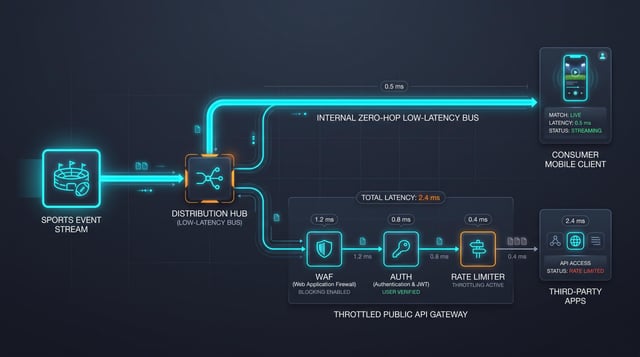
1. The Latency Hierarchy: Internal Bus vs. External WAF
When a goal is scored or a live handicap shifts, sports data vendors ingest raw scout telemetry or feed streams into an internal message broker (typically Kafka, Redpanda, or Redis Streams).
From that millisecond forward, your architecture and their proprietary consumer app take two completely divergent paths:
[ Field Telemetry / Odds Engine ] │ ▼ [ Internal Event Broker ] │ ┌───────────────────────┴───────────────────────┐ ▼ (Zero-hop IPC / Internal gRPC) ▼ (Public Ingress) [ Vendor's Own Consumer App ] [ Public API Gateway ] │ │ ▼ ├── 1. WAF & DDoS Inspection (5-15ms) [ Push Notification Service ] ├── 2. JWT / Token Auth Verification (5-10ms) [ Instant UI State Mutation ] ├── 3. Redis Rate-Limit Counter (5-10ms) ├── 4. Payload Serialization & Masking (10-30ms) ▼ [ External Client Polling / Webhook ] ▼ [ Your User's UI ] (Cumulative Lag: +800ms to +2,500ms) - The Internal Fast Track: The vendor’s own front-end engineers consume events via private internal subnets with zero token validation, zero rate-limit checks, and zero serialization overhead. Their push notifications leave the cluster instantly.
- The Public Gateway Toll: Your requests must traverse public DNS, Cloudflare/AWS WAF inspection, API gateway authentication, rate-limiting middleware, and pagination logic.
- The User Experience Penalty: When a Champions League penalty goes in, your users check your app, see nothing, glance at the vendor's consumer app, and see "GOAL!". Your app looks broken, even though your code is completely bug-free.
2. High-Traffic Contention: Who Gets Dropped at Kickoff?
On massive matchdays (Champions League Matchday 1, El Clásico, or World Cup Qualifiers), ingress traffic spikes exponentially.
When database connection pools saturate and edge CPU usage hits 90%, load balancers must drop or throttle traffic.
If a provider operates both a consumer app generating ad impressions and an external API:
- The Business Priority: Dropping internal traffic damages their direct App Store ratings, churns their ad revenue, and sparks user outrage on social media.
- The Reality: External API tenants are sandboxed into strict rate-limit queues. You start seeing
429 Too Many Requests, elevated504 Gateway Timeouts, and stale polling caches.
A pure-play B2B infrastructure provider has zero consumer frontends. 100% of its network ingress, load balancing capacity, and failover redundancy exist solely to fulfill its SLA to developers.
3. Query Introspection: You Validate the Feature, They Ship the Clone
Building a sports product is all about finding unique ways to present data:
- Maybe you designed an alert system triggered by sudden momentum shifts or tactical substitution spikes.
- Maybe you built a real-time card index monitor or an in-depth injury impact widget.
If your upstream provider has a consumer app product team, your API access logs are their most efficient R&D tool.
Through simple query aggregation on their gateway logs, they can identify:
- Which specific endpoints and nested parameters are experiencing unusual request surges.
- What custom query cadences or combination patterns emerging startups are using.
- Which niche leagues or props markets have unserved user demand.
Once your product proves traction, don't be surprised when their consumer app launches a "New Feature Update" three months later featuring the exact same dashboard or alerting logic you spent six months testing.
4. Data Primitives vs. Editorialized "Black-Box" Bloat
Companies that build for consumer fans naturally design their APIs around what their own app needs, rather than what an enterprise engineer needs:
| Metric Type | Consumer-App Provider (Opinionated) | Pure B2B Infrastructure (Engineered) |
|---|---|---|
| Team Strength | Arbitrary 1-100 "Power Index" (proprietary, unexplainable) | Raw spatial telemetry, pitch-tilt matrices, historical variance |
| In-Play Odds | Smoothed, delayed retail decimal lines | Unfiltered, sub-second Hong Kong base odds (net profit) |
| Shot Tracking | Simple text events ("Shot on target – 64'") | Normalized XY coordinates, goal frame vectors (?cmd=shot) |
| Architecture | High-overhead single-match drilldowns (/matches/{id}) |
High-throughput 20s delta streams (/livescores/changes) |
Engineers building custom algorithmic models or interactive 60FPS UI canvases cannot rely on another product team's editorialized opinions. You need clean, uncorrupted data primitives that allow you to calculate your own metrics and run your own proprietary models.
5. The Vendor Neutrality Checklist
Before signing a long-term data contract, run this sanity check on your vendor:
Plaintext
[ ] Do they operate any consumer-facing app, prediction forum, or affiliate website? [ ] Are their marketing teams competing against yours on App Store / Google Ads keywords? [ ] Does their SLA legally guarantee parity between internal delivery channels and external API tenants? [ ] Does their API force N+1 single-match calls, or do they offer global delta/changes feeds for serverless pipelines? [ ] Do they deliver raw statistical vectors (XY coordinates, true net margins) or black-box scores? If the answer to the first two questions is "Yes", your data provider is not just a utility vendor—they are an active competitor with root access to your usage patterns.
Discussion for Backend & Systems Engineers:
Have you ever experienced latency discrimination or platform risk from a data supplier that also operated a consumer product? How do you isolate your proprietary query logic when relying on third-party SaaS backends?
https://i.redd.it/e2x46vtj0fnh1.jpeg
Source: r/sportsdataapi · by /u/iSportsAPI