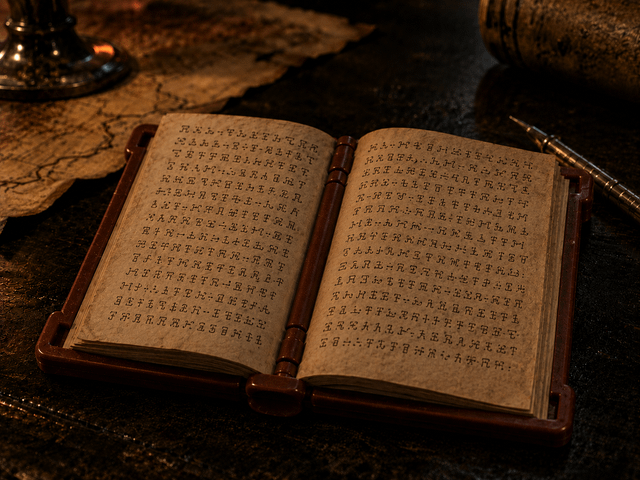
What followed was no ordinary traveler’s account. Within the weathered pages, Kaelen found the observations of someone who had journeyed far beyond familiar lands and recorded what they had witnessed, learned, and survived there.
Journal of the Nexus of Realms
First Observations
I have now passed through the Nexus of Realms more times than I care to count, and I find that each journey answers one question only to leave three more in its place. What I record here is not meant to be taken as unquestionable truth. Some of it I have seen with my own eyes, some was explained to me by mortal scholars and experienced travelers, and much of it I learned from Immortal Beings who claim knowledge stretching back farther than the histories of kingdoms. Even they disagree upon many matters.
The first and most important thing to understand is that the Nexus does not belong to any realm. It occupies some strange cosmic place between the innumerable realities of existence. One Immortal described it to me as the space between worlds. Another called it the road upon which all realms cast their shadows. I suspect both descriptions are merely attempts to put familiar words to something that cannot truly be understood by minds such as ours.
To my eyes, the Nexus resembles an impossibly vast cylinder of ancient metal and stone, stretching upward and downward farther than sight can follow. Its walls, passages, floors, and arches appear solid enough beneath the hand, yet I have repeatedly been assured that this is not its true form. Some Immortals believe this is merely how the mind interprets a place existing beyond ordinary dimensions. Even the concepts of above and below may not truly exist there as we understand them. Different travelers sometimes describe small differences in its appearance, yet nearly everyone I have questioned agrees upon the same general vision: a colossal structure without visible beginning or end.
I have often wondered whether I have truly walked upon stone at all.
Of the Nexus in Ancient Times
According to the oldest accounts I have collected, the Nexus was once very different. In its earliest remembered form, it was said to resemble a tremendous open plain upon which stood thousands of gateways. Each gate opened into another realm. Some led to the domains of gods and Immortals, others to lands inhabited by mortal beings, and still others to places where the souls of the dead dwelled.
As creation grew, however, the number of realms increased with it. Thousands of gateways became millions, and millions became numbers beyond sensible counting. The ancient crossroads spread farther and farther until navigating it became increasingly difficult even for beings who had traveled it for ages.
It was then that a great alliance of Immortal Beings from many Divine Realms gathered to remake the Nexus. No single god commanded this undertaking. From what I have been told, this was deliberate. The Immortals feared the consequences if any one god, empire, or faction gained control over the roads connecting all existence.
Their work became known as the Great Reconstruction.
The old plain disappeared, and the Nexus took the form in which travelers perceive it today. It is now said to contain trillions of floors. I have no means of proving such a number, though after seeing only a tiny portion of the place I find myself reluctant to doubt it. Some floors contain only a few dozen gateways. Others stretch farther than entire kingdoms, with roads, passages, and chambers containing gateways numbering in the thousands or perhaps more.
The interior dimensions clearly bear little relation to whatever exterior the Nexus might possess. I have walked corridors for hours that should have carried me far beyond the bounds of any structure visible from within. I once crossed a chamber so broad that mist concealed its opposite wall. The Nexus does not obey ordinary measures of distance.
The Immortals who performed the Great Reconstruction also made the Nexus self-sustaining. They established its structure and many of its laws, but they did not retain control over it. The Nexus now repairs, expands, and regulates itself. When new realms come into existence, new gateways eventually appear. Corridors change. New sections are sometimes discovered where travelers swear there had once been nothing but unbroken stone.
No one I questioned could explain precisely how this occurs. Some believe the Nexus possesses a form of awareness. Others insist that it merely follows laws established during the Great Reconstruction. I have heard Immortals argue over the matter with no more certainty than mortal scholars.
As for destroying the Nexus, I have been told that damaging even a portion of it would require extraordinary power. Destroying the whole of it would require power beyond anything presently known.
The Three Great Regions
The reconstructed Nexus was deliberately divided into three immense regions. The upper reaches contain gateways leading primarily to Divine Realms. The middle reaches contain those leading to Mortal Realms. Far below are the gateways to the Soul Realms.
The Immortals apparently intended this arrangement to reflect what they considered the course of existence: the influence of the divine above, mortal life between, and the passage of souls below. Yet this should never be mistaken for a division between goodness and evil.
I learned this quickly.
Not every Divine Realm belongs to a benevolent god. Some are ruled by Immortals who are cruel, violent, jealous, ambitious, or openly malevolent. There is considerable tension among some of the upper regions. During one journey I watched the servants of an Immortal deliberately take a much longer passage rather than walk near the gateway of a rival power. I asked one of them why. His only answer was that crossing before that gate would be considered an insult.
Apparently even the gods have troublesome neighbors.
The three classifications themselves are also less rigid than I once believed. Divine Realms are primarily associated with gods and Immortals, Mortal Realms with beings who are born and eventually die, and Soul Realms with the spirits of mortals after death. Yet Immortals may dwell within Mortal or Soul Realms, mortals may venture into Divine or Soul Realms, and some souls are permitted to reside among Immortal Beings in Divine Realms.
There are stranger places as well: shadow realms, elemental worlds, dream realms, prison dimensions, artificial realities, void realms, and places for which I know no proper name. Scholars still attempt to classify these within the three great divisions according to whichever nature dominates them. Not everyone agrees. I once listened to three learned travelers argue over whether a certain dream realm should properly be considered Mortal or Divine. They had apparently been having the same argument for several years.
I left them to it.
The Lower Roads and the Dead
The deepest portions of the Nexus have acquired many names. I most commonly hear the Underworld, though other travelers speak of the Realm of the Dead, the Spirit Realm, or similar names from their own cultures. These titles are misleading if taken too literally. The lower Nexus is not itself one vast land of death. It contains the gateways leading to innumerable Soul Realms.
Nor are all such realms terrible places. I have spoken with spirits who described peaceful lands, paradises, gardens, halls of ancestors, and realms devoted to rest. Others described places of judgment or purification. Still others spoke of prisons, wastelands, realms of torment, and domains occupied by demons or cruel rulers of the dead.
One should therefore never assume that descending farther into the Nexus means drawing nearer to evil.
Death itself appears to have an intimate connection with the Nexus. When a mortal dies, the soul is ordinarily drawn toward it and from there toward an appropriate Soul Realm. Exactly what determines that destination is difficult to say. From what I have gathered, divine allegiance, magical bonds, cultural beliefs, deeds performed during life, and the laws of the mortal's own realm may all play a part.
Some souls resist this passage altogether. They refuse to enter the Nexus and remain within their Mortal Realm. Fear, hatred, love, unfinished duties, curses, powerful magic, or simple refusal to accept death may hold them there. Such souls sometimes become the ghosts and wandering spirits spoken of in so many lands.
Those who do reach a Soul Realm generally cannot simply leave whenever they please. Powerful spirits sometimes can. Servants of gods may be granted passage, and some Immortal rulers permit favored souls to travel between realms. The rules appear to differ greatly from one Soul Realm to another.
Mortals of sufficient magical ability can sometimes reach across these boundaries as well. Some call spirits forth merely to speak with them. Others command them, bind them to objects, creatures, or places, or compel them into service. Such practices are dangerous for reasons beyond the magic itself. Souls may belong to realms governed by powerful beings who do not appreciate having their subjects taken from them.
It is even possible, at least in theory, for a living person to enter a Soul Realm and attempt to recover a particular soul. I have met several who claim to know of such journeys, though I have never witnessed one myself. Finding the proper Soul Realm would be difficult enough. Finding a single soul within it could prove harder still. The soul might refuse to return, its ruler might deny its release, or the laws of the realm itself might prevent its departure. Even then, a suitable mortal body would still be required.
It is little wonder that true resurrection remains uncommon.
The Traveler's Veil
One mystery troubled me almost immediately upon entering the Nexus: how can so many incompatible creatures walk the same halls?
I have passed beings clearly born beneath oceans walking beside creatures that breathe ordinary air. I have seen travelers surrounded by vapors that would surely have poisoned me had I breathed them. Others appeared accustomed to crushing pressures, terrible heat, bitter cold, or conditions no human body could endure.
Yet none seemed troubled.
A scholar from a Mortal Realm far removed from my own explained what travelers call the Traveler's Veil. The Nexus does not contain air in the ordinary sense. Instead, it creates conditions around each traveler suitable to that being's natural existence. A creature born beneath the sea may breathe and move as though surrounded by water, while one requiring poisonous vapors may stand beside a human without harming either of them. Heat, pressure, atmosphere, and other necessities are somehow adjusted around each individual.
I could see no boundary between these protections. Two beings requiring completely different environments may stand within arm's reach, each experiencing only what is necessary for survival.
After learning this, I began noticing just how varied the travelers truly were.
Travelers of Unequal Ages
Perhaps stranger than the beings themselves are the tools they carry.
Before my journeys through the Nexus, I assumed that Mortal Realms developed in much the same manner. Kingdoms rose and fell, craftsmen improved their trades, scholars studied natural philosophy, magic waxed and waned, and peoples gradually discovered better means of building, traveling, healing, and making war.
I now know how foolish that assumption was.
I have seen travelers dressed in wool, leather, and mail carrying swords, bows, lanterns, and wooden shields much like those found in my own lands. Others wore armor strengthened by enchantments, carried staffs inscribed with runes, or possessed weapons clearly fashioned through sorcery.
Then there were travelers whose belongings I could scarcely comprehend.
I once watched several emerge from a Mortal gateway wearing smooth suits fashioned from metal and materials unknown to me. Their armor seemed lighter than steel yet stronger than plate. One carried a weapon without string, blade, bow, powder flask, or visible working that I understood. When another traveler questioned its purpose, the wielder caused a brilliant line of light to leap from it and cut into stone.
I decided not to question him further.
Another traveler carried what looked like a thin piece of dark glass. Images moved across its surface. Maps appeared and vanished at the touch of his finger, as did symbols and writing. I detected no spell upon it, though I admit that does not mean there was none.
I have seen carriages travel without horses and metal vessels rise into the air without wings. I have encountered artificial servants made not through necromancy or enchantment but through mechanisms their owners insisted were the product of natural philosophy. Some moved and spoke with such ease that I initially mistook them for living creatures.
Other travelers possessed devices somewhere between these extremes: firearms of unusual design, intricate engines, instruments that glowed without flame, remarkable tools used for healing, and mechanisms capable of feats that many in at home would certainly call sorcery.
The travelers themselves often insist otherwise.
It appears that Mortal Realms do not progress together. Some remain lands of swords, castles, beasts, craftsmanship, and magic much like my own. Others have pursued natural philosophy and mechanical arts to heights beyond anything I had imagined. A few have gone farther still. I have spoken with men and women who claim their people construct great vessels capable of leaving their worlds and crossing the darkness between the stars.
At first I assumed such vessels must be enchanted.
They assured me they were not.
The most remarkable part is how ordinary these encounters eventually begin to seem. I have watched a knight carrying a steel sword pass beside a soldier holding a weapon powered by forces neither the knight nor I could name. A wizard may walk past a natural philosopher from a realm whose people insist magic is nothing more than superstition. A sailor whose greatest journey was across an ocean might share a passage with someone who claims to have traveled between distant worlds in the heavens.
Neither is necessarily more astonished than the other.
The Nexus makes no distinction between them. Civilizations separated by thousands, perhaps millions, of years of discovery may walk the same corridor within only a few paces of one another.
I often wonder which of them believes the other more primitive.
The Cosmic Transporter
At the center of the Nexus lies the great means by which travelers cross its unimaginable height. It is generally called the Cosmic Transporter, though I doubt anyone from my homeland would know what to call it upon first sight.
It resembles an immense vertical passage filled with shifting cosmic energy. There are no ropes, lifts, stairs, or visible machinery. Travelers enter and are carried upward or downward through the Nexus, sometimes across distances encompassing numbers of floors too great to comprehend.
Without it, meaningful travel through the Nexus would be nearly impossible.
The Transporter can theoretically reach any floor, but this should not be confused with knowing how to use it. A traveler must have some understanding of where they are going. Incorrect instructions, damaged maps, incomplete knowledge, magical interference, or simple mistakes can result in being carried to the wrong level.
I once met several travelers who claimed that one such mistake cost them nearly half a year before they found their proper road again. After my own experiences navigating the place, I had no reason to disbelieve them.
The Transporter can move large numbers of travelers, but not without limit. Armies must move through in groups rather than all at once. Wagons, beasts, siege engines, supplies, and large creatures occupy additional room and make the process slower. This becomes important whenever one realm attempts war upon another.
Realm Marks, Gate Marks, and the Problem of Getting Home
There are two things every wise traveler learns to record.
The first is the Realm Mark, the cosmic signature belonging to a realm itself. It is not truly a written symbol, though scholars often represent it as one. Knowing a Realm Mark allows a traveler to identify the broad destination they seek.
The second is the Gate Mark. A single realm may possess hundreds or thousands of gateways, and each one has its own Gate Mark. Thus, knowing the Realm Mark may lead one toward a particular world, while the Gate Mark identifies the particular entrance within that world.
Neither mark is plainly written upon a gateway for anyone to read. They must be understood through magic, specialized instruments, old records, direct experience, or someone already knowledgeable in their interpretation.
Experienced travelers guard this information carefully. I have seen Realm and Gate Marks engraved upon tablets, written in journals, placed upon enchanted tokens, and even carved into armor. Many carry records of the gateway through which they entered for one very simple reason: finding a way out of one's homeland is of little value if one cannot find the same road back.
This is perhaps the greatest misunderstanding outsiders have about the Nexus. Entering it does not mean one suddenly possesses easy access to every realm in existence. There may be trillions of floors, and some floors contain gateways numbering in the millions. Without a Realm Mark, Gate Mark, reliable map, knowledgeable guide, or extraordinary luck, finding one particular destination could be hopeless.
I have heard tales of travelers who entered confidently and were never seen again. Some may have died. Others may still wander the Nexus. Perhaps some simply found another gateway and began new lives in worlds far from the ones they left.
There is no way to know.
Of Gateways in Mortal Lands
Many civilizations have no knowledge of the Nexus at all.
A gateway may remain dormant for centuries beneath a city whose inhabitants believe it to be nothing more than an ancient ruin. Others lie beneath mountains, beneath lakes, forgotten in forests, buried beneath collapsed temples, sealed inside fortresses, or hidden in regions no living person has visited in generations.
Activating them often requires knowledge that has long since been lost.
A kingdom may therefore exist for thousands of years without realizing that several roads into other realities lie within its borders.
Large and ancient realms often possess many gateways. Some may have appeared thousands of years apart and on opposite sides of a world. All lead ultimately into the Nexus, but not necessarily to the same floor or district.
Dead Gates
Not every gateway still leads somewhere.
When a realm is destroyed, or when one of its gateways is destroyed from the other side, the corresponding structure inside the Nexus often remains standing. The light or substance within the opening disappears, leaving only darkness.
Travelers call these Dead Gates.
Most appear to lead nowhere at all, yet explorers still seek them out. Some believe fragments of destroyed realms remain beyond certain Dead Gates.
I once spoke with a man who claimed to have entered one.
He told me that he found the ruins of a city suspended in endless darkness, broken buildings hanging where no ground existed beneath them. He carried with him a small object made from a material I could not identify and claimed it had been taken from those ruins.
He may have been lying.
Before traveling the Nexus, I would have assumed so.
Now I am less certain.
Gods Walking Mortal Roads
Immortal Beings may travel through Nexus gateways just as mortals do, though entering a Mortal Realm does not necessarily allow them to wield their full strength.
Many Mortal Realms appear to possess natural or magical laws limiting how completely a god or similarly powerful being can manifest there. There are also treaties among Immortals intended to prevent excessive interference in mortal affairs.
These agreements are not always obeyed.
Even so, they help explain why gods so often work through natural events, prophets, champions, cults, servants, avatars, and mortal allies rather than simply descending upon every battlefield themselves.
A god may therefore possess unimaginable strength within its own Divine Realm while finding its power greatly diminished upon entering another world.
I imagine some Immortals find this deeply irritating.
Roads That Do Not Pass Through the Nexus
One of the more surprising things I learned is that the Nexus is not the only method of traveling between realms.
Because its halls are so vast and its navigation so difficult, powerful beings and civilizations have devised ways of bypassing it. Magic may tear open a temporary passage directly between two realms. Rituals may accomplish similar things. Enchanted devices can create crossings, gods can intervene, and bargains with otherworldly beings may open roads where none existed before.
I have heard of still stranger methods.
Such travelers may leave one realm and arrive in another without ever physically setting foot in the Nexus.
This does not necessarily make such travel safer.
One Immortal compared the difference rather well. A Nexus gateway, he told me, is an established road through known country. A direct magical passage is like cutting through wilderness because the road is too long and hoping the forest does not close behind you before you reach the other side.
Some travelers therefore prefer the Nexus despite its difficulty.
Others would rather risk nearly anything than become lost within it.
Those Who Pass Through
No permanent civilization appears to inhabit the Nexus itself, though many have tried to establish themselves there.
Temporary camps are common enough. Merchants rest beside important passages. Armies raise barricades. Travelers gather around gateways while waiting for companions. Some groups remain for days or even months.
Yet permanent structures do not endure.
Buildings erected within the Nexus gradually decay, become absorbed into the surrounding stone, shift from where they were built, or occasionally disappear entirely. I have been told of travelers who slept inside shelters they had constructed only to awaken beneath an open stone arch with every wall around them gone.
Whatever causes this, the effect is clear enough. No kingdom has successfully claimed lasting territory within the Nexus.
Its corridors are nevertheless rarely empty.
I have passed mortals, gods, demons, spirits, merchants, pilgrims, soldiers, messengers, explorers, and creatures unlike anything found in my homeland. Some spoke languages I could not understand. Some wore garments stranger than any costume devised for a royal court. Some carried weapons and devices that appeared to belong to another age entirely.
Most paid little attention to one another.
Everyone was going somewhere.
The best description I can give is that the Nexus is the great crossroads and waystation of existence. Travelers arrive from one realm, find their road, and depart into another.
Everyone passes through.
Almost no one stays.
On War Between Realms
Given such a place, one might assume that conquering other worlds would be simple.
It is not.
Gateways form natural choke points. An army seeking to enter another realm must pass through a limited opening, and any people aware of such an entrance can fortify the land around it. Walls may be raised. Soldiers stationed nearby. Magic placed upon the gateway. In some cases the passage may be concealed or sealed entirely.
An invading army must also feed itself.
Every weapon, wagon, animal, healer, reinforcement, siege engine, and measure of food must pass through the same vulnerable road. The Cosmic Transporter slows matters further because large forces cannot move through it all at once.
A handful of travelers may pass through the Nexus easily. An army of thousands is another matter.
Should the gateway behind an invading force be sealed, destroyed, suppressed, or captured, those soldiers may find themselves trapped in a foreign realm with no reinforcements, no supplies, and perhaps no way home.
This is why trade, exploration, diplomacy, raids, and smaller conflicts between realms seem far more common than outright conquest.
A veteran soldier I met near one of the Mortal gateways explained it better than any scholar.
“Finding the gate begins the war,” he told me. “Holding the gate wins it.”
I wrote the words down that same evening.
Closing Thoughts
The longer I travel the Nexus, the less certain I become that anyone truly understands it.
The Immortals reconstructed it but no longer control it. The gods travel its halls but cannot explain all of its workings. Souls pass through it toward destinations beyond mortal death. Entire civilizations remain ignorant that gateways lie beneath their feet, while others have traveled between realities for ages.
Perhaps strangest of all is the difference between those civilizations themselves. One realm may still fight wars with sword, bow, beast, and spell, while another sends metal vessels across the darkness between stars. Yet their travelers may step through separate gateways and find themselves standing together upon the same floor.
The Nexus judges neither as greater.
Some use its roads. Others avoid them through magic, ritual, strange devices, divine intervention, or bargains with powers I would prefer never to meet.
Some gateways lead to kingdoms. Others lead to gods. Some lead to the dead. Some stand silent and dark because whatever once existed beyond them is gone.
And somewhere among those trillions of floors must be gateways into realms that no traveler I have met has ever seen.
Perhaps there is no being who knows every road through the Nexus.
Perhaps there never will be.
For now, I will continue recording what I find, keeping careful note of every Realm Mark and Gate Mark I use. The Nexus is too large for certainty, and I have learned that the most dangerous words a traveler can speak within its halls are these:
“I know the way.”
https://i.redd.it/cl6i5u4v37mh1.png
Source: r/Lego_Minifigure_Realm · by /u/luniz6178