110
Lucinda Ray
I moved to this street in April.
Not to this town.
I’ve belonged to it for fourteen years,
long enough to know its shortcuts,
its seasons,
the things that disappeared
before someone newer arrived
to miss them.
But this street was new to me.
And I arrived late enough
to miss the living,
but early enough
to witness the leaving.
There were houses down the street
already sentenced.
I didn’t know that word yet.
Not sentenced, exactly.
Eminent domain.
I was thirty-four years old
when I Googled what it meant
for the government to want your house
more than you were allowed to keep it.
There is something embarrassing about learning
the vocabulary of ownership
before ever owning anything worth taking.
I have never signed my name
to thirty years of debt
and called it security.
Never stood in a kitchen with a realtor
and tried to imagine Christmas there.
Never watched a bank dissect my income,
my credit,
my history,
to determine whether I had sufficiently obeyed
the rules required
to purchase permanence.
But I know the rules.
Work hard.
Pay your bills.
Build your credit.
Save your money.
Buy the house.
Raise the children.
Plant something that will outlive the season.
This is yours.
This is home.
This is the American Dream.
There should have been an asterisk.
Subject to acquisition.
Subject to progress.
Subject to somebody deciding
the interstate needs another lane.
More than two hundred homes.
They say homes in the articles,
but I imagine somewhere in an office
they are parcels.
Numbers.
Right-of-way.
Square footage.
Fair market value.
Just compensation.
Language is useful that way.
Call a home a parcel
and no one has to wonder
where the Christmas tree went.
I worked from home,
which meant some afternoons
I would leave mine
and walk down the street
to watch other people’s homes
slowly stop belonging to them.
The families were already gone.
At first, though,
their lives hadn’t entirely gotten the message.
They came back for things.
Not the important things.
Those had gone first.
They came back for plants.
A bush.
Something from the yard.
Little pieces of a life
too impractical to make the first trip
and too beloved to leave for the last.
I watched the houses become emptier
in increments.
It turns out leaving a home
is not always one departure.
Sometimes you leave it
a hydrangea at a time.
And then there was 110.
I never knew the people who lived there.
I still don’t.
Part of me hopes I never do.
Because I know them now
only through evidence:
funny little birdfeeders,
plants chosen by someone
who apparently liked things with personality,
Christmas lights in a front-yard tree
that had no business being Christmas lights
for most of the year,
and tiny, cheap disco balls
hanging from the branches.
Disco balls.
Of all the useless things
a person could buy.
Someone stood in a store,
or scrolled past them online,
and thought,
those would be fun.
And then they took the time
to hang them in a tree.
There is something sacred
about unnecessary joy.
About decorating a thing
that was already beautiful.
About catching sunlight
for no reason
except to throw it somewhere else.
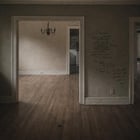
I climbed onto the porch one afternoon.
I wasn’t supposed to know these people.
I wasn’t supposed to know this house.
But through the doorway
there were hardwood floors,
old light fixtures,
green walls,
and handwriting.
To Our House.
They had written a letter
to the house itself.
Not to the state.
Not to the construction crew.
Not to whoever might wander through
after they were gone.
To the house.
As if a house could read.
As if walls could grieve.
As if somewhere beneath the plaster
and brick
and lumber
there were enough years of laughter,
arguments,
birthdays,
dinners,
doors slammed,
doors held open,
people coming home,
that the structure itself
had become someone
worth saying goodbye to.
Another person wrote beneath it.
More gratitude.
More love.
More proof that whatever
an appraiser had calculated
was measuring the wrong thing.
Because you can measure a bedroom.
You can measure acreage.
You can compare recent sales.
You can assign a dollar amount
to brick and timber and dirt.
But where, exactly,
on the appraisal
do you list the place
your child learned to walk?
What is the comparable sale
for the kitchen where your mother
was still alive?
What is the depreciation schedule
for sixteen years of laughter?
How much per square foot
for knowing exactly which floorboard creaks
when someone comes home late?
Maybe none of those things happened at 110.
I don’t know.
That is the point.
Neither does fair market value.
We are told ownership is permanence
you can purchase.
And maybe that is why
I cannot make the arithmetic work.
Suppose they did everything right.
Suppose their credit was perfect
when they bought it.
Suppose they worked themselves exhausted
to qualify.
Suppose years later
life had done what life does.
A lost job.
A changed income.
A credit score bruised
by circumstances no banker cares to sentimentalize.
Suppose the check was fair.
Suppose every dollar was accounted for.
What if they could not buy
their own life back?
A check can replace a structure.
It cannot guarantee another mortgage.
It cannot keep a child
in the same school.
It cannot move the neighbor
who keeps a spare key.
It cannot transplant
the route home
your hands know without thinking.
It cannot compensate you
for believing
you were finished having to leave.
I was lucky as a child.
One house.
The same schools.
The same geography
beneath my growing up.
I mistook stability
for something adults could guarantee
if they tried hard enough.
Maybe that is what 110 taught me.
Parents can do everything right
and still be overruled
by a line someone else
draws on a map.
The strange thing is,
everyone here
may have followed the rules.
The homeowners followed the rules.
The state followed its rules.
The men who came to tear it down
were following theirs.
Some came from Florida,
I heard.
They’ll live here for years
while they finish the project.
I think about that sometimes.
Men leaving their own homes
to earn enough money
to keep them,
paid to dismantle
someone else’s.
Maybe one of them calls his children
from a hotel room at night.
Maybe somebody asks when he’s coming home.
Maybe he says,
when the job is done.
There is no villain satisfying enough
for this story.
Only machinery.
Paperwork.
Paychecks.
Procedure.
A system functioning
exactly as designed.
And somehow
that frightens me more.
Before 110 came down,
I went back to the tree.
The family had taken what they wanted.
Or what they could.
Five little disco balls remained.
I took them.
I don’t know whether that was stealing
or rescuing.
Maybe both.
They weren’t mine.
Neither was the house.
Neither was the grief,
technically.
But I couldn’t bear the thought
of those stupid little mirrors
being fed into the same machine
as everything else.
So I have five pieces of 110.
No.
That’s not right.
I have five pieces
of its joy.
I thought I would go back.
I thought there would be another walk,
another afternoon,
another chance to stand there
and understand what I was watching.
I thought demolition
would look more like a goodbye.
I thought I had more time.
And then one day
110 was gone.
Not empty.
Not abandoned.
Not waiting.
Gone.
I never took a photograph
of the whole house.
I saw it.
My camera didn’t.
I have a photograph
of what they wrote to it.
I have photographs
of where it stood.
But I cannot show you 110.
Only its before
and its after.
Only the goodbye
and the grave.
In the photographs now
there is concrete.
Broken brick.
Dust.
The perimeter of rooms
that no longer require doors.
The house has been reduced
to its footprint,
which is a strange word
for something
that never got to walk away.
A brick inside a wall
is a house.
The same brick on the ground
is debris.
Nothing about the brick changed.
Only what we decided
it belonged to.
Soon there will be an interstate.
Cars will pass through
carrying people toward
their own homes.
Someone will complain about traffic.
Someone will miss an exit.
Someone will change lanes
without looking.
Someone will spill coffee
and curse.
Someone will say,
Thank God they finally widened this.
And they won’t know.
They won’t know about the green walls.
They won’t know about the handwriting.
They won’t know somebody came back
for the plants.
They won’t know a family
once hung tiny disco balls
from a tree
because sunlight was apparently
not festive enough on its own.
They won’t know
there were more than two hundred
versions of this story.
Maybe that is what progress means:
we become very good
at arriving somewhere faster
and very bad
at remembering
what used to be in the way.
I still have the disco balls.
Five small mirrors
from a house that no longer exists,
each one fractured into dozens
of tiny reflections,
each one incapable
of showing the whole picture.
Maybe that’s appropriate.
I don’t have the whole picture either.
I don’t know their names.
I don’t know where they went.
I don’t know whether they are okay.
But I know they loved 110.
They left that much
written on the wall.
What I don’t know
is whether they’d mind
that I kept something.
Five little disco balls
that belonged to their tree
before they belonged to my memory.
I hope they wouldn’t.
I hope somehow
they would understand.
I hope they know
that after they left,
someone noticed.
Someone saw the lights in the tree.
Someone saw the birdfeeders.
Someone saw the plants.
Someone read what they wrote
to their house
and understood, finally,
why they had written to it.
Someone remembered 110
after 110 was no longer there
to remember itself.
And somewhere nearby,
five ridiculous little disco balls
are still catching light.
Still throwing it somewhere else.
Still doing the unnecessary thing someone once bought them to do.
The interstate can have the dirt.
I kept the light.
https://www.reddit.com/gallery/1vx6nzc
Source: r/asheville · by /u/if_yu_seek_amy