A note on sources before the essay begins
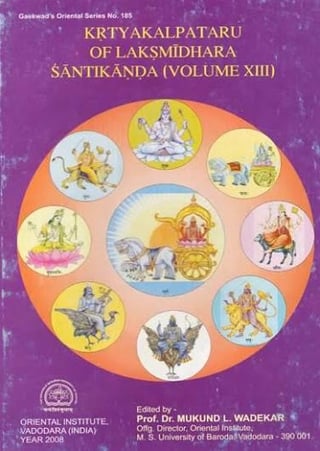
Since this essay rests on a specific technical claim — that Lakṣmīdhara described something called a dvāribandha, defined as "a high-level reservoir produced by damming a mountain spring" — it is worth being direct about what I could and could not verify before proceeding. Lakṣmīdhara's authorship of the Kṛtyakalpataru under the patronage of the Gāhaḍavāla king Govindacandra of Kanyakubja is solidly attested across the dharmaśāstra secondary literature, the Aufrecht catalogue tradition, and the modern critical editions produced under K.V. Rangaswami Aiyangar's general editorship for the Gaekwad Oriental Series. What I could not independently confirm, in the time available, is the specific technical term dvāribandha as a named category of hydraulic structure in that text, glossed precisely as "a high-level reservoir produced by damming a mountain spring." I did not find this term in the secondary scholarship on the Kṛtyakalpataru's water-related sections, and I want to flag that possibility to you plainly rather than manufacture a confident gloss around a term I cannot source. It is entirely possible the term exists in an untranslated portion of the Dānakāṇḍa or a related kāṇḍa that simply hasn't surfaced in the English-language secondary literature I could access — nibandha texts of this bulk (the Kṛtyakalpataru runs to fourteen books) contain enormous amounts of untranslated technical material, and dharmaśāstra digests are exactly the kind of text where a term like this could sit unremarked for a century. But I would rather tell you that the specific attribution is uncertain than write as though I had verified it.
What follows, therefore, is an essay grounded in what is actually documented: who Lakṣmīdhara was, what the Kṛtyakalpataru is, why a jurist-minister at a twelfth-century Rajput court would be writing about reservoirs and dams at all, what the dharmaśāstra tradition's engagement with hydraulic works actually looked like, and where the Gāhaḍavāla dynasty's own material record of water architecture stands. I treat the dvāribandha claim as a live thread worth pulling rather than a settled fact, and I place it inside the larger, well-attested pattern of nibandha literature treating water infrastructure as a subject of religious and civic law — which is very likely the actual textual context, whatever the term's precise nomenclature, in which such a reservoir-type would have been discussed.
Who was Lakṣmīdhara
Lakṣmīdhara Bhaṭṭa was the son of Hṛdayadhara and served as a minister — described variously in the secondary literature as minister for peace and war (sāndhivigrahika) — at the court of Govindacandra, the Gāhaḍavāla ruler of Kanyakubja (Kannauj), who reigned from approximately 1114 to 1154 CE. This dating places Lakṣmīdhara squarely in the first half of the twelfth century, at a moment when the Gāhaḍavāla kingdom, ruling from its dual seats at Varanasi and Kannauj, had become the dominant power of the Gangetic heartland, having absorbed Kalachuri territory, held off successive Ghaznavid incursions from the northwest, and extended its authority eastward toward Bihar. Govindacandra's reign is unusually well documented for a twelfth-century Indian polity, owing to a substantial corpus of surviving copper-plate land grants, which allow historians to reconstruct not just his military campaigns but the administrative texture of his court — its officials, its religious patronage, its revenue instruments, and its intellectual output.
Lakṣmīdhara belongs to that intellectual output. He is remembered today almost entirely for a single monumental work: the Kṛtyakalpataru, literally the "Wish-Fulfilling Tree of Duties" or "Wishing Tree of Rites," a work so influential in its genre that it is often referred to simply as the Kalpataru. It belongs to the literary category of the nibandha — the digest or compendium — a genre that dominates the later history of dharmaśāstra literature. Where the earlier tradition had produced primary treatises (the Manusmṛti, the Yājñavalkyasmṛti, and so on) and then commentaries on those treatises, the nibandha genre represents a third stage: a systematic re-organization of the entire accumulated corpus of smṛti and purāṇic material by topic, so that a judge, a king's minister, or a household priest could look up, under a single heading, everything the tradition had to say about a given subject — marriage law, inheritance, penance, pilgrimage, or the merit of digging a well.
The Kṛtyakalpataru is organized into fourteen books, or kāṇḍas, each devoted to a domain of duty: rites to be performed at fixed times (Niyatakālakāṇḍa), the duties of the householder (Gṛhasthakāṇḍa), rules of gifting (Dānakāṇḍa), the duties of a king (Rājadharmakāṇḍa), and rules governing liberation (Mokṣakāṇḍa), among others. The scale of the undertaking — and the fact that it survives in enough manuscript witnesses to have supported a multi-volume critical edition in the Gaekwad Oriental Series under Rangaswami Aiyangar's editorship in the twentieth century — testifies to how central this text became to the subsequent history of Hindu law. Later nibandhakāras across the subcontinent, including Śūlapāṇi in Bengal, drew on and quoted Lakṣmīdhara. In effect, Lakṣmīdhara did for the sprawling, often self-contradictory mass of dharmaśāstra material what a good indexer does for an unwieldy archive: he made it usable.
Why a dharmaśāstra digest talks about reservoirs at all
To a modern reader, the idea that a treatise on religious law and ritual duty would contain technical material on water engineering can seem like a category error. It is not. The convergence of hydraulic works and dharmaśāstra literature runs through one specific and very well-attested channel: the theology of dāna, or meritorious gift-giving, and its associated category of pūrta, or works of public utility undertaken for religious merit.
Classical Hindu ethical thought divides meritorious action broadly into two streams: iṣṭa, merit accruing from properly performed Vedic sacrifice and private ritual, and pūrta, merit accruing from acts that benefit the wider community — building temples, planting groves, excavating tanks, digging wells, constructing rest-houses for travelers, and building embankments or reservoirs that made water available to people and livestock who would otherwise go without it. This is not incidental moralizing tacked onto engineering; it is the reverse. In a society where the state's capacity to compel large capital works was limited, and where a great deal of infrastructure was instead built by kings, queens, wealthy merchants, and local notables acting out of a combination of piety, prestige, and genuine civic concern, the theological framework of pūrta-dharma functioned as the actual incentive structure for infrastructure construction. If digging a well or excavating a tank carried specified, textually guaranteed religious merit — merit whose magnitude depended on the size, permanence, and water-yielding capacity of the structure — then patrons had a concrete reason, beyond simple utility, to fund such works, and to fund the more durable and better-engineered version of such works rather than a cheap and short-lived one.
This is precisely the terrain the Dānakāṇḍa, the gift-section of the Kṛtyakalpataru, occupies. Dāna-nibandhas of this era — and Lakṣmīdhara's is one of the earliest and most influential specimens of the sub-genre — systematically compile purāṇic and smṛti verses specifying the different categories of water structure recognized by the tradition, their relative merit, the correct season and ritual procedure for their consecration, and the penalties or lesser merit attached to structures that failed to hold water reliably or that were built without proper technical care. The vocabulary here is itself revealing of a real engineering typology embedded in religious law: kūpa (a simple dug well), vāpī (a stepped well, often rectangular, with descending tiers of steps and landings, the type that produced the great stepwells of Gujarat and Rajasthan), taḍāga (a pond or tank, typically formed by excavation and embankment), dīrghikā (a long tank or elongated reservoir), puṣkariṇī (a lotus-tank, often attached to a temple), and jalāśaya as the umbrella term for any water-holding structure. Purāṇic sources quoted in these digests go further and specify engineering-adjacent detail: the recommended depth-to-width ratios of a well-built tank, the merit bonus attached to a tank that never runs dry even in the hot season, the importance of a reliable perennial water source feeding the structure rather than dependence on rainfall alone, and the special status of a reservoir fed by a spring (prasravaṇa or utsa) as opposed to one dependent purely on monsoon runoff.
It is exactly in this last category — a reservoir engineered to capture and retain the flow of a perennial spring, particularly a mountain spring whose water descends with some natural head or pressure — that a term denoting something like "a high-level reservoir produced by damming a mountain spring" would sit comfortably within the dāna literature's typology. Whether Lakṣmīdhara's actual vocabulary for this sub-type was dvāribandha specifically, I cannot confirm from the sources available to me. But the underlying engineering category the term describes — an impounded spring-fed reservoir, elevated relative to the settlement it serves, created by a constructed barrier or dam (bandha, from the same root that gives us bandh in modern Hindi for an embankment or closure) across the spring's natural outflow channel — is entirely consistent with, and very plausibly drawn from, the kind of purāṇic verse-material that dāna-nibandhas routinely compile. The word bandha itself is the standard Sanskrit term for a dam or embankment, appearing widely in inscriptional and technical literature for artificial water barriers, and it is the root of the modern word "bund" used across South Asian irrigation engineering to this day for an earthen embankment. A compound built on bandha to denote a particular category of impounding structure — whether dvāribandha, "gate-dam" or "gate-closure," referring perhaps to a sluice-regulated barrier, or some cognate term — would fit naturally into this technical-religious vocabulary.
The engineering logic of spring-fed hill reservoirs in the Indian tradition
It is worth dwelling on why a reservoir formed by damming a mountain spring represents a distinct and valued engineering category within Indian water management, independent of whatever Lakṣmīdhara did or did not call it. Most of the celebrated ancient and medieval Indian tank systems — the great eri tanks of the Tamil country, the taḍāgas of the Deccan, the Sudarśana Lake at the foot of Girnar in Gujarat, built in the Mauryan period and repeatedly repaired by Rudradāman I and later by Skandagupta — are primarily monsoon-catchment structures: they are sited across the natural drainage of a river valley or seasonal stream, designed to capture the runoff of the rains and hold it through the dry months, with their engineering challenge centered on embankment strength, spillway design to handle flood discharge, and silt management.
A spring-fed reservoir belongs to a different engineering family. Its water source is perennial rather than seasonal, but typically much smaller in volume and more constant in flow than a monsoon-fed catchment. The engineering problem shifts from managing a large, intermittent, and potentially violent flood discharge to managing a small, steady, year-round inflow — which changes the design priorities toward minimizing evaporative and seepage loss, protecting the water's purity (springs, particularly those emerging near temple sites or associated with tīrtha traditions, were frequently regarded as sacred and their water treated with a purity standard higher than tank water generally), and, crucially, exploiting the natural elevation of a hill or mountain spring to deliver water by gravity to settlements or agricultural land downslope, without requiring any lifting mechanism. This is the real significance of "high-level" in the description under discussion: a reservoir sited at elevation, fed by a spring rather than surface runoff, converts the geological accident of altitude into a distributable resource, because water impounded high on a hillside can subsequently be released through channels, spouts, or nāla conduits to serve settlements, temple complexes, or terraced agriculture at lower elevations without any mechanical assistance. This is the same basic principle exploited by hill-station and temple-town water systems across the subcontinent — the temple tanks fed by hill springs at sites in the Himalayan foothills, the dhārā (spring-channel) systems of the central Himalayan temple towns, and comparable spring-impoundment structures recorded at temple sites in the Western Ghats and in parts of the Vindhya-Kaimur hill tracts that border the Gangetic plain where the Gāhaḍavālas ruled.
This last geographic point matters. The Gāhaḍavāla kingdom's core territory — the doab between the Ganga and Yamuna, extending east to Varanasi and the edge of the Vindhyan hill country — is not a Himalayan alpine zone, but it does abut precisely the kind of low hill and scarp country (the northern fringes of the Vindhya-Kaimur range, the Chunar-Mirzapur sandstone hills near Varanasi itself) where spring-fed impoundments of exactly this kind would have been both geologically feasible and practically valuable. If Lakṣmīdhara, writing at Govindacandra's court, discussed a reservoir type of this kind, it would not be an abstract borrowing from some distant hill tradition; it would describe a structure whose physical referents were within reach of the Gāhaḍavāla domain's own hill margins, at sites like the sandstone escarpments around Chunar and the Vindhyan outliers south of Varanasi where natural springs do occur.
The Gāhaḍavāla court as a hydraulic patron
Govindacandra's reign, quite apart from Lakṣmīdhara's textual production, has its own material record of water-works patronage, which is worth setting alongside the dharmaśāstra material because it shows that hydraulic construction was not merely a theoretical concern for the Gāhaḍavāla elite but an active area of royal and aristocratic building activity. The Gāhaḍavāla copper-plate corpus — one of the richest inscriptional archives to survive from any twelfth-century Indian dynasty — records extensive land grants to Brahmins and religious institutions, many concentrated around Varanasi's sacred geography of ghats, tanks, and river frontage, a landscape whose entire religious economy depends on constructed and maintained water access. Govindacandra's queen Kumāradevī, who came from a Rāṣṭrakūṭa lineage, is remembered in the epigraphic and Buddhist textual record for patronage extending to religious establishments at Sarnath, and the broader pattern of Gāhaḍavāla queenly patronage — a recurring feature of the dynasty, given the number of queens attested for Govindacandra alone (Nayanakelidevī, Gosalladevī, Kumāradevī, and Vasantadevī) — fits a pattern seen across medieval Indian dynasties in which royal women were disproportionately associated with the pious, non-military category of public works: temples, tanks, wells, and rest-houses, precisely the pūrta category the dāna-nibandhas theorize.
Varanasi itself, the Gāhaḍavāla dynastic capital for much of its history, is a city whose entire premodern infrastructure is organized around water access at scale — the ghat system along the Ganga, supplemented by an extensive network of urban tanks (of which the Puṣkara or Pushkarini tanks associated with specific temple precincts, several later famous, such as those at the Kāmeśvara or other temple complexes, likely have their origins or major renovations traceable to this general period) that served both ritual bathing needs and everyday water supply for a dense riverine city. A court that ruled from this city, and whose ruling ideology (as attested repeatedly in the Gāhaḍavāla inscriptions themselves, which portray Govindacandra and his predecessors as protectors and restorers of a distressed earth) was explicitly framed in terms of dharmic kingship and the maintenance of righteous order, is exactly the kind of court where a minister-jurist would be expected to produce systematic guidance on the religious law of water-works — because such guidance had direct, practical application to how the king, his queens, his ministers, and his wealthy subjects allocated resources to visible, meritorious public construction.
Lakṣmīdhara's method and what it means for a technical claim like this
It is worth saying something about how nibandha authors like Lakṣmīdhara actually composed their works, because it bears directly on how a claim about a specific engineering term should be evaluated. Nibandha literature is not original composition in the modern sense. As modern Indological scholarship on the Kṛtyakalpataru has emphasized, the genre consists overwhelmingly of quotation: the nibandhakāra's skill lies in selecting, arranging, and reconciling verses drawn from an enormous prior corpus of smṛti texts and purāṇas, imposing a coherent topical order on material that, in its original scattered form, offered no such order. Lakṣmīdhara's own methodological statements, discussed in the specialist literature on the Kṛtyakalpataru's dāna-section, situate the work explicitly within this citational tradition. This means that if the Kṛtyakalpataru does contain a passage describing a reservoir formed by damming a mountain spring, Lakṣmīdhara is very unlikely to be the originator of that description. He would be transmitting and categorizing a verse or set of verses drawn from an earlier purāṇic source — quite possibly from a source like the Matsya Purāṇa, Agni Purāṇa, or Devī Purāṇa, all of which the Kṛtyakalpataru is documented to draw on extensively, and all of which contain material on the merit and typology of water constructions as part of their treatment of dāna and pūrta.
This matters for how one should think about the term dvāribandha itself. If it exists in the text, it almost certainly reflects an older purāṇic technical vocabulary for water structures that Lakṣmīdhara inherited and organized rather than coined, which would place its origins potentially centuries earlier than the twelfth-century Gāhaḍavāla court — perhaps in the Gupta-era or early medieval purāṇic redactions that most of this dāna-material derives from. That would make Lakṣmīdhara's contribution not the invention of the hydraulic concept, but something arguably more historically significant: the act of extracting a scattered purāṇic reference to a specific reservoir-type from the diffuse mass of gift-merit literature, and fixing it, with a name, inside a systematic legal-technical compendium where later readers — commentators, other nibandhakāras, and the king's own officials — could find it, cite it, and presumably act on it. This is, in miniature, exactly the kind of transmission mechanism by which pre-modern Indian technical knowledge about engineering, agriculture, and craft frequently survives: not in freestanding treatises devoted to the technology itself, but embedded inside religious, legal, and ritual literature whose primary purpose was something else entirely, with the technical content preserved almost as a byproduct of the text's theological argument.
Placing the claim within the wider historiography of Indian hydraulic engineering
The broader historiography of Indian hydraulic engineering has increasingly recognized that a great deal of the subcontinent's premodern technical knowledge about water management is recoverable only through exactly this kind of indirect, embedded transmission — inscriptions recording tank construction as a religious donation, purāṇic verses specifying the ritual and practical requirements of a properly built reservoir, and dharmaśāstra digests systematizing that purāṇic material into usable legal categories. This is a different evidentiary base from, say, the Harappan hydraulic engineering visible directly in the excavated check-dams and reservoir structures at sites like Dholavira, or the well-documented sluice technology (the bisokoṭuwa) of ancient Sri Lankan tank irrigation, both of which survive as physical archaeology independent of any textual description. Indian dharmaśāstra-embedded hydraulic knowledge survives instead as a kind of technical residue inside legal-religious prose, requiring exactly the sort of careful philological excavation that a specialist would need to perform on the Kṛtyakalpataru's Dānakāṇḍa to establish precisely what Lakṣmīdhara's vocabulary for a spring-fed hill reservoir actually was, how it differed technically from the more commonly attested taḍāga and vāpī categories, and what specific purāṇic source underlies the passage.
That specialist philological work — checking Rangaswami Aiyangar's critical edition of the Dānakāṇḍa volume directly, and tracing any dvāribandha-type reference back to its purāṇic source citation, which the nibandha genre's citational method would make traceable — is precisely the kind of task that would resolve the uncertainty I flagged at the outset of this essay. I have set out here what is firmly established: Lakṣmīdhara's position at Govindacandra's Gāhaḍavāla court, the Kṛtyakalpataru's structure and its dāna-section's demonstrated engagement with the typology of water-works as objects of religious merit, the coherent engineering logic of an elevated spring-fed reservoir within that typology, and the Gāhaḍavāla court's own well-attested material culture of water and tank patronage centered on Varanasi. Whether the specific term dvāribandha, and the exact definition supplied, corresponds precisely to a locatable passage in the critical edition is a narrower philological question that the material assembled here cannot itself settle, and that I did not want to paper over with false confidence.
https://i.redd.it/11811899xykh1.jpeg
Source: r/IndicKnowledgeSystems · by /u/Positive_Hat_5414