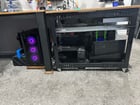
What started as I need a few servers to test software when I was consulting has developed into a mildly unreasonable collection of servers, containers, dashboards, local AI models, and services that my household now quietly depends on.
As most people who get into the hobby my original stack was 4 power hungry HP dl360p that ran continually in my garage for about 2 years with a full VMware stack on them. It then rapidly grew into something that I have to schedule down with the wife on haha. This is the form today but will likely change in the very near future.
Core infrastructure
– Ragnar — primary Proxmox host
– Frode — Docker host for Forgejo, Nginx Proxy Manager, Uptime Kuma, Portainer, and internal services
– Rothbruk — Jellyfin/media VM with a roughly 40TB MergerFS pool
– Logathien — monitoring and operations stack
– Bodil — Home Assistant OS
– Arne — Sharkord, a self-hosted Discord-like server
– Claw — Hermes AI agent/operator VM
– docker-gaming — dedicated VM for containerized game servers (Taking suggestions for the rename lol)
Most of the important services run as Proxmox guests
The media pile –
Rothbruk runs:
– Jellyfin
– Sonarr
– Radarr
– Bazarr
– Prowlarr
– Jellyseerr
– qBittorrent
– Autobrr
– Cleanuparr
– ClamAV
qBittorrent, Prowlarr, and FlareSolverr are kept behind Gluetun and ProtonVPN. Media storage is pooled with MergerFS so I can expand it one disk—and one poor financial decision—at a time.
Local AI –
ai-bob:
– Ryzen 7 5800X
– 32 GB RAM
– Radeon RX 6800 XT 16 GB
– Radeon RX Vega 56 8 GB
– Dedicated NVMe model storage
– Ollama and llama.cpp
– Odysseus AI workspace
– Custom Discord LLM bot with Redis and Qdrant memory
llama.cpp can split models across both AMD GPUs using Vulkan. I also have my local models using a nomic database that runs fully in GPU through Ollama. My Local AI piece is constantly changing but I have found it to be more and more useful.
Monitoring and operations
Logathien runs the observability pile:
– Grafana
– Prometheus
– Loki
– Grafana Alloy
– InfluxDB
– Telegraf
– node-exporter
– cAdvisor
– Beszel
– ntfy
– SearXNG
I also have read-only health scripts and an AI operator that can correlate metrics, check hosts, inspect Docker/Proxmox state, and recommend the smallest safe remediation. High-impact actions like reboots, DNS changes, storage changes, but broad container updates still require explicit approval. Part of this iteration of my homelab is to find the limits of agentic workflows. I want to see what it can do with well written GIT helper documents and hopefully be able to run everything locally in the future.
Network and household infrastructure
– UniFi Dream Machine Pro (Not Pictured)
– USW-16-PoE(Not Pictured)
– USW-48-G2
– U6 Pro and U6 Lite
– Separate IoT networks
– Two Pi-hole DNS servers
– Nginx Proxy Manager for internal routing and selected external services
– Home Assistant with a dedicated household dashboard display
Power protection is a CyberPower CP1500PFCLCD connected to a physical Pi-hole host through USB and monitored with NUT. It is currently notification-only while I validate runtime and shutdown behavior before allowing it to automatically turn off the lab.
Source of truth
One of the biggest improvements was treating documentation as part of the infrastructure. Compose files, inventories, host artifacts, recovery notes, and runbooks live in a self-hosted Forgejo repository.
https://www.reddit.com/gallery/1vqwcqy
Source: r/homelab · by /u/lotofsoldier