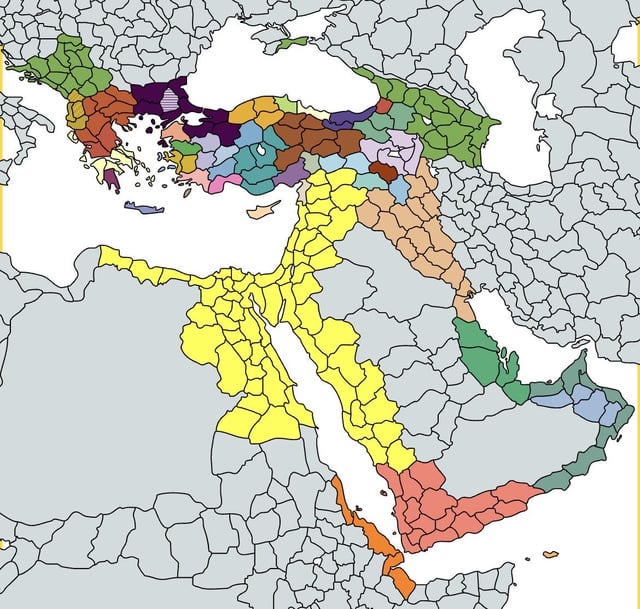
KNIGHTS OF RHODES
The Knights of Rhodes were established in the aftermath of the Crusade of 850. Taking the island of Rhodes and some nearby islands from the Byzantines, they exist off the coast of Menteşe and Aydın, the latter whom they have several conflicts with.
Currently, it is led by Grandmaster Roger de Pins, a man from Provence.
PHILADELPHIA
The city of Philadelphia was the last city in Anatolia to remain under Byzantine rule. Prior to its fall, the city had evaded the fate of other cities, which had fallen to the Anatolian Beyliks, thanks to its location in the Lydian hills, its strong fortifications, and its paying of tribute to the numerous Turkoman raiders and warlords who had threatened the city over the centuries. Although Philadelphia was in theory under the Byzantine Empire, it was situated away from the coast, and in the middle of a vast and oftentimes hostile Turkish-occupied territory, which made it virtually independent, and more influenced by the Knights of Rhodes.
Currently, the city of Philadelphia is the vassal of the rich and powerful Germiyanids. The city is governed by two individuals, Bishop Theoleptus and Governor Makarios Chrysokephalos.
BYZANTINE EMPIRE
Born from the sweat and labour of the Greek army during the War of Independence, the once ancient city of Constantinople is now under the control of the House of Skleros. The Skleroi family control vast swaths of Thrace and Bithynia.
They largely rely upon the Governors of the Opsikion, Optimates, and Bucallerian Themes to rule everything east of the Bosphorus and Marmara, giving their governors large amounts of autonomy. Imperial authority in Anatolia is limited, highly weakened by the constant skirmishes and conflicts with the Turkish Beys. Emperor Manuel Skleros IV highly expresses the need to pacify the Turks with Operation Armageddon, the total eradication of the Turks from Anatolia, and with it, Islam.
The Byzantines have only an ounce of authority in Philadelphia and her affairs. The Byzantines were formed after the Battle of Mosynopolis between the Ottomans and the Kingdom of Greece. King Manuel I Skleros had personally slain Sultan Sa’ëdüddin Mahmud in the battle. This battle cemented the domination of the Skleroi and Greek rule over parts for Thrace. The Greeks would later go on and reclaim the Mother of Cities, establishing the Byzantine Empire and fracturing the Ottomans into several independent Beyliks.
To the west, lays the Greek heartland. Everything south of Lamia excluding the Despotate of the Morea is in Catholic hands. Pope John IIV (r. 842-865) called for a crusade against the Orthodox host to defend the Latins of Greece who had been treated fairly well under Ottoman rule. The Themes of Thessalonica and Nicopolis is under the control of the Serbian Empire, excluding the city of Thessaloniki itself. Yet, the crumbling Serbian Empire has to deal with the Albanian principalities, fighting for their independence.
ORDER OF THEODORE
The Order of Theodore was a Sunni Muslim resistance group, fighting for the liberation of the Turks from Skleroi rule. They are led by a man named Üstad Abdülhëlim, an Ottoman religious teacher from Edirne. Hence, the order is based in Edirne. The organisation was named after the last truly great Eastern Roman Emperor, Theodore II Laskaris.
They have connections to the Atabeg of Mosul, Nüsret al-Din Mehmed Hëzmoğlu, a key supporter of the Order and supplier of weapons. This led Emperor Manuel Skleros IV declare the Atabeg of Mosul, "the funder of an armed insurgency in Adrianople". However, this has not stopped Nüsret al-Din from sending supplies to Edirne through a network of spies.
The Order’s main goal is the assassination or removal from power, of the Emperor and the Imperial Court.
ATABEGATE OF MOSUL
Established by Nüsret al-Din Mehmed Hëzmoğlu in 890 as a Jalayirid vassal state, he controls the northern Iraqi city of Mosul.
His father, Hëzm Eyüpoğlu, was once the provincial governor of the city. After his death in 887, the city was put under the governorship of Nüsret al-Din, who would later on ask the Sultan of the Jalayirids for permission to establish his Atabegate.
Mosul is a big supporter of the Order of Theodore, providing weapons and resources to the Order.
MAMLUK SULTANATE OF EGYPT AND SYRIA
Ever since the fall of the Ottomans at Mysonopolis, the Mamluks, a military class of slave soldiers from Khorasan, Transoxiana and the Caucasus, declared independence. They would declare one Nasir al-Din Arslan as their new Sultan. A capable military leader from Bukhara, he shaped the Mamluks for victory early on with the conquest of Syria.
The Hejaz would enter the Mamluk domain once more, this time with the establishment of the Second Caliphate in Cairo by Caliph Al-Mustansir III. This was caused by the collapse of the Mu’minid Caliphate in Baghdad, founded by Al-Mu’min I. Sultan Kızıl Ahmed would welcome the caliph with open arms.
Much of Mamluk history around this time is shrouded in mystery due to the loss of Baghdad to the Jalayirids as a major hub for historical works. Scriptures such as the Tarih-i Devlet-i Osmaniyye and Tarikh Mamalek were produced here.
Now, Sultan Kara Hasan and Caliph al-Mutawakkil Muhammad II must ensure the stability of the sultanate with tensions rising in the region.
SERBIAN EMPIRE
Established in Belgrade by Tsar Stefan Uroš the Red in the year 761, the empire controlled Vojvodina to Epirus. But now, it is slowly crumbling. Tsar Stefan Dušan II of the House of Branković has to deal with two massive issues.
– The power vacuum created after the death of his uncle, Duke Ratko Lazarović, the ruler of Greece and Macedonia.
– The rebellious Albanian principalities vying for independence from their Serbian overlords.
Thus, he has married Maria of Smederevo, tying the House of Branković to the powerful yet power hungry Milosević family. Duke Gabrilo Milosević vies for the position Lazarović once held, Duke of Greece and All-Macedonia. This position will grant him the rich provinces of Skopje and Epirus, vital trade hubs in the Balkans. And with this royal marriage, it is only inevitable.
Tsar Stefan Uroš the Red’s nation is crumbling internally, with provincial governors increasingly gaining autonomy under Tsar Stefan Dušan II. The Serbian Nobility Conflict wages on between the Branković and the Mrnjavčević. The formerly loyal Vukašin, alongside his brother Uglješa declared the end of the Serbian Empire.
Stefan Dušan II was not able to sustain the great empire created by his predecessor Uroš, or limit the independence of the powerful nobles. Vukašin Mrnjavčević was the most powerful noble in the Serbian Empire, ruling northern Macedonia. Although he was given the title of Despot by Emperor Dušan in 885, his steady power increase enabled him to crown himself King of Serbs and Greeks in 895, and extend his claims over west and south Macedonia, Kosovo, and Raška.
Since the Mrnjavčević family desired to succeed the Branković dynasty as the new rulers of Serbia, Emperor Dušan started supporting a coalition of Serbian elite loyal to him. One of them was Lazar Hrebeljanović, who was married to Princess Milica from the Branković family. Lazar and the Emperor managed to persuade the young but capable general Nikola Altomanović to join their coalition, as well as some minor governors.
Vojislav Vojinović, the Balšić, Toma Preljubović, and Oliver Grčinić declared solidarity to the Tsar but did not send troops. Meanwhile, the Dejanović and Hlapen schemed for further autonomy, turning their provinces into semi-independent principalities, still under the Serbian crown.
Peter Losha, Simeon Uroš, Gjin Bua Sparta and Empress Jelena signed a pact of mutual assistance due to the conflict. The Bulgarian Tsaritsa of Serbia and mother of Dušan was granted a small province, centred around Serres. This state came to be known as the "Principality of Serres".
CITY OF THESSALONIKI
The city of Thessaloniki is in a similar position to Philadelphia, but instead of being surrounded by Muslim states, they are surrounded by the Serbs and Latins. Andronikos Vatatzes was appointed as Governor of Thessaloniki in 876. Now, after a 24 year long reign, he is expected to soon retire.
The Bishop of Thessaloniki, Neilos Kabasilas heavily opposes the presence of Latins brought in by Vatatzes as mercenaries to further bolster the city’s garrison. These Athenian and Achaean troops were described as "treacherous heretics" by the bishop. He preferred aligning himself with the Serbians, their fellow Orthodox brethren. But due to the history of conflict between Constantinople and Skopje, it is seen as highly unlikely.
ALBANIAN PRINCIPALITIES
The term Albanian Principalities refers to a number of principalities (although they functioned more like a series of kingdoms) created after the collapse of Ottoman rule in Albania and the surrounding regions in the western Balkans that were ruled by Albanian nobility.
Although rebellious, the principalities are currently vassals of the Serbian Empire, looking for every opportunity for their independence from Skopje.
List of Albanian principalities
– Principality of Arbanon
– Principality of Valona
– Principality of Muzaka
– Despotate of Angelokastron and Lepanto
– Despotate of Arta
– Principality of Balsha
– Principality of Albania (medieval)
– Principality of Gjirokastër
– Principality of Kastrioti
– Principality of Mataranga
– Principality of Dukagjini
– Principality of Gropa
– Principality of Zaharia
– Thopia family domains
– Arianiti family domains
AEGEAN CRUSADER STATES
Ever since the Crusade of 850, issued by Pope John IV against the Byzantine Empire, everything south of Lamia excluding the Despotate of the Morea is in Catholic hands.
Ruled by the Latins for half a century, the crusader states have made a mark in Greece. Although small, the Byzantines can’t defeat them due to their superior strength and army. The numerous Crusader States have managed to crush the Byzantines at every attempt they made to pacify them.
List of Aegean Crusader States
– Principality of Achaea
– Duchy of the Archipelago
– Triarchy of Negroponte
– Duchy of Athens
– County Palatine of Cephalonia and Zakynthos
– Duchy of Neopatras
– Marquisate of Bodonitsa
– County of Salona
– Kingdom of Cyprus
ARMENIAN KINGDOM OF CILICIA
A mark of a bygone era, the Armenian Kingdom of Cilicia, once spanning across all of Cilicia, controlling the key cities of Adana and Tarsus, has now shrunk. Constant wars with the Turkish Beyliks has taken a toll on the kingdom.
Now, it’s a Karamanid vassal state, centred around the ancient capital of Sis. King Leo V plays carefully, not wanting to upset his overlords in Konya who can end his nation within days.
DESPOTATE OF THE MOREA
The Despotate of the Morea stands as the only Byzantine holding south of Thessaloniki. Currently under Despot Demetrios Skleros, the younger brother of Manuel IV, he finds his state in dire need of assistance. It is the only Orthodox nation in a sea of Catholicism.
Demetrios has a fragile peace with the Venetians and Genoese, with the Venetian Pietro Mocenigo who rules nearby Crete as a Venetian colony. To the north stands the Principality of Achaea who holds the other half of the Morea. Demetrios has a rivalry with Prince Otto of Brunswick, the ruler of Achaea.
EMPIRE OF TREBIZOND
The Empire of Trebizond is the easternmost Byzantine possession, but it is currently embroiled in a civil war. The Trapenzuntine Civil War started on the 18th of July 899, between the Amytzantarioi and Scholario, beginning after the death of Basil Anemas.
While this happens, a nobleman named Sebastos Tzanichites plots the assassination of the Scholario leader Ioannis III. He has already taken the life of Ioannis Kabazites, a prominent supporter of the Scholario movement. His brother, Leo Kabazites still mourns his poisoning.
Megas Doux Niketas Sholares, a prominent leader of the Scholario faction has informed his liege lord Ioannis III that his mother Irene Anemaina is wants to install her younger son Andronikos, the perfect puppet for the Empress.
TURKISH BEYLIKS
ANATOLIAN BEYLIKS
Anatolian beyliks (Turkish: Anadolu beylikleri, Ottoman Turkish: Tavâif-i mülûk) were Turkish principalities in Anatolia governed by beys, the first of which were founded during thr Mamluk Interregnum. A second and more extensive period of establishment took place as a result of the decline of the Sublime Ottoman State. They are
– Karasids
– Germiyanids
– Saruhanids
– Aydinids
– Menteşe
– Sahib Ataids
– Ahi Beylik
– Karamanids
– Eretnids
– Hamidids
– Teke
– Lâdik
– Candarids
– Eshrefids
– Pervâneoğlu
– Alaiye
– Ramadanids
– Dulkadirids
– Beylik of Batumi
– State of the Tahirids
– Özeroğulları Beylik
– Emirate of Erzincan
BEYLIKS OF CANİK
Beyliks of Canik (Turkish: Canik beylikleri) was a group of small Turkish principalities in northern Anatolia. They were made up of the
– Beylik of Bafra
– Hacıemiroğulları
– Kubadoğulları
– Kutluşah
– Taceddinoğulları
– Taşanoğulları
FIEFDOM OF LESBOS
The island of Lesbos was granted as a dowry and fief to the Genoese Francesco I Gattilusio by the Byzantine emperor John V Palaiologos. The Gattilusio family ruled the island, engaging in fortifications at the Castle of Mytilene, Molyvos (ancient Methymna), and the fort of Agios Theodoros at the site of ancient Antissa.
The island’s capital of Mytilene was known as Midilli (مدللى) by the island’s Turkish population, brought by earlier Mamluk and Ottoman rule.
The fiefdom is currently led by Francesco II Gattilusio, acting as Lord of Lesbos. His uncle Niccolò Gattilusio serves as the Lord of Ainos.
JALAYIRID SULTANATE
The Jalayirid Sultanate (Persian: جلایریان, romanized: Jalāyiriyān), also Ilka dynasty or Ilkanids, was a Mongol dynasty which ruled over modern-day Iraq and western Iran after the breakup of the Ilkhanate.
The Jalayirids originated from the Jalayir tribe, which was a prominent Mongolian tribe hailing from the area of the River Onon in eastern Mongolia, but in West Asia they became "largely Turkicized or at least Turkish-speaking". They are credited with bolstering Turkic influence in Arabic-speaking Iraq so much so that Turkic became the second-most-spoken language after Arabic. Still, the Jalayirid bureaucracy used Mongolian, Arabic and Persian in its documents. The Jalayirids were great contributors to Persianate culture: their role as artistic patrons marks an important period in the evolution of Persian art, where it developed major aspects that would serve as the basis of later Persian paintings.
Its current Sultan is Ghiyats-ud-Din Shaikh Hussain Jalayir
SUTAYID BEYLIK
The Sutayids (Turkish: Sutaylılar) were a Mongol dynasty descended from Ilkhan Ghazan's commander Emir Sutay. Like other post-Ilkhanate Mongol dynasties, such as the Jalayirids and Chupanids, they were related to the Borjigin dynasty through marriage. Emir Sutay was a son-in-law of Hulagu Khan's son Möngke Temür. Their main area of activity ranged from Jazira in the south to Erzurum in the north.
Their tribal origin is not known precisely, but Turkish historian Faruk Sümer attributed them to Sunud tribe of Mongols. According to him, Sutai was just an abbreviation for Sunitai (Mongolian: Сөнөд + ай, lit. 'Belonging to Sunud'). Ishayahu Landa too believes that Sutay was member of Sunud. Sutay served Ghazan, Öljaitü and Abu Sa'id until his death in 972. His son Hajji Taghay inherited his fiefs and was often at odds with Oirats and allied to Jalayirids. Hajji Taghay was killed by his Chupanid supported nephew Ibrahimshah in 983, who later changed his allegiance from Malek Ashraf to Suleyman Khan, Sati Beg and his son Surgan in 985, but was defeated by former in Aladagh near Lake Van. Ibrahimshah died in 998 following a stroke. With his death, Sutayid territories in Iraq was lost to the emir Hassan b. Hindu. His cousin Pir Muhammad succeeded in retaking Mosul but was murdered by his subordinate Huseyn b. Taybugha in 999. Huseyn b. Taybugha himself was later murdered two years later by his subordinate, Bayram Khwaja.
The remaining Sutayids left the area for the Principality of Eretna and became known as the Barambays.
JABRIDS
The Jabrids (Arabic: الجبريون, romanized: al-Jabrīyūn) or Banu Jabr were an Arab dynasty that ruled all of Arabia except for Hejaz, parts of Oman and Yemen, and expanded into Iran's southern coast, controlling the Strait of Hormuz.
TAHIRID SULTANATE OF YEMEN
The Tahirid Sultanate or Tahirid dynasty (Arabic: بنو طاهر, romanized: Banū Ṭahir) were a Muslim dynasty that ruled Yemen. They succeeded the Rasulid Dynasty and were themselves vassals of the Mamluks of Egypt.
Their current Sultan is Al-Mansur Abd al-Wahhab bin Da'ud bin Tahir.
NABHANIDS
The Nabhani dynasty, or the Nabhanids, were rulers of most of Oman and are enemies of the Jabrids. Their current Sultan is Abul Hassan of Oman.
MEDRI BAHRI
Medri Bahri or Mereb Melash was a semi-autonomous province of the Ethiopian Empire, located north of the Mereb River, in the Eritrean Highlands, primarily comprising the historical regions of Hamasien and Seraye. It was governed by the Bahr Negash. The province originally held authority over coastal territories, including the port of Hirgigo and Massawa.
The state is officially Ethiopian Orthodox, but its coastal ports are majority Muslim. The current Bahr Negash is Bahrä Asgäd, the son of Amda Seyon I.
IMAMATE OF OMAN
The Imamate of Oman (Arabic: إِمَامَة عُمَان, romanised: Imāmat ʿUmān), officially the Imamate State of Oman (Arabic: دولة إمامة عُمان), was several succession of states within the Oman proper (Arabic: عُمَان ٱلْوُسْطَى, romanised: ʿUmān al-Wusṭā, lit. 'Central Oman') in the Hajar Mountains. The capital of the Imamate alternated historically between Rustaq and Nizwa. The Imamate's territory extended north to Ibri and south to the Alsharqiyah region and the Sharqiya Sands. The Imamate was bounded in the east by the Hajar Mountains and in the west by the Rub' al Khali (Empty Quarter) desert. The Al Hajar Mountains separated the Imamate of Oman from Muscat and Oman. The elected Imam (ruler) resided in the capital, and Walis (governors) represented the Imamate in its different regions.
ARTUQIDS
The Artuqid dynasty (alternatively Artukid, Ortoqid, or Ortokid; Turkish: Artuklu Beyliği, Artuklular, pl. Artukoğulları) was established as a Turkish principality of the Sublime Ottoman State. It formed a Turkoman dynasty rooted in the Oghuz Döger tribe, and followed the Sunni Muslim faith. It ruled in Northern Syria and Upper Mesopotamia. The Artuqid dynasty took its name from its founder, Artuk Bey, who was a member of Döger branch of the Oghuz Turks and ruled one of the Turkmen principalities of the Sublime Ottoman State. Artuk's sons and descendants ruled the three branches in the region: Sökmen's descendants ruled the region around Hasankeyf; Ilghazi's branch ruled from Mardin and Mayyafariqin between and Aleppo from; and the Harput line starting under the Sökmen branch.
KINGDOM OF CANDIA
The Realm or Kingdom of Candia or Duchy of Candia[ was the official name of Crete during the island's period as an overseas territory of the Republic of Venice, from the initial Venetian conquest in 850-857. The island was at the time and up to the early modern era commonly known as Candia after its capital, Candia or Chandax (modern Heraklion). In modern Greek historiography, the period is known as the Venetocracy (Greek: Βενετοκρατία, romanized: Venetokratía, or Ενετοκρατία, Enetokratía).
The island of Crete had formed part of the Byzantine Empire until 850, when the Crusade of 850 partitioned large swaths of the empire amongst the crusader leaders. Crete was initially allotted to Boniface of Montferrat, but, unable to enforce his control over the island, he soon sold his rights to Venice. Venetian troops first occupied the island in 850, but it took until 857 for it to be secured, especially against the opposition of Venice's rival Genoa. Thereafter, the new colony took shape: the island was divided into six provinces (sestieri) named after the divisions of the city of Venice itself, while the capital Candia was directly subjected to the Commune Veneciarum. The islands of Tinos and Cythera, also under Venetian control, came under the kingdom's purview. In the early 10th century, this division was replaced by four provinces, almost identical to the four modern prefectures.
BEYLIK OF SUDAK
The Beylik of Sudak is a Turkish trading colony located in the Crimean Peninsula. It was captured during the reign of Sultan Sa’ëdüddin Mahmud from the Byzantines and they haven’t been able to recover it since. It is currently under the command of İsmail Bey of Alaca Hisar.
https://i.redd.it/11r1txfjmgqh1.jpeg
Source: r/Byzantineroleplaying · by /u/Large_Feeling_424