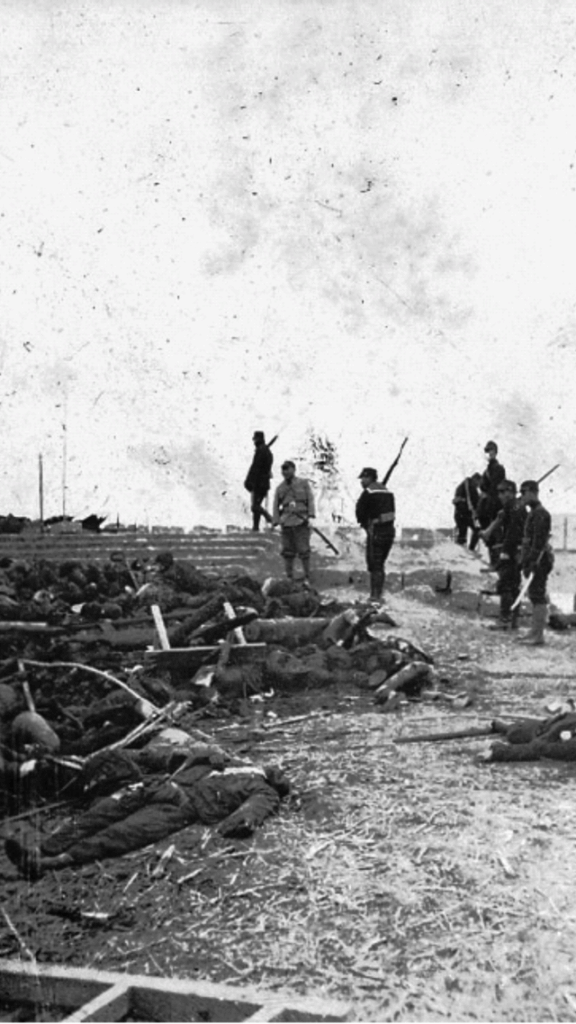
⚠️ Content Warning: The introductory segment of the attached video contains verified historical archival photographs of wartime casualties from the 1937 Nanjing Massacre. Viewer discretion is advised.
When we look back at catastrophic events like the Nanking Massacre in 1937, our modern minds instinctively try to categorize it as an anomaly. We label it an era of extreme wartime radicalization, look at the archival photos, and move on with a sense of comfortable detachment. We treat the horror as a distant, closed chapter.
The attached video begins with four critical pieces of historical evidence from the archives of the Nanjing Massacre:
• The Itau Kaneo album displaying casualties along the city streets.
• The execution of a Chinese POW by a Japanese officer.
• The deliberately burned remains of civilians near Xiaguan.
• Bodies of Chinese massacred by Japanese troops along a river in Nanjing.
Confronting these raw images is deeply shaking. But if we pause to think deeply, a jarring question arises: Why does humanity find it so easy to gloss over the absolute dirt of our past to maintain a comfortable, unexamined present?
True history isn't just a timeline of grand strategies and political victories. It is a mirror reflecting a chaotic, unyielding cycle of human unconsciousness. In the attached video clip, philosopher Acharya Prashant breaks down this exact dilemma of historical amnesia. He challenges the idea that we can cleanly separate ourselves from the brutalities of the past.
When a society refuses to address its historical group trauma and deep-seated survival instincts, it doesn't solve the problem, it merely buries it under a thin veneer of modern civilization. The primitive, defensive ego that drove the atrocities of the 20th century didn't vanish; it just learned to wear a suit and tie.
If we keep studying history purely on the surface level, without examining the inner darkness and primal urges that created these events, aren't we just waiting for the exact same patterns to replay themselves under a different name?
I’d love to hear this sub’s thoughts on this. When we look at the wildest, most brutal moments in history, are we looking at a failure of political systems, or are we looking at a fundamental flaw in the unchanged human psyche?
***
Archival Note & Image Credits: All historical images utilized in the introduction are sourced directly from the public domain historical records preserved on the Wikipedia page for the Nanjing Massacre (including documented photographs by Itau Kaneo and Moriyasu Murase).
https://v.redd.it/44uqtd8ak6qh1
Source: r/HistoryWasWild · by /u/Kalpesh_38