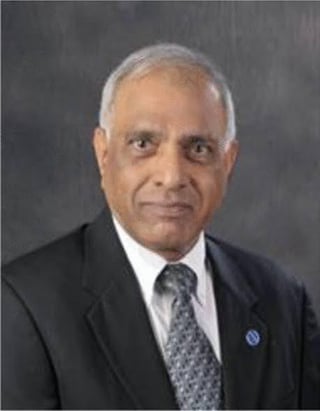
Among engineers of Indian origin who have shaped modern mechanical engineering, Junuthula N. Reddy—universally known as J. N. Reddy—occupies an exceptional position. His career spans finite-element analysis, solid mechanics, composite structures, plate and shell theories, variational methods, continuum mechanics, fluid mechanics, nonlinear mechanics, nonlocal theories, fracture, and engineering education. More importantly, several of his contributions became part of the conceptual machinery by which later generations of engineers actually analyse structures.
Calling any individual the "greatest" mechanical engineer of Indian origin is necessarily subjective. Mechanical engineering is too broad for a mathematically provable ranking: one scholar may revolutionize materials, another manufacturing, another fluid mechanics, another design, and another computational engineering. Yet if greatness is judged by a combination of fundamental theory, methods used in engineering practice, named theories, worldwide scholarly influence, textbook impact, mentorship, longevity, and recognition by the major mechanics societies, then a remarkably strong argument can be made that J. N. Reddy has the strongest overall claim among modern mechanical engineers of Indian origin.
He is not simply an extremely prolific professor. He belongs to the much smaller category of engineers whose names become attached to the mathematical theories that other researchers routinely use.
Texas A&M describes Reddy as internationally known for pioneering shear-deformation theories bearing his name—the Reddy third-order plate theory and Reddy layerwise theory—as well as for major contributions to finite-element methods and the mechanics of composite structures. His work has also found its way into engineering software including ABAQUS, NISA and HyperXtrude.
From Osmania University to the Frontiers of Mechanics
Reddy's academic beginnings were in India. He received his Bachelor of Engineering in Mechanical Engineering from Osmania University in Hyderabad in 1968. He subsequently moved to the United States, earning an M.S. in Mechanical Engineering from Oklahoma State University in 1970 and a Ph.D. in Engineering Mechanics from the University of Alabama in Huntsville under J. Tinsley Oden, one of the great pioneers of computational mechanics. He then undertook postdoctoral work at the Texas Institute for Computational Mechanics at the University of Texas at Austin.
That intellectual lineage was important. Computational mechanics was then undergoing a remarkable transformation. Computers were becoming sufficiently powerful for numerical methods to move from specialist mathematical techniques toward practical engineering tools. The finite element method, in particular, was developing into one of the foundations of modern engineering simulation.
Reddy entered the field at precisely this formative moment.
After a period as a research scientist at Lockheed Missiles and Space Company, he joined the University of Oklahoma. He moved to Virginia Tech in 1980 and eventually, in 1992, joined Texas A&M University as the inaugural holder of the Oscar S. Wyatt Jr. Endowed Chair in Mechanical Engineering.
His later titles—Distinguished Professor, Regents Professor, endowed chair professor, National Academy of Engineering member—reflect what became one of the most decorated careers in modern applied mechanics.
But the titles tell only a fraction of the story.
The Finite Element Method: Turning Continuum Mechanics into Computable Engineering
To understand Reddy's importance, one must first understand the finite element method.
Mechanical engineering problems are frequently governed by partial differential equations. A structure deforms according to elasticity equations; heat flows according to thermal equations; fluids obey momentum and conservation equations; vibrating structures satisfy dynamic equations.
For realistic engineering geometries these equations usually cannot be solved exactly.
The finite element method solves this problem by dividing a complicated physical domain into smaller regions—elements—within which the unknown field is approximated using relatively simple functions. The element equations are assembled into a large system of equations representing the complete structure or continuum.
Modern aircraft, automobiles, turbines, bridges, spacecraft, biomedical implants and countless other engineered systems are routinely analysed with finite-element software.
Reddy did not invent the finite element method, and describing him as its sole inventor would diminish rather than strengthen the historical case for his greatness. FEM had important pioneers before and alongside him, including Richard Courant, Ray Clough, John Argyris, Olgierd Zienkiewicz, J. Tinsley Oden, Robert Taylor and others.
Reddy's achievement was different.
He became one of the major figures who deepened its mathematical foundations, extended it into difficult classes of mechanical problems, developed influential formulations and taught generations of engineers how to understand it systematically.
His early collaboration with Oden produced works such as A Mathematical Theory of Finite Elements and Variational Methods in Theoretical Mechanics. His later An Introduction to the Finite Element Method became a classic engineering textbook, reaching a fourth edition and being translated into other languages. Texas A&M lists editions beginning in 1984 and continuing through the fourth edition, while McGraw-Hill describes the modern edition as a broad treatment connecting FEM with multiple branches of engineering.
Reddy's approach was particularly important because he did not treat FEM as merely a collection of computer recipes.
He connected the method to:
differential equations,
continuum mechanics,
energy principles,
variational calculus,
weak formulations,
interpolation theory,
numerical approximation,
constitutive behaviour,
and computational implementation.
Thus students could understand not merely how to run a finite-element calculation, but why the equations existed.
This became one of the defining characteristics of the Reddy school of mechanics: mathematical rigor connected directly with engineering usefulness.
Reddy's Third-Order Shear Deformation Theory
Perhaps Reddy's most identifiable scientific contribution is his work on higher-order shear deformation theories for plates and shells.
A plate seems geometrically simple: its thickness is small relative to its length and width. But modelling plates accurately becomes difficult when the plate is moderately thick, laminated, anisotropic or made from composite materials.
Classical thin-plate theory assumes that lines initially normal to the middle surface remain normal after deformation. This works extremely well for sufficiently thin plates.
For thicker plates, however, transverse shear deformation matters.
First-order shear deformation theories improve the situation by permitting transverse shear deformation. But the assumed shear strain distribution is simplified, frequently requiring an empirical shear correction factor.
Reddy developed a more refined description.
In the celebrated third-order formulation, the displacement variation through the plate thickness includes cubic terms. In simplified notation, the in-plane displacement can be represented schematically as:
(4z³/3h²)(φ_x + ∂w₀/∂x)
with an analogous expression for the second in-plane direction.
This produces a transverse shear-strain distribution that varies through the thickness approximately as:
γ_xz ∝ (1 − 4z²/h²)
At the upper and lower surfaces,
z = ±h/2
and therefore
1 − 4z²/h² = 0
Consequently the transverse shear stress naturally satisfies the appropriate zero-traction behaviour at the surfaces.
The physical significance is profound: the theory can capture important transverse-shear effects without relying on the artificial shear-correction factor required by simpler first-order models.
Reddy's 1980s work demonstrated that refined higher-order theories could provide substantially improved predictions of deflections, stresses, vibration characteristics and related quantities compared with simpler classical formulations. NASA documentation of related Reddy shear-deformation work explicitly notes that the formulation avoids the need for shear-correction factors.
The theory became sufficiently influential that later engineering literature routinely refers to formulations as "Reddy's third-order shear deformation theory," "Reddy's higher-order theory," or simply Reddy TSDT.
That is an extraordinary form of scientific legacy.
Engineering history contains many highly cited researchers. Far fewer researchers develop a mathematical model so influential that subsequent authors identify the theory using the researcher's surname.
Composite Materials and the Reddy Layerwise Theory
Reddy's influence became particularly important with the growth of laminated composite structures.
Composites are fundamentally different from ordinary homogeneous metals. A composite laminate may consist of many thin layers whose fibers point in different directions. Engineers deliberately select those orientations to obtain desired combinations of stiffness, strength, weight and directional behaviour.
This gives composites enormous advantages in aerospace and advanced structures—but creates difficult analytical problems.
Consider a laminate containing ten or twenty individual layers. The displacement may be continuous across the structure while stresses and material properties vary substantially from layer to layer. Interlaminar stresses can become critical because they influence delamination, one of the major failure mechanisms in laminated composites.
A simple equivalent-single-layer model can miss important through-thickness behaviour.
Reddy developed influential layerwise theories in which the displacement field can be described with much greater resolution through the individual laminate layers.
Instead of pretending that the complete laminate behaves like one uniform plate, a layerwise theory acknowledges its internal architecture.
This allows improved prediction of quantities such as:
interlaminar stresses,
transverse shear stresses,
layer-by-layer deformation,
delamination-sensitive behaviour,
thick composite response,
sandwich structures,
and highly anisotropic laminates.
Texas A&M explicitly identifies both the Reddy third-order theory and the Reddy layerwise theory as internationally recognized contributions.
This work arrived during the period when advanced composites were becoming increasingly important in aerospace engineering.
Modern aircraft and spacecraft depend heavily upon laminated composite materials. Accurate mathematical modelling of these structures therefore has consequences far beyond academic plate theory.
It affects how engineers understand real lightweight structures.
From Equations to Engineering Software
A particularly important measure of engineering impact is whether a mathematical contribution escapes the research paper and becomes part of engineering practice.
Several of Reddy's formulations did.
Texas A&M reports that his shear-deformation theories of composite laminates, penalty finite-element models for viscous flows and finite-element models for non-Newtonian fluids were incorporated into commercial programs including ABAQUS, NISA and HyperXtrude.
This is significant.
A theorist can produce elegant mathematics that remains known primarily to other theoreticians. An industrial engineer can produce practical solutions without fundamentally changing theory.
Reddy repeatedly crossed the boundary between the two.
He derived mathematical formulations at the level of continuum mechanics and variational principles, converted them into numerical formulations, and helped establish methods capable of being incorporated into practical computational tools.
That combination—theory → numerical method → software → engineering application—is one reason his career is so difficult to match.
Variational Methods: The Mathematical Core of Reddy's Work
Underlying much of Reddy's research is the theory of variational methods.
A mechanical problem can often be expressed in multiple mathematical forms.
One may begin with differential equations describing local equilibrium. Alternatively, one may formulate the same physical problem by considering energy or an integral functional.
The finite-element method becomes especially natural when written in such a variational or weak form.
Schematically, if a physical field u is governed by a differential operator,
L(u) = f
one may transform the problem into an integral statement such as:
∫_Ω δu [L(u) − f] dΩ = 0
followed by integration by parts and appropriate boundary conditions.
This transformation can reduce differentiability requirements and create a formulation suitable for finite-element discretization.
Reddy became one of the leading engineering educators in explaining the connection between mechanics, variational calculus and computational approximation.
His contributions included primal-dual and complementary variational principles, mixed finite-element methods and other mathematical formulations. Texas A&M's description of his research specifically highlights dual-complementary variational principles, the mathematical theory of finite elements, mixed formulations and least-squares approaches.
His importance therefore extends deeper than any single plate equation.
He helped establish a way of thinking about engineering mechanics mathematically.
Fluid Mechanics, Heat Transfer and Least-Squares Finite Elements
Reddy's career was also unusually broad.
It would have been sufficient for a major scientific reputation to develop influential theories of composite plates and shells. But he also worked extensively on computational fluid mechanics and heat transfer.
Among the subjects investigated by Reddy and collaborators were:
incompressible viscous flows,
non-Newtonian fluids,
penalty finite-element formulations,
Navier-Stokes equations,
least-squares finite-element methods,
heat-transfer problems,
coupled continuum problems.
His later textbooks similarly crossed conventional disciplinary boundaries. Cambridge University Press describes him as an internationally recognized authority in applied and computational mechanics and notes the implementation of his formulations in commercial engineering software.
This breadth matters when assessing his place in mechanical engineering.
Reddy was not exclusively a structural engineer.
His work spans the three great mathematical continua encountered throughout mechanical engineering:
solids, structures and fluids, with heat transfer connecting them.
Nonlocal Mechanics, Damage and the Later Reddy
Another indication of Reddy's stature is that his career did not simply freeze around the theories that made him famous in the 1980s.
He continued working on newer problems in continuum mechanics, including:
nonlocal theories,
non-classical continuum mechanics,
nanoscale structural theories,
functionally graded materials,
fracture and damage,
viscoelasticity,
biomechanical applications,
advanced shell formulations.
With Arun Srinivasa and others, Reddy developed graph-based approaches to finite-element analysis, including GraFEA/GraFEM ideas aimed at modelling damage and fracture in elastic and viscoelastic solids. Texas A&M describes this as a network-based methodology for studying damage and fracture, including in composite structures.
The important point is not that every later Reddy theory achieved the fame of his plate theories.
Rather, it demonstrates extraordinary intellectual longevity.
His career stretches from the formative decades of finite-element mechanics to twenty-first-century problems involving multiscale, nonlocal and damage mechanics.
The Textbooks: Reddy the Teacher of Engineers
If Reddy had published no famous plate theory but had written his textbooks alone, he would still possess an impressive engineering legacy.
His works cover subjects including:
finite-element methods,
nonlinear finite-element analysis,
continuum mechanics,
composite structures,
plates and shells,
variational methods,
applied functional analysis,
solid mechanics,
heat transfer and fluid dynamics.
A 2025 scholarly tribute marking his eightieth birthday describes him as the author of 25 widely adopted textbooks and monographs covering finite elements, composites, continuum mechanics, applied mathematics and nonlinear mechanics.
Among them, An Introduction to the Finite Element Method is particularly important.
Its endurance through multiple editions is itself revealing. Engineering computation changed enormously between the first edition and the fourth. Yet the underlying framework remained useful because Reddy taught not one software package, but the mathematical structure of FEM.
This educational contribution multiplies the effect of his research.
Suppose an engineer develops one influential equation. Thousands may use it.
But suppose the same engineer writes textbooks through which hundreds of thousands of students learn how to derive and implement computational mechanics.
The second contribution continually reproduces itself.
A professor trained from Reddy's books teaches another generation. Those engineers design aircraft, automobiles, machines, structures and biomedical systems. Others become researchers and extend the theories further.
This is how an academic career acquires civilizational-scale technical influence: not because every engineer knows the author's biography, but because the author's methods have entered the intellectual infrastructure of the discipline.
The Extraordinary Medal Record
Reddy's awards provide another reason the claim of greatness deserves serious consideration.
He received the ASME Medal in 2016, the highest award of the American Society of Mechanical Engineers. ASME's citation recognized his lasting contributions to applied mechanics, particularly his textbooks and the development of shear-deformation plate and shell finite elements for composite structures.
In 2017 he received the John von Neumann Medal from the U.S. Association for Computational Mechanics. USACM describes it as its highest award, and Reddy was cited for pioneering work on shear-deformation and layerwise theories, finite-element methods for solids and fluids, and his highly cited books.
In 2018 he received the Theodore von Kármán Medal, one of the premier honors in engineering mechanics. The citation emphasized his fundamental contributions to shear-deformation theories of plates and shells and his influence on mechanics education.
Then came the Timoshenko Medal in 2019.
The Timoshenko Medal is one of the most prestigious lifetime honors in applied mechanics. Reddy was recognized for lifetime contributions involving variational principles, refined plate and shell theories, computational methods, nonlocal theories and engineering education.
And in 2022 he received the IACM Congress Medal, or Gauss-Newton Medal, the highest honor of the International Association for Computational Mechanics. Previous recipients include giants such as John Argyris, O. C. Zienkiewicz, J. Tinsley Oden, Thomas J. R. Hughes and Ted Belytschko—the foundational names of computational mechanics itself.
In 2023 the European Academy of Sciences awarded Reddy its Leonardo da Vinci Award, its highest honor, recognizing his research and educational contributions to composite materials and structures.
This combination is exceptional.
It means that Reddy has been recognized at the highest levels in:
mechanical engineering, applied mechanics, engineering mechanics and computational mechanics.
Few engineers anywhere—not merely among engineers of Indian origin—assemble such a collection.
National Academy of Engineering and International Recognition
Reddy was elected to the U.S. National Academy of Engineering in 2015, with recognition for his contributions to composite structures and engineering education.
He has additionally been associated with or elected to numerous engineering academies internationally. Recent professional biographies list recognition from engineering academies in India, Canada, Brazil, China, Spain and European scientific academies.
His influence has even produced an unusual institutional tribute: the establishment of a J. N. Reddy Chair in Applied Mechanics at Texas A&M, while a J. N. Reddy Medal was created to recognize distinguished contributions to mechanics of advanced materials and structures.
Having a medal named after a living researcher is a particularly striking indication that the professional community considers his work foundational enough to represent a continuing tradition.
Why Reddy Has Perhaps the Strongest Claim to "Greatest"
There have been other extraordinary mechanical engineers of Indian origin, and any serious assessment must acknowledge that.
Satya N. Atluri, for example, has made enormous contributions to computational mechanics, fracture mechanics and meshless methods. Subra Suresh has made seminal contributions to materials mechanics, fracture, nanomechanics and biological materials while also holding major scientific leadership positions. Numerous Indian-origin engineers have achieved distinction in fluids, combustion, manufacturing, materials and aerospace engineering.
Therefore Reddy cannot be declared mathematically or historically "the greatest" as if an objective ranking exists.
But he has perhaps the strongest comprehensive case.
Why?
Because virtually every conventional measure of engineering greatness converges in his career.
1. He created identifiable fundamental theory
The Reddy third-order theory and Reddy layerwise theory are not merely papers with many citations. They became recognizable families of structural theories.
2. His theory entered engineering practice
Parts of his work were incorporated into major commercial computational packages.
3. He shaped computational engineering
His contributions span finite elements, variational formulations, mixed methods, penalty formulations, least-squares methods and later computational frameworks.
4. He influenced multiple branches of mechanics
His work crosses solids, structures, composites, fluids, heat transfer, fracture, nonlocal mechanics and biomechanics.
5. He educated generations
Few leading researchers have simultaneously produced such an extensive library of major textbooks.
6. His influence lasted for more than half a century
Reddy's work stretches from the formative era of modern computational mechanics into current twenty-first-century research.
7. His profession repeatedly awarded him its highest honors
ASME Medal.
John von Neumann Medal.
Theodore von Kármán Medal.
Timoshenko Medal.
Gauss-Newton Medal.
Leonardo da Vinci Award.
Membership in the U.S. National Academy of Engineering.
A medal and endowed chair bearing his own name.
The accumulation is extraordinary.
Reddy's Deeper Legacy
Perhaps the most important way to understand Reddy is not to ask how many papers he wrote or how many medals he collected.
Ask instead:
What does an engineer trained in computational mechanics today do differently because J. N. Reddy existed?
The answer appears in many places.
When an engineer chooses a refined plate theory rather than a crude thin-plate approximation, Reddy's intellectual legacy may be present.
When a researcher analyses a laminated composite layer by layer, Reddy's work forms part of the lineage.
When graduate students learn how variational principles lead systematically to finite-element equations, many encounter the subject through Reddy's books.
When commercial computational tools employ formulations descended from his work, engineers may use his ideas without ever seeing his name.
And when researchers publish papers extending "Reddy's higher-order shear deformation theory," the name itself reveals how completely the contribution has entered the vocabulary of mechanics.
That is a level of impact beyond ordinary academic success.
It represents discipline-building.
Conclusion: An Engineer Whose Work Became Part of the Discipline
J. N. Reddy's career represents one of the most remarkable achievements by an engineer of Indian origin in modern times.
Beginning with mechanical engineering at Osmania University, he entered computational mechanics during its formative decades and eventually became one of its internationally recognized masters.
He developed fundamental mathematical theories.
He converted theory into computational methods.
He addressed real engineering materials and structures.
He influenced commercial engineering software.
He wrote textbooks from which generations learned.
He trained researchers who themselves became professors and engineers.
And the mechanics community rewarded that lifetime with virtually every major distinction available in his field.
For that reason, the strongest formulation is not simply that J. N. Reddy is a great Indian-origin mechanical engineer.
It is that he has one of the strongest—arguably the strongest—cases for being regarded as the greatest mechanical engineer of Indian origin in the modern era when greatness is defined by the combined weight of fundamental mechanics, computational methodology, engineering application, education and sustained worldwide influence.
Researchers can equal him in individual dimensions. Some may have had greater influence in a particular subfield. Some have occupied more prominent institutional positions. Others have produced transformative technologies.
But extraordinarily few combine all the dimensions that Reddy does.
His name is attached to theories.
His mathematics became computational machinery.
His computational machinery entered engineering practice.
His books became part of engineering education.
And his professional honors place him in the historical company of the very people who created modern mechanics and computational engineering.
That is why J. N. Reddy should not be viewed merely as an exceptionally successful professor from India who built a distinguished career abroad.
He belongs to the lineage of engineers who helped define the mathematical language through which modern engineers understand structures and continua.
And that is the strongest basis for considering him the leading candidate for the greatest mechanical engineer of Indian origin in the modern age.
https://i.redd.it/cx2ecgwo22qh1.jpeg
Source: r/IndicKnowledgeSystems · by /u/RossbihariGhost1900