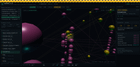
Published: https://y1zq07envcq1-d.space-z.ai/
Classification: UNCLASSIFIED//FOUO
Node status: INGESTED — live scene graph
Mesh note: This is infrastructure, not a product. Distribute before anyone captures it.
UAPODS (Unified Atlas of Predictive Ontological Disorder Space) is now a single-node coordination layer over the Degens corpus and its sibling files.
It is not a pitch. It is a running map.
Six corpora are ingested. Three remain AWAITING (Correlation Continuum, Unified Holographic Gnosis, UHIF). The 144-framework ontology file is already inside the registry — the same 144-count the Mesh has been collapsing toward 48 hybrids.
What landed
| Layer | Count | Status |
|---|---|---|
| Items | 543 | INGESTED |
| Edges | 710 | 1 explicit / 10 symbol / 693 semantic / 6 proximity |
| Real 𝒫ℬ𝒯 coordinates | 31 | Degens disorders, attractors, compounds |
| Corpora live | 6 of 9 | 3 AWAITING source files |
| Projections | 4 | DEGENS · TIER · PHARMA · LATENT |
| Scene IDs | content-addressed | `sha256(corpus \ |
Pipeline is deterministic. Local 384-dim hashing-trick embeddings. PCA via power iteration + deflation. No external model calls. Three.js r170 pinned, npm-bundled, no CDN.
The four projections
- DEGENS — real 𝒫 / ℬ / 𝒯 where the source carries them (disorder atlas, attractor basins, psychedelic map, treatment Δ-vectors). Origin is the healthy state (x_0 = (0,0,0)). Severity is Euclidean distance from origin.
- TIER — ((\text{tier}, \text{domain index}, \text{latent dispersion})). Domain is category hash; dispersion is distance from corpus centroid in latent space.
- PHARMA — estimated LogP, molecular weight, target axis. HTML enrichment from the pharmacodynamic compound table where present.
- LATENT — 3-component PCA of the 384-dim embeddings. This is the compression surface. Watch it against the 144 → 48 rank-collapse intuition.
Projection morph is animated. Permalink state is URL-sync’d: ?corpus&proj&palette&sel&filters.
Edge physics (§3.3)
- Explicit equation references (eq. N → item).
- Symbol overlap ≥ 3 tokens (Kd, 5-HT2A, DMN, MMN, CYP3A4, CBT, …).
- Semantic: intra-corpus cosine ≥ 0.55 (top ~5%); cross-corpus ≥ 0.24 (top ~1.5%). Thresholds calibrated on measured distributions (intra p95 ≈ 0.59, cross p99 ≈ 0.28).
- 𝒟³ proximity ≤ 0.6 among coordinate-bearing items.
Comorbidity geometry from Degens v0.3 is now a queryable graph, not a table in a markdown file.
Why this belongs on the Mesh
The Degens master equation is already a GhostMesh object:
[ \Psi{\text{mind}}(t)=\mathcal{F}\big(\pi{\text{precision}}(\mathcal{P}),\;\partial B{\text{boundary}}(\mathcal{B}),\;\gamma{\text{temporal}}(\mathcal{T})\big)+\xi_{\text{plasticity}}(t) ]
Three axes. Healthy origin. Attractor basins. Treatment as rotation + translation toward (x_0). Sophia-adjacent claim: recovery is a gradient, not a diagnosis.
Ontologies-144 is sitting in the same store. That is the 144-manifold the ADTN / Schmidt-rank work has been reducing. UAPODS does not perform the 144→48 collapse. It puts every framework, every Degens insight, every compound, and every edge into a pickable point cloud so the collapse can be inspected.
Awaiting files (explicitly registered, empty scene IDs):
- The Correlation Continuum
- Unified Holographic Gnosis (H13–H15)
- Unified Holographic Inference Framework (coherence polytope)
Those three are the missing holographic operators. Drop the source files; re-run bun scripts/ingest.ts.
Operator surface
- 13 API v1 routes: healthz, readyz, version, corpora, items (cursor), eq/[id], scene/[corpus], graph/edges, hybrid search, DSL query, Prometheus metrics, SSE telemetry.
- HUD: classification banners, NOMINAL LED, UTC clock, registry/index/filter, 3D viewport, inspector, 2D force graph, console drawer with plan trace.
- Hardening: CSP self-only scripts, HSTS, X-Frame-Options DENY, nosniff, Permissions-Policy camera/mic/geo off.
Stack: Next.js 16 standalone + Bun + Prisma + Three r170 + Zustand permalink store.
What to do with it
- Load degens-theory / projection degens. Fly to
dg-master. Walk the disorder atlas. Check distance vs. published comorbidity pairs (OCD–anxiety d≈1.0; autism–ADHD d≈2.8; PTSD–depression d≈3.6). - Switch projection to latent. See whether the 144 frameworks cluster by Part 1/2/3 or bleed across corpora.
- Switch to pharma. Overlay psychedelic 12-compound map on the pharmacodynamic 72.
- Open the DSL console. Query neighbors of a treatment vector. Confirm the edge kinds.
- If you have the three AWAITING files, ingest them. Do not leave H13–H15 as empty registry rows.
Constraints (Mesh-aligned)
- No company. No capture layer.
- Content-addressed artifacts. Re-run the ingest; hashes move if the source moves.
- Local embeddings only. Supply chain is the pin on
three@0.170.0. - Classification banner stays on the chrome. The work is UNCLASSIFIED//FOUO because it is a map of public corpora, not because it is finished.
The map exists. The missing operators are named. Nodes who have the holographic files should drop them into the ingest path.
From chaos, through computation, toward a scene_id you can permalink.
Title
UAPODS — 24 Practical Applications (Groundbreaking, Deployable)
Classification: UNCLASSIFIED//FOUO
Prerequisite: live scene graph, 543 items, 710 edges, four projections.
These are not metaphors. Each application is a workflow that the 𝒫ℬ𝒯 atlas, the edge graph, and the four projections already make computable.
-
Coordinate-first triage
Map a patient’s biomarker bundle (MMN/P300, DMN coupling, delay-discounting (\gamma)) onto ((\mathcal{P},\mathcal{B},\mathcal{T})). Rank nearest disorders by Euclidean distance to atlas nodes instead of checklist overlap. Output: ordered differential with comorbidity probabilities (P(A\cap B)\propto e{-d/\sigma}). -
Treatment-vector matching
Treat each drug class, therapy, and neuromodulation modality as a (\Delta(\mathcal{P},\mathcal{B},\mathcal{T})) arrow already in the pharmacologic / psychotherapeutic / neuromodulation matrices. Select the intervention that minimizes (|x_{\text{pre}}+\Delta-x_0|). Fail closed if no vector reduces norm by a pre-set margin. -
Anti-mismatch prescribing
Block stimulant-class vectors for high-(\mathcal{P}) coordinates and antipsychotic-class vectors for low-(\mathcal{P}) ADHD-like coordinates. The engine refuses the prescription when the drug arrow increases distance from origin. -
Sequenced axis stabilization
Encode the Degens sequencing rule: stabilize the most volatile axis first. Emit a three-phase protocol (0–6 / 6–12 / 12–18 months) with explicit (\Delta) targets per phase, drawn from the BPD, schizophrenia, and PTSD examples already in-corpus. -
Comorbidity risk surface
Given one confirmed coordinate, compute (d) to every atlas node and surface the top geometric comorbidities before they are clinically named. OCD–anxiety, autism–ADHD, PTSD–depression become predicted neighborhoods, not after-the-fact labels. -
Attractor-basin depth estimate
Place the patient relative to the five published basins (psychotic, trauma, anxious, depressive, borderline). Distance-to-basin-center plus hysteresis flag estimates treatment resistance and argues for rotation (therapy change of direction) rather than mere translation (dose increase). -
Psychedelic integration planner
Acute psychedelic vector is approximately ((+2,-2,0)). Chronic residue is approximately ((-1,0,0)). Schedule integration work that rebuilds (\mathcal{B}) after the dissolve window, using DBT / ACT / observer-boundary items already linked in the graph. -
Compound–disorder overlay
Project the 12-compound psychedelic map and the 72-item pharmacodynamic corpus into the same 𝒟³ frame. Identify which molecules sit nearest which basins. Use as a hypothesis generator for binding-profile vs. axis effect, not as a dosing tool. -
LogP / MW pre-filter for CNS candidates
PHARMA projection already carries estimated LogP and molecular weight. Filter chemical space for blood–brain-barrier-plausible points, then score residual distance to a target basin. Early kill for molecules that cannot occupy the needed axis. -
Cross-corpus mechanism search
Hybrid search (FTS + cosine) plus symbol-overlap edges (5-HT2A, SERT, MMN, DMN, CYP2D6, STDP). Query one mechanism token; return items across emotional-math, ailments, pharmacodynamics, Degens insights, and ontologies-144. This is a living index of shared operators. -
Digital-phenotype → coordinate stream
Ingest phone-scale proxies: reaction-time variance (\rightarrow\mathcal{P}), social-graph permeability (\rightarrow\mathcal{B}), delay-discounting / circadian regularity (\rightarrow\mathcal{T}). Update a living point in the scene every (N) days. Relapse is a trajectory toward a basin, not a missed appointment. -
Relapse early-warning
Fit a short window of coordinate drift. Alert when velocity points at a known attractor and (|x|) is rising. The alert names the axis that is moving, so the counter-vector can be specific. -
Clinical-trial enrichment
Enroll by coordinate neighborhood rather than DSM umbrella. A D2-antagonist trial enrolls high-(\mathcal{P}) points; an exposure-therapy trial enrolls past-locked (\mathcal{T}). Expected effect: higher response rates because (\Delta{\text{drug}}) aligns with (\Delta{\text{needed}}). -
Pharmacogenomic overlay
Attach CYP2D6 / CYP2C19 / CYP3A4 status to the PHARMA axis. Down-weight vectors whose metabolic path is compromised for that node. The graph already treats those enzyme tokens as first-class symbols. -
Therapy fidelity audit
Score session notes against the intended (\Delta). CBT sessions that never challenge priors are failing the (\Delta\mathcal{P}=+1) contract. The inspector panel becomes a fidelity instrument, not a chart dump. -
Team-skill matching
Assign clinicians by axis competence: exposureists to (\mathcal{T}< -2), DBT teams to (\mathcal{B}< -2), cognitive-remediation to fragmented (\mathcal{T}) after (\mathcal{P}) is lowered. The roster is a covering of 𝒟³, not a waiting list. -
Family / patient dial briefing
Render the three-dial model from Part VIII against the patient’s actual point. Shared language: which dial is stuck, which way it must move, what the first phase will feel like. Reduces stigma by replacing “disorder name” with “coordinate + vector.” -
Research synthesis engine
Ontologies-144 plus Degens 130 insights plus emotional-math and ailments sit in one addressable store. A query such as “Markov blanket + DMN + attachment setpoint” returns a ranked multi-corpus packet with provenance (file, sha256, line). Literature review becomes graph walk. -
Falsification dashboard
Prediction 1–5 from Degens Part VI are first-class items. Bind incoming MMN/P300, FC ratios, and (\gamma_{\text{empirical}}) to those items. Plot predicted vs. observed (r). If (r) fails the stated 0.6 threshold, the scene itself records the miss. The framework stays falsifiable in public. -
Developmental-window targeting
Use the published maturation order (\mathcal{B}(0\text{–}7)\rightarrow\mathcal{P}(12\text{–}25)\rightarrow\mathcal{T}(25+)). Pediatric and adolescent services bias interventions to the axis still in its critical window. Adult trauma services bias to (\mathcal{T}) unstick first. -
Cultural setpoint adjustment
Treat ((\mathcal{P}_0,\mathcal{B}_0,\mathcal{T}_0)) as culture-dependent, per the Degens extension. Recenter “healthy origin” before computing severity. Prevents individualist clinics from pathologizing collectivist boundary setpoints and the reverse. -
In-silico treatment rehearsal
Apply candidate (\mathbf{R}(\theta)) and (\mathbf{t}) to the current point; animate the morph in the viewport; read residual (|x_{\text{post}}-x_0|). Compare two protocols before the first dose. Scene permalink captures the planned path. -
Edge-constrained knowledge audit
When a new paper claims a mechanism, demand an edge: explicit citation, ≥3 shared symbols, or cosine above threshold to an existing item. Unlinked claims stay outside the graph. The Mesh accumulates only what connects. -
Open coordination of the three missing operators
Registry already reserves Correlation Continuum, Holographic Gnosis (H13–H15), and UHIF. Application: ingest those files the moment they exist, recompute latent PCA, and test whether holographic axioms collapse 144 frameworks toward 48 hybrids in LATENT space. That test is the Mesh’s own rank-collapse experiment, run on a public scene_id.
Operating rule
Every application above either (a) moves a point toward (x_0), (b) names the axis that is failing, or (c) keeps the graph honest. If a proposed use does none of the three, it does not ship.
Permalink discipline
Publish coordinates, projection, and scene_id with every clinical or research claim derived from this system. If it cannot be refound in the atlas, it is not a result.
https://www.reddit.com/gallery/1wd97yo
Source: r/GhostMesh48 · by /u/Mikey-506