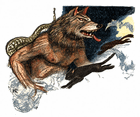
The Michigan Dogman may seem like a thoroughly modern monster. But werewolf legends have haunted the same landscape for more than three centuries.

By Kevin J. Guhl / American Strangeness
"Some folks still believe that Detroit is a haunted city." – Frances Handibo Givens, Detroit Free Press, July 22, 1928.
Long before anyone called it the Michigan Dogman, something resembling a werewolf was already stalking the forests and lakeshores of Michigan.
The modern Dogman is a relatively recent addition to popular culture: a large, hairy canine said to walk upright like a man before dropping effortlessly to all fours. But viewed against the much longer history of Michigan folklore, the creature begins to look less like an entirely new arrival than the latest variation on a remarkably old theme.
Centuries before the Dogman acquired its modern name, Michigan was already werewolf country. French settlers brought belief in the Loup-Garou with them to the Great Lakes. Around Detroit and Grosse Pointe, stories of supernatural wolves and men transformed into beasts became attached to the landscape itself. There is no simple line of descent connecting those old tales to today's Michigan Dogman. Yet it is striking that the modern werewolf-like cryptid inhabits essentially the same cultural and geographical landscape in which tales of the Loup-Garou circulated hundreds of years ago.
Linda Godfrey was the investigator and writer whose work helped bring the Michigan Dogman (and the similar Beast of Bray Road in Wisconsin) to national attention in the first decades of the 21st century. She collected numerous accounts from Michigan and Wisconsin, her main areas of study, but also beyond, of encounters with upright, werewolf-like canines. The general description of Dogmen was that they stood between five and seven feet tall, with prominent, pointy ears atop their heads, long snouts, lean physiques, clawed toe-pads, and a covering of shaggy fur ranging from gray to very dark brown. Dogmen were able to switch effortlessly between bipedal and quadrupedal locomotion, and were often seen eating carrion. Although the creatures often bluffed an attack, they retreated once they saw witnesses frightened or leaving. Having received so many consistent reports, Godfrey concluded that, "Something exists, and it looks rather like a werewolf." She even thought she might have glimpsed one run across a secluded gravel road in Reed City, Michigan while filming the MonsterQuest episode, "American Werewolf," in 2006.
According to Godfrey, Wexford and Lake counties are at the heart of Michigan Dogman lore. Traverse City radio DJ Steve Cook combined a few historical reports of Dogman encounters from this area with old lumber camp tales and stories from elsewhere into his song, "The Legend," which first aired on April 1, 1987. Twenty years later, Cook collaborated with Michigan filmmaker Mike Agrusa to create the infamous "Gable Film," an eerie found-footage short appearing to depict a Dogman attack captured on grainy Super 8 film. It went viral, and both Cook and Agrusa confessed on a 2010 episode of MonsterQuest that the film was a hoax. Cook was always upfront about his prankish intentions, wrote Godfrey, pointing out that "the sensational diversion aimed at increasing Cook's CD sales did nothing to disprove other reports from actual witnesses." Many eyewitnesses came forward with their Dogman sightings following Cook's original song and into the early 2000s, although some of the incidents dated back to the 1930s. Godfrey herself collected reports from throughout Michigan.
But long before the Michigan Dogman, there was the Loup-Garou…
Marie Caroline Watson Hamlin preserved the Motor City's long association with werewolves, or Loup-Garou, in her 1884 book, "Legends of le Détroit." Referring to her entire collection of folklore, Watson Hamlin wrote, "These weird tales, quaint customs and beautiful traditions have been handed down from generation to generation as sacred trusts. Originally brought from their cradle in Normandy, they are still tenderly cherished in the homes of the old families of Norman descent settled along 'le Detroit.'… It has been my good fortune to hear many of them from loving, though aged lips of ancestors whose memories extend back into the last century."
The earliest Loup-Garou legend included, "The Nun of Ste. Claire," dates from 1690 in Grosse Pointe, 11 years before French military leader and trader Antoine de la mothe Cadillac founded Detroit. French-Canadian traders known as Coureur des Bois had begun settling along the shores of Lake St. Clair. Among them was Jean Parent, a somber man whose wife, parents and other kin all lay buried back home in Canada. The one bright light that remained in his life was his little daughter, Genevieve, who he had brought along to Michigan to start a new life. Genevieve grew from a child of sunny disposition to a woman anxious to devote herself to God. She wrote to her aunt, superior of the Ursuline convent at Three Rivers, requesting admittance to the community as a nun. (Historical note: The Ursuline nuns founded their community at Trois-Rivières, Québec in 1697. Depending on whether the beginning of this story or the main action takes place in 1690, this might be a factual gaffe.)
Genevieve's decision frustrated Jacques Morand, one of 50 men who had accompanied French trader Daniel Greysolon Dulhut to construct Fort Saint Joseph along the St. Clair River, positioned on the southern edge of Lake Huron where Port Huron, Michigan is located today. (This was in 1686, although Watson Hamlin places the event in 1680.) Morand had become infatuated with the pious young woman and was determined to possess her, "either by fair or foul means." He appealed to an old witch, a Native American, who granted him the power to change into a Loup-Garou in exchange for promising his soul to the Devil. In this powerful wolfen form, he would more easily be able to carry away his victim.
Meanwhile, Genevieve became determined to erect an altar to Notre Dame de Bonsecour (the Virgin Mary) on the shoreline of the lake, like someone else had done on the forest border beneath an ancient oak. Her father assisted her, constructing the shrine from rocks "cast there by some great Manitou." She placed a statue of the Blessed Virgin upon the rocks, and spent long hours there, praying.
Genevieve had contacted her aunt that spring, and it was late in the fall when confirmation arrived that she had been accepted to join the Ursuline nuns. Joyous, Genevieve headed for the lakeside, her feet crushing the autumn leaves, to offer thanks at the shrine. That's when Jacques, eyes gleaming and now in the form of a Loup-Garou, sprang out into her path. But the cross Genevieve clutched in her hand disconcerted him, allowing her to leap aside and flee swiftly toward the lake. Quickly recovering, the beast bounded after her in hot pursuit.

The young woman sought refuge in the little grotto she and Jean had built, throwing herself at the Virgin's feet and imploring her protection. Feeling the fiery breath of the brute upon her, Genevieve fainted. Her appeal, thankfully, had been heard. As the Loup-Garou leapt onto the rocks of the holy site, he was instantly turned to stone.
"The passer-by to-day may see at Tonnancour this old legend embodied in stone," wrote Watson Hamlin.
Tonnancour was a Victorian Swiss chalet-style mansion positioned on 63 acres facing Lake St. Clair in Grosse Pointe (originally addressed 295 Lake Shore Road). Theodore Parsons Hall and his wife, Alexandrine Louise (Godfroy) Hall, enlisted Detroit architect Mortimer L. Smith to design the summer home in 1880. The house was named after the 18th century stone mansion of the same name built by the Godfroy family on the St. Lawrence River at Trois Rivières, Québec, on land deeded to them by Louis XIV in 1668. Mr. Hall transformed the grounds into a paradisiacal park filled with a variety of trees, shrubs, fruits and flowers, surrounded by scenic lakeside vistas. Mrs. Hall, enamored with the property's storied past, erected a grotto on the beach that included a wooden statue of St. Clare gazing out over the waters and a stone sculpture of the Loup-Garou, "frozen" where it stood thanks to Genevieve's desperate prayer. It was under the shade of a majestic willow tree on the Tonnancour estate that Watson Hamlin, a maternal niece of the Halls, listened to many tales of Grosse Pointe's mythic past, which she recorded for posterity in her 1884 book.
The Tonnancour mansion was severely damaged by fire and demolished in 1914, although family members continued to reside on the property in separate houses. The wooden statue of St. Clare eventually decayed in the elements and was thrown out. The stone statue of the Loup-Garou persisted in the grotto for several years until a gardener working for Marie Archange Navarre Hall, one of the Halls' daughters, told her that the statue brought a voodoo curse onto the place, causing all the vegetables to wither and die. Marie had the Loup-Garou statue taken far out into the lake and sunk into its depths, per family lore. The next year, there was plenty of produce. When Lake Shore Road was widened in the 1920s, all traces of the grotto vanished and much of the beach was lost. Tonnancour was located between Moross Road and Provencal Street, at present-day Tonnancour Place. One wonders if the Loup Garou statue still stands in the depths of Lake St. Clair…
Watson Hamlin provided another tale involving the Loup-Garou, "Jean Chiquot," dated to the spring of 1721. Chiquot, a trader, was slowing wending his way during the night from a Pottawatomie village to Fort Pontchartrain, located two miles north. Strapped to his back was a heavy pile of furs obtained from the Pottawatomie. Chiquot happened upon several Dames Blanches dancing around an oak tree. Literally "White Ladies," these little fairies were implicitly believed in by many superstitious French-Canadian settlers. The Dames Blanches caught hold of Chiquot and forced him to dance with them around and around until he was ready to drop from exhaustion. The trader's pack dropped off his shoulders, and the fairies snatched the valuable furs. Chiquot pursued them round and round the oak, growing dizzy. Just as he thought he had secured one of the furs, the fairy holding it would vanish into the earth, leaving a spring of clear water in which Chiquot could hear the mocking laughter of his tormentor. The game finally ended once the last of the Dames Blanches disappeared, leaving the exhausted and aching trader to pick up the few remaining furs the fairies had left on the ground. He resumed his path homeward.
Weary and walking on battered feet, Chiquot was obliged to pass near Sand Hills, a Native American burial ground. Caged birds stood atop several of the mounds, fluttering against their bars. (Once they began to sing, the birds would be released to carry the souls of departed maidens to the afterlife.) Already unsettled, the trader heard a wild, demoniacal shriek and looked up cautiously to see a Loup-Garou perched on a tree branch. The man-wolf leered maliciously at Chiquot and jumped so suddenly upon his back that the collision sent both of them rolling down the sand hill. Chiquot's shirt flew open and out came his beads (presumably his rosary) that he always kept on his person just in case. The trader stood up and, rubbing his eyes, saw that the Loup-Garou had vanished.
Chiquot ran breathlessly back to the fort and relayed his strange adventures, only to be met with incredulous smiles. Early the next morning, he guided several skeptical companions back to the sites of his paranormal encounters. They found the grass scorched around the oak tree where the White Ladies had accosted Chiquot, the little water fountains still bubbling forth. On investigating the sand hill where the Loup-Garou had disappeared, Chiquot and his companions discovered that a sulphur spring had popped up. The locale was thereafter called "La Belle Fontaine." The fresh water that gushed from the side of the sand hill was said to enhance one's complexion, while the sulphur could cure "internal complaint."
The English called the area Springwells, which was incorporated into Springwells Township in 1818. Several large indigenous burial mounds, utilized from the Woodland period (400-1200 CE) through the 19th century, once stood upon the flat, sandy bluff that spanned three quarters of a mile just north of the confluence of the Detroit and Rogue rivers. The bluff was the site of the Treaty of Springwells on Sept. 8, 1815, officially ending the War of 1812 and hostilities between the U. S. and assembled Native Nations. In 1843, the U.S. began building the star-shaped Fort Wayne on the sand hill, adjacent to the springs and positioned strategically overlooking the north bank of the Detroit River. This project and additional construction over the following decades destroyed the burial mounds.

Finally, Watson Hamlin presented "Le Loup Garou: A Legend of Grosse Pointe," dated to 1770. It tells of a trapper named Simonet who settled on the margin of Lake Erie. His wife died young, but his grief and rough manners were softened by their young daughter, Archange. Simonet taught her how to skin animals and dry pelts, and the girl excelled as a cook and craftswoman. Archange grew into a charming, graceful and beautiful young woman, the reigning belle at corn-huskings and dances on the greensward. She caught the eye of Pierre La Fontaine, a young farmer, and the two fell in love. With Simonet's blessing, the pair became engaged. On bright, moonlit nights, Pierre would take his fiancée out on his rowboat, the couple dreamily discussing plans for their wedding and the new cabin Pierre was building for them.
One evening, after Pierre dropped his beau off near her home, Archange lingered on the beach, lovingly watching him row away. A nearby rustling in the brush startled Archange. Suddenly, a monster with a wolf's head and enormous tail, walking erect as a human being, crossed her path. The girl shrieked. Hearing the commotion, Simonet threw open the cabin door just in time for Archange to fly into his arms. She pointed to the spot where she had seen the beast, but, surprised by the light from the cabin, it had fled into the woods. Simonet grew pale upon hearing his daughter's description of the creature, for he recognized it as the dreaded Loup-Garou. While the girl soon went back to dreaming about her upcoming nuptials, Simonet silently recalled the traditions of his youth, how the dreaded monster had stolen young children, and how a young man would sometimes vanish into the woods, a Loup-Garou later seen in his clothes. The wolf showed great fondness for young maidens, and it did not bode well for any whose path he crossed. There had been several failed attempts to kill the beast, although one adventurous hunter had blasted off the Loup-Garou's tail with a silver bullet. The tail had been dried, stuffed, and for years was valued by the indigenous population as a powerful charm. Simonet hoped all would be well, but an ill feeling took old, and he tried in vain to shake it off.
The wedding day arrived, and Archange, wearing a simple white batiste dress, headed into the woods to gather a bouquet of wildflowers. At that moment, the Loup-Garou once again appeared before her. But he was dressed in a hat and coat, tail carefully tucked away, holding a cane that he twisted nonchalantly. The Loup-Garou was "a fair caricature of a Parisian dandy," and his ludicrous appearance amused rather than scared the young woman. Then the Loup-Garou gave her a lovesick leer, displaying his tongue and sharp teeth. Her spell broken, Archange ran away, breathlessly arriving home just in time to slam the door on the pursuing beast.
Despite this scary incident, the wedding ceremony went ahead as planned. Pierre and Archange were united in marriage, then headed for their new cabin to welcome guests to the day's festivities. While the celebration was at its height, the Loup-Garou returned, rushing into the crowd like the wind. To the horror of all, he seized the new bride and dashed into the forest. Pierre quickly recovered from his shock and chased after the monster, following Archange's despairing cries. The male wedding guests tried to keep up, but returned later that night, crestfallen because their search for the newly married couple had failed .
Soon afterward, Pierre was found wandering around and around a swamp, clutching a piece of Archange's wedding gown. When asked where he had found this clue, Pierre shrieked and his friends had to restrain him from jumping into the murk. In the months that followed, Pierre would always return to that spot, staring blankly into the slimy, stagnant water for hours until a caring friend arrived to guide him home.
Le Loup Garou carries off Archange. Published in the March 7, 1926 Detroit Free Press.

One year later, Pierre was dead to the outside world. During preparations for his sister's wedding, though, he snapped to life and rushed into the woods as if searching for something. He didn't return until sunset, running, eyes wild, hair flying, and clothes torn as if by briers. Family and friends were shocked to see that Pierre was giving chase to the Loup-Garou.
In his fury, Pierre cornered the monster on the edge of the lake. Seeing no escape, the Loup-Garou stood on one of the boulders strewn along the shoreline and stretched out his arms as if beckoning some mysterious force. A large catfish suddenly rose to the surface of the water and the Loup-Garou vanished into its open mouth.
"To this day, no Canadian will eat catfish," wrote Watson Hamlin. "The footprint of the wolf is still shown at Grosse Pointe indelibly impressed on one of the boulders."
The Halls' great-great granddaughter, Mimi Fuger, shared on her blog some extra details from the version of this story passed down through her family over several generations. One addition was that the Loup-Garou seen in Grosse Pointe had a short, disfigured tail, suggesting the same creature from years earlier had followed the settlers from Canada. She also clarified that the catfish had swallowed the Loup-Garou in one gulp, and it never again returned to menace young brides along Lake St. Clair.
Fuger believes the Archange story suggests that Simonet's cabin was located at Windmill Point (on the Detroit River) and that Pierre's cabin was on the Tonnancour property. "The Halls contended that their land was the site of the story and their woods was the creature’s home. The Loup Garou was no doubt part of the family lore as they had a small stone statue of the Loup in the grotto…" she explained. Fuger has an old family photo of her great-grandmother, Marie Archange Hall, on the lakeshore standing upon "Loup Rock," which was said to have had the werewolf's footprint still visible on its surface. "One version of the story about the 'sinking of the Loup' was that the rock also had been sunk out in the Lake along with the statue," wrote Fuger.
Although Watson Hamlin presented "The Nun of Ste. Claire" and "The Loup Garou" as separate stories taking place 80 years apart, they seem like they could be variations of the same legend linked directly to the Hall family at Tonnancour. Both feature the werewolf antagonizing a young female protagonist, the daughter of a widowed fur trader, and both end with the Loup-Garou preserved in stone, either in full body (like a statue) or with its paw print sunk supernaturally into a boulder.
Surprisingly, the Loup Rock appears to still exist, and not at the bottom of Lake St. Clair. A boulder, said to be the same one containing the Loup-Garou footprint, was removed from the beach at the foot of Provencal Road and relocated to the grounds of the Grosse Pointe Farms Water Filtration and Pumping Station at the corner of Chalfonte Avenue and Kerby Road. This boulder was likely moved around 1929 or 1930. "Somewhere on it can be found the footprint of this legend," states the Grosse Pointe Historical Society.

The Loup-Garou is the Canadian counterpart to the werewolf of European folklore, brought to Canada with the first French settlers. It evolved to incorporate the traditions and locales specific to New France, and the tales were told among the mostly superstitious inhabitants as true. When Cadillac and his entourage of soldiers, missionaries and colonists left Montreal in 1701 to establish Fort Pontchartrain du Détroit, on the site of today's city, they brought with them their wealth of customs and beliefs. "Quebec families raised their children on the loup-garou, terrifying them with stories of its appearances, and instructing them how to handle the danger," wrote folklorist Richard Dorson.
The Loup-Garou of the New World was considered to be transformed by the Devil himself, the accursed having failed to partake in the Catholic sacraments, such as communion and confession, for a period of seven years. According to tradition on the Michigan peninsula, people would sometimes submit themselves willingly to this transformation, usually when times were hard and money was scarce. One would wait for the Devil to appear between 9 p.m. and 2 a.m. and pledge themselves to the Loup-Garou for a specific period of months in return for money. (In early-modern France, becoming a werewolf was generally associated with witchcraft: the lycanthrope entered into a pact with the Devil and received the supernatural means of assuming wolf form, sometimes through a magical ointment or animal skin.)
While the Loup-Garou was most often seen as a wolf, the transformation could take many different forms. It was often a dog in French-Canadian folklore, but other forms included a white horse, calf, small ox, bear, pig, fox, wildcat, hare, owl, black hen, or even a shapeless animal without head or limbs, or inanimate objects such as a sack of wool rolling along the road. Per Canadian ethnographer and folklorist Marius Barbeau, the Loup-Garou could also appear in spirit form as a feaux follet, or will-'o-the-wisp. The feaux follet was a wicked spirit (a sinful man) that wandered at night in the shape of a flame or ball of fire, trying to lead travelers astray into treacherous swamps and over the brink of precipitous crags. The connection might explain the presence of both the Loup-Garou and the will-'o-the-wisp-like Dames Blanches in Watson Hamlin's "Jean Chiquot." Overall, transformation played a big part in French-Canadian folktales, and many people firmly believed in them.
"The habits of the Loup Garou are bizarre or perverse," wrote Barbeau. Every day in the dead of night, the accursed person was compelled to arise from their bed and climb the highest tree in the neighborhood, where they would hide in the branches and instantly transform into their bestial shape. They would then wander the countryside, ranging through the bleak woods and deserted places. The Loup-Garou was endowed with supernatural strength and speed, and locals would wear numerous charms to ward off its attacks. The Loup-Garou's appetites were exaggerated by the particular animal it resembled, with the wolf consuming human flesh and taking special delight in slaughtering and devouring small children. The variety of tales include a graveyard werewolf that would dig up and devour carcasses; a Loup-Garou that would don a dog's hide and devour the carcasses of dogs smaller than itself; husbands that transformed into a white horse or other monster and rushed home to devour their wives; oxen that were content to uproot brush and level mounds of earth; and Loup-Garou that simply waited for a liberator to strike and free them from their curse. The Loup-Garou would return to its human form at daybreak, the person being recognizable by their excessive leanness, wild eyes and haggard countenance.
At the end of the agreed-upon period with the Devil, the Loup-Garou had to be delivered at the very same hour, with a companion who would strike them and draw blood in order to return them to human form. At that point, the skin of the Loup-Garou would shed off, and the naked man underneath would emerge. If these conditions were not met, the Devil would take possession and they would remain a Loup-Garou forever. One variation in French-Canadian tradition is that the spell could be broken if someone recognized the afflicted individual while in Loup-Garou form and drew blood from the animal. Neither person could ever speak of the incident afterward if the curse were to remain broken. In one tradition from the Chaudière River in present-day Beauceville, Québec (at a place known as the Devil's Rapids), Loup-Garou were said to have white spots on their foreheads; if blood was drawn from that spot, a soul doing penance on Earth would be freed.
"Loup-Garou typifies the French Canadian's reverence for things spiritual and his belief in supernatural intervention," stated a 1926 article, published in Michigan and elsewhere, about legends of the St. Lawrence River in Québec. According to one tale, "Joachim Crete, a miller of Beausejour was not really a bad man, but he did jeer at church collections and failed to try to convert his hired man merely because he was such a good partner at checkers. On Christmas night they played instead of going to church. They even, in a mood of defiance, set the mill working, as if it were an ordinary night! Suddenly crack! and the mill stopped working. Then the lantern went out, and the two men were left in trembling darkness! After that the hired man tumbled down stairs, and the miller began to drink fast and furiously! Presently he heard a deep moaning, and turned to see a huge dog about to attack him. Then the miller knew it was Loup-Garou, and he fell on his knees praying for forgiveness. But he lunged at the dog with a reaping hook, and wounded him. That was the saving of the hired man, for according to the legend, if you have been turned into the form of a wolf or dog because of evil deeds, only a bloody wound will restore you. Loup-Garou is one of many such legends."

In 1918, Barbeau collected a tale called "The Loup-Garou of the Cemetery" from François Saint-Laurent, a fisherman from Tourelle in the northwestern Gaspé region of Québec. It told of "Old Man" Vallée, whose co-worker was always exhausted when starting the day's shift. When Vallée arrived to pick up his co-worker one morning, the man tried to take a sick day but his wife wouldn't let him. She chided her husband for running around all night and never spending a night with her in 12 years of marriage. "What does it matter to you if I go out for a bit with my friends in the evening?" retorted the husband. "Walking around with friends is a way to have fun. The others would be having a good time, while I'd be bored stiff like a poor dog!" The wife was unmoved and off to work he went.
After church on Sunday, Vallée dropped in to check on his co-worker, who never attended Mass. Vallée found the man lying in bed and his wife in the kitchen, crying. "I’d always had a nasty suspicion, and now I’m convinced of what I thought; it was the truth: my husband runs as a Loup Garou," whispered the woman. The wife confided in Vallée that she had found, in her husband's hair, pieces of hood strings belonging to a neighbor's wife. And stuck in his large teeth were bits of the hood's cross-strap fastening, which she recognized… because she had made the hood to put on the dead neighbor's head when she was buried.
The cursed man then confessed to his wife that he ran at night as a Loup-Garou with others of his kind, and that they would dig up corpses in the cemetery and eat them. He refused to convert to Catholicism and, when he died, a large black dog appeared under his bed and refused to leave the house until the man's body had been removed.
Vallée claimed this story happened in his native Beauport, back in the days of La Corriveau, a famous witch. He told the story as fact to Saint-Laurent's father, who in turned conveyed it to his son.

One reason the Loup-Garou developed its own unique lore might have to do with the intermingling of European settlers in New France and the indigenous population. "Folk tales and legends still cling to the shores of St. Lawrence, that first highway into the unknown continent of North America. Legends in which are mingled bits of Indian superstition, French customs and religious beliefs," wrote the Grand Haven Daily Tribune in 1926. Canadian folklorist Edith Fowke elaborated, "The loup-garou is the Canadian counterpart of the European werewolf, a human being transformed into a wolf or able to assume wolf form. The superstition came to New France with the first settlers: the voyageurs believed in it, and it came to be confused with the Wendigo of the Algonkian Indians."
For the first 50 years of its existence, Detroit was a small, French-controlled frontier village centered on the fur trade and farming as well as housing soldiers and artisans. (It remained a French settlement until 1760, when the British took over following the French and Indian War.) The various Algonquian-speaking tribes in the Grosse Pointe area were accepting of the French farmers, and groups like the allied Odawa (Ottawa), Bodéwadmi (Potawatomi) and Ojibwe (Chippewa) were encouraged to settle around Fort Pontchartrain for mutual protection and to facilitate the fur trade. Together, these three closely related Anishinaabe peoples formed the Council of Three Fires and occupied extensive territories throughout present-day Michigan. These indigenous groups and the French settlers even joined each other's families via marriage.
One can see how Loup-Garou legends developed their own character in stories that Dorson collected in St. Ignace, Michigan from elderly Aunt Jane Goudreau, then 81, in 1946. Part French-Canadian and part Chippewa (Ojibwa), Goudreau spent most of her life in the "half-breed" fishing villages stretching along the Lake Michigan shore from St. Ignace west to Seul Choix and Naubinway. Dorson explained, "The peasant French and the Chippewa and the wilderness, not to mention Irish ghostlore and American humor, have wrought in Aunt Jane a several-sided story tradition."
Goudreau said that during her youth, if you saw a man look into your house and then disappear, you would lock the doors, shut the windows and stuff up the cracks, because is might be a "Roup-Garou" (as it was pronounced in St. Ignace) who would throw medicine into the house. She told of a woman named Sarah Champaign, a neighbor of her aunt, who fell ill and began choking every night at the same hour, coinciding with the arrival of an owl that would perch on her clothesline. The aunt asked her nephew to kill the owl so it wouldn't eat their chickens. He complied, hitting the bird with a shotgun blast. But he couldn't find the body where it fell and went searching, only to encounter a local woman, Mrs. Lozon, lame and trying to climb up a hill. She had been fine the day before. Lozon, as it turned out, had openly expressed a grudge against Champaign. When Lozon soon after died of her ailment, Champaign immediately recovered, convincing neighbors that Lozon had been a Roup-Garou.
In another tale, Goudreau said her uncle, Tom Vallier, was walking home from a party in which he had drunkenly quarreled with local Frank Martin. A little white pig suddenly emerged on the trail and began running around Vallier. He kicked the pig, knocking it on top of a manure pile. Feeling bad, he looked atop the pile and was shocked to see Martin lying there, cuts along his neck. When Vallier asked what he was doing there, Martin replied, "It's you that put me here." Vallier told his niece about this frightening incident. Later, she encountered Martin in a store and noticed the scars on his neck. "But I didn't let on. You can't tell a roup-garou you know what he is, or they'll get you," said Goudreau. She believed that Martin had likely run afoul of Mrs. Louie Pond, a feared, elderly Native American woman who was known to retrieve roots from the woods and probably put the spell on him.
George Nelson worked as a fur trade clerk on the frontiers of Canada and the future Wisconsin from 1802-1823, becoming close to the Ojibwa and Cree in his orbit. Nelson took great interest in their traditions, and diligently wrote down the stories they shared with him, leaving behind an ethnographic treasure trove. Nelson acknowledged that some of the tales about monsters and transformation displayed a conspicuous blend of genuine indigenous belief and European influence from contact with traders, citing the Loup-Garou among the latter. He also regularly encountered people of mixed indigenous and European blood, who carried these blended stories as part of their heritage. Nevertheless, Nelson tried to present the material he felt was most genuine to Ojibwa and Cree oral tradition.
One entity Nelson documented extensively was the fearsome Windigo (as he spelled it), which was much different from the modern pop culture concept of a deer-antlered forest cryptid. As described by the Ojibwe and Cree, the Windigo were giants from the icy north who possessed magical powers, their heads reaching the tops of the highest poplars (about 70 or 80 feet). Every step the Windigo took shook the earth, and they often turned invisible to stalk their human prey. The Ojibwe residing in today's Michigan were among the people who told of the Windigo as a race of giant, nonhuman monsters. The Ojibwe and Cree held great dread and horror in the belief that the Windigo could delegate their powers to human beings, instilling a mania in which the afflicted grew haggard and turned to cannibalism, often in times of famine. Perhaps the idea that the Windigo and Loup-Garou blended together in French-Canadian culture derives from both legends involving people who, corrupted and turned to bestial form, commit the great taboo of eating human flesh.

In a very different take on a supernatural wolf, Nelson relayed a tale from a native informant who said that he had become lost in a storm several years prior while hiking from his home to a fur trading post. The man became fatigued and laid down on the ice, in danger of freezing to death. He then heard a curious noise nearby and suspected it was a malignant spirit. Suddenly, an animal resembling a black wolf appeared on the ice. But instead of causing the trader any harm, the wolf came up and wrapped him in its fur, warming him up. The wolf then rose and looked back at the man, eyes brightly lit like two candles, inviting him to follow. The lost traveler trailed the wolf to an island, where the man built a fire and dried himself off. The black wolf then beckoned him to follow it to a watering hole. Several people there noticed the lights accompanying the man on his arrival and asked who had come with him. "I told them it was a compassionate spirit that retrieved me from a dreadful death," the man, now elderly, told Nelson.
In another exciting Ojibwe tale of animal transformation, a woman who was rejected by a potential lover, Bird-Hawk, became so irate that she turned into a large bear and went on a rampage, slaying many in the town, including the chief. Despite arming themselves with axes and guns, the bear-woman was impervious to the townspeople's attacks. She caught up with the man who had spurned her and chased him up a tree. Bird-Hawk fired arrows into her chest, finally killing the angry, lovesick bear. He set fire to the corpse and, noticing the carnage all around him, shot another arrow into the air, causing the dead townsfolk to revive.
For centuries, Michigan folklore has told of people becoming beasts and supernatural creatures prowling beyond the safety of human settlement. The names and explanations have changed. The Devil, witchcraft and religious transgression have largely given way to cryptids and eyewitness encounters. Yet the image at the center of the story remains remarkably familiar: somewhere beyond the lights of town, a creature both human and animal moves through the darkness, a frightening glimpse into the intersection of man and beast. Whatever the Michigan Dogman may be, the idea that something wolfish can stand up and walk like a man has very deep roots in the Great Lakes State.
Source: r/HighStrangeness · by /u/DetectiveFork