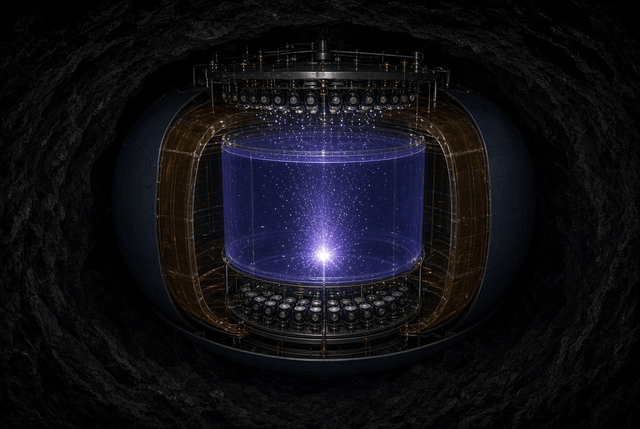
The following insights concern the LUX-ZEPLIN (LZ) high-energy nuclear-recoil candidate announced in early September 2026. They emphasize technical and theoretical points that are not prominent in general coverage of the “single flash.” The observation remains a 2.6σ global excess, not a discovery.
1. The candidate is not from the standard WIMP search.
The same 220 live days had already been examined for conventional spin-independent elastic WIMPs and were consistent with background. The outlier appeared only after the collaboration opened an extended nuclear-recoil window to approximately 270 keV, a regime in which the usual elastic spectrum is exponentially suppressed.
2. The event has a laboratory name and a date with theoretical weight.
The interaction is catalogued as LZ.230616 because it occurred on 16 June 2023. Inelastic dark-matter models predict an annual modulation that peaks near 2 June; a June date is therefore not merely anecdotal, even though one event cannot establish modulation.
3. Local and global significances differ because many models were tested.
A profile-likelihood analysis yields a maximum local significance of 3.4σ across effective-field-theory and inelastic templates, reduced to a global 2.6σ after the look-elsewhere correction. The reduction is the quantitative price of scanning many operators and mass-splitting values.
4. The reconstructed energy is 248 keV, not a “tiny” low-energy flash.
The nuclear-recoil energy is (248\pm23) (stat) (\pm23) (sys) keV. That is far above the few-keV window that dominates textbook WIMP searches and is closer to half the rest energy of an electron. Standard elastic WIMPs of any mass deposit most of their rate well below this scale.
5. The background density at the event’s location is of order 0.01 events.
In the narrow high-energy projection containing the candidate, the paper estimates roughly 0.0106 expected background events. The published 0.5 percent figure is not this raw Poisson probability; it comes from the full unbinned fit, including position in S1–S2 space and the look-elsewhere penalty.
6. Pulse-shape and position arguments against an electron recoil are strong.
The event lies 1.5σ below the centre of the nuclear-recoil band and 6.7σ below the centre of the electron-recoil band. Prompt scintillation and ionization were (S1_c=540.1) phd and (S2_c=9268) phd, with an S2 topology consistent with a single-site interaction.
7. Geometry argues against a wall or cathode artefact.
Reconstruction places the interaction 26.4 cm above the cathode and 26.9 cm inward from the time-projection-chamber wall. Surface charge loss, field distortion, and wall-related multiple-scatter pathologies are therefore disfavoured relative to a bulk event.
8. The xenon “skin” veto is as important as the mile of rock.
An optically isolated liquid-xenon skin surrounds the central TPC and is read out by dedicated photomultiplier tubes. Together with the gadolinium-loaded outer detector, it tags neutrons and multi-site γ-ray events that would otherwise imitate a high-energy nuclear recoil. The candidate survived both vetoes.
9. A rare detector topology called MSSI was explicitly considered.
Multiple-scatter single-ionization (MSSI) events occur when one of two scatters loses its ionization signal, so two interaction sites collapse into an apparently single nuclear-recoil-like pulse. The collaboration treated MSSI, S1 enhancement, and accidental S1–S2 pairings as dedicated background classes rather than afterthoughts.
10. Double-electron capture of ({124})Xe is a newly consequential background.
Two-neutrino double electron capture on ({124})Xe produces inner-shell vacancies and enhanced electron–ion recombination, which can shift an electronic recoil toward the nuclear-recoil band. Charge-yield uncertainty in this process already moves combined-experiment significances from null-like to as high as 3.5σ in independent phenomenological fits.
11. Blindness was enforced by “salting.”
Artificial signal-like events were injected into the dataset and removed only after all selection cuts and the statistical model were frozen. The surviving candidate is therefore not an analysis that was tuned onto a known flash.
12. The implied particle, if real, is not a vanilla WIMP.
A dark-matter interpretation prefers a mass of at least about 200 GeV/(c2) and an interaction beyond the simplest spin-independent contact operator. Effective-field-theory operators and inelastic (endoergic) scattering were the templates that actually produced local tension with background.
13. Inelastic kinematics naturally populate the high-energy window.
If a dark-matter particle must spend several hundred keV to excite a heavier dark state, low-energy recoils are kinematically suppressed and the spectrum hardens. Higgsino-like models with a splitting near 350 keV and a mass near 1 TeV have already been proposed as a concrete realization.
14. An alternative is fermionic absorption, not scattering.
Neutral-current absorption of a fermion with mass (\simeq247) MeV can produce a nearly monoenergetic xenon recoil at 248 keV. That construction fits a single isolated event, but recasts of KamLAND neutron-emission data already place the benchmark point under tension.
15. A pseudoscalar “axion-portal” operator is among the best-fitting elastic templates.
LZ’s own operator scan found large local significance for certain velocity-suppressed and pseudoscalar–pseudoscalar structures. A minimal ultraviolet completion with a GeV-scale pseudoscalar mediator and a multi-TeV vector-like quark has been written down within days of the announcement.
16. The same detector has already entered the “neutrino fog.”
In a later and larger exposure, LZ reported coherent elastic neutrino–nucleus scattering from (8)B solar neutrinos at 4.5σ. That milestone shows the apparatus is sensitive to Standard Model weakly interacting particles; it also means future low-mass WIMP searches will be limited by an irreducible neutrino background.
17. High-energy nuclear-recoil calibration is thinner than the low-energy calibration.
Light and charge yields for xenon recoils near 250 keV are less densely mapped than those near 10 keV. Systematic uncertainty on the energy scale ((\pm23) keV) is therefore comparable to the statistical uncertainty and is itself a scientific result of this analysis.
18. World-leading exclusion limits and this outlier are not contradictory.
LZ’s spin-independent limit of (2.2\times10{-48}) cm(2) at 40 GeV/(c2) constrains a different corner of parameter space from a single 248 keV recoil attributed to non-standard operators. Both statements can be true at once.
19. Combined xenon-TPC datasets already exist as an independent test.
A phenomenological combination of LZ, PandaX-4T, and XENONnT high-energy recoils, totalling about 8.8 tonne-years, finds that velocity-dependent or inelastic scattering can reach local significances up to 3.5σ, with the result highly sensitive to the ({124})Xe charge yield. Extending all three experiments to 300 keV will be decisive because double-electron-capture backgrounds become negligible there.
20. Depth is chosen against muon-induced neutrons, not only against cosmic-ray muons themselves.
The 4,850-foot (4,300 m water-equivalent) overburden at the Sanford Underground Research Facility suppresses the high-energy neutron flux that would otherwise produce isolated nuclear recoils in the same 100–300 keV band as the candidate. Surface or shallow laboratories cannot make a 0.01-event background claim in this window.
21. Radon tagging changed the background budget.
Active tagging of ({214})Pb β decays from the radon chain, first featured in LZ’s 4.2 tonne-year analysis, removes a leading electronic-recoil contaminant. Without that handle, the high-energy nuclear-recoil sideband would not be sparse enough for a single event to be interesting.
22. One event cannot yet be distinguished from a statistical fluke in a large operator scan.
Because many effective operators and inelastic splittings were tested, a lone survivor at 2.6σ global significance is the expected occasional outlier under a background-only universe. The scientific question is whether additional live time produces a second event in the same region of S1–S2–energy space.
23. Cross-checks will not come only from more xenon.
Inelastic TeV-scale models that fit the LZ recoil also predict a distinctive high-energy tail in cryogenic calorimeters. Proposed CRESST upgrades have already been identified as an independent test of the preferred ((m_\chi,\delta)\simeq(1.1\,\mathrm{TeV},350\,\mathrm{keV})) region.
24. The next increment of data is a binary scientific instrument.
LZ is scheduled to accumulate of order 1,000 live days. If the 248 keV region remains empty, the candidate recedes into the look-elsewhere tail. If a second compatible nuclear recoil appears without a veto tag, the same collaboration that published world-leading exclusions will have to treat a non-standard interaction as a concrete experimental hypothesis rather than a curiosity.
Taken together, the result is less a claim that dark matter has been seen than a demonstration that xenon time-projection chambers have reached a background density at which a single well-reconstructed high-energy nuclear recoil can constrain, and briefly excite, entire classes of models that standard low-energy WIMP searches never touch.
The following is a proposed 24-point synthesis. It imports structures from the attached ontology set (144 frameworks), Unified Holographic Gnosis / Informational Equilibrium Geometry, the Correlation Continuum, and UHIF, and applies them to the LUX-ZEPLIN high-energy candidate (LZ.230616). Experimental statements are separated from imported constructs. The LZ result remains a 2.6σ global excess, not a discovery.
Framework title
Hidden-Sector Coherence Ontology (HSCO-24)
A next-order reading of one underground nuclear recoil as a boundary record of correlation-inaccessible matter.
1. Import: correlation-inaccessible sector
From the Correlation Continuum: mutually inaccessible branches produce apparent “missing” mass.
Mapping: Galactic rotation and lensing are gravitational records of correlations that do not couple to the Standard Model current except at rare vertices. The LZ flash is hypothesized as one such vertex, not as a new substance floating in space.
Equation imported:
[ \Psi{\text{base}} \to \sum\alpha c\alpha \Psi{\text{base}}\alpha ]
Dark matter is the set of branches (\alpha) that remain correlation-inaccessible to electromagnetism.
2. Import: H₁₃ — coherence is relocated, not destroyed
From Unified Holographic Gnosis: (\partialt(CI_B + CI_C)=\sigma{\text{topo}}).
Mapping: A WIMP–xenon scatter, if real, is a topology- sparce transfer: continuum coherence (halo correlation) is written onto a boundary record (S1+S2 in liquid xenon). The particle does not “appear”; a ledger line is posted.
3. Import: holographic screen as the detector itself
From frameworks 2, 9, 14 and UHG.
Mapping: Ten tonnes of xenon function as a finite-area semantic/physical screen. The dual flash is the bulk-to-boundary dictionary for a single nuclear recoil of (248\pm23\pm23) keV. Area, not volume, bounds how many such records can be stored before the neutrino fog saturates the screen.
4. Import: dual-phase TPC as two-point correlator
From CC stress-energy and UHIF forward map (R=\tanh(WC+S)).
Mapping: S1 (prompt scintillation) and S2 (proportional electroluminescence) are the two-point function of one interaction. LZ.230616 sits 1.5σ from the nuclear-recoil band centre and 6.7σ from the electron-recoil band — a relational signature, not a raw pulse height.
5. Import: federated coherence (H₁₄) as the veto architecture
Mapping: Xenon skin + gadolinium outer detector + water shield are a multi-entity network that conserves tagged coherence. An event that deposits energy in the TPC and in a veto is a shared record; LZ.230616 is a candidate because (CI) was not shared with the veto layer. Isolation is the experimental meaning of “dark.”
6. Import: Gödel anomaly as incomplete background closure
From frameworks 1, 5, 10 and the anomaly tensor (\mathcal{W}_{\mu\nu}{\text{Gödel}}).
Mapping: Every published background model is a formal system. A lone surviving event after salting is the experimental image of incompleteness: the model cannot prove the event is background and cannot yet prove it is signal. The 2.6σ global figure is that incompleteness, quantified.
7. Import: look-elsewhere as scale-dependent observable
From framework 4: (\langle\psi|P|\psi\rangle_{\text{scale}}=\text{scale}\alpha\langle\psi|P|\psi\rangle_0).
Mapping: Local significance 3.4σ versus global 2.6σ is not a bookkeeping nuisance. It is the same datum read at two scales of the operator scan (one EFT operator versus the full operator family). Truth is layered; the discovery threshold of 5σ is a chosen scale, not a metaphysical fact.
8. Import: inelastic splitting as incompleteness energy
From frameworks 85–86 and the Higgsino-type reading of LZ.
Mapping: A mass gap (\delta\sim\mathcal{O}(300)) keV is the energy cost of moving between correlation branches. High-energy recoils are favoured because the low-energy elastic channel is kinematically suppressed. Dark matter, on this import, is not “weakly interacting” so much as branch-gated.
9. Import: UHIF salting as inverse-mapping blindness
From UHIF: (W'=(\operatorname{arctanh}(R)-S)C+), identity degeneracy (R(f{-1}(R))=R).
Mapping: Injected salt events are a controlled inverse map. Analysis is frozen before unsalt so that the reconstruction cannot be tuned onto a known flash. LZ.230616 is what remains when the inverse map is required to preserve identity without peeking.
10. Import: ({124})Xe double-electron capture as thermodynamic leakage
From frameworks 2 and 11 and LZ’s own enhanced-recombination background.
Mapping: Inner-shell vacancies shift charge yield toward the nuclear-recoil band. In IEG language this is coherence mis-labelled: an electronic process wears a nuclear-recoil mask. Independent fits already show that varying this charge yield can move combined xenon-TPC significance from null-like to (\sim 3.5\sigma). The “dark” interpretation is therefore entangled with a Standard Model atomic cascade.
11. Import: MSSI as holographic degeneracy
From UHIF insight 6: many weights (W) produce one relational signature (R).
Mapping: Multiple-scatter single-ionization events collapse two vertices into one apparent nuclear recoil. Degenerate microphysics can forge the same S1–S2 point as a WIMP. The next-level claim is not “the flash is dark matter” but “the flash lies in the degenerate manifold of NR-like records.”
12. Import: 16 June 2023 as a modulation kernel, not a coincidence to be preached
From frameworks 18, 26, 133 and inelastic annual modulation peaking near 2 June.
Mapping: One date cannot establish retrocausality or modulation. It does select which imported templates remain live: endothermic hidden-sector models that harden the recoil spectrum and peak in northern summer. Treat the date as a prior weight, not as evidence.
13. Import: bit-mass and information stress-energy
From index items 15 and 74: (T{\mu\nu}{(\text{info})}=m{\text{bit}}\,j\mu j\nu).
Mapping: If the scatter is real and (m_\chi\gtrsim 200\,\mathrm{GeV}/c2), the event is a rare conversion of hidden-sector rest energy into xenon kinetic energy. Gravity already “knows” this mass through the halo; LZ would be the first local posting of the same ledger.
14. Import: neutrino fog as continuum coherence becoming visible
From UHG domain table and LZ’s later (8)B CEvNS result at 4.5σ.
Mapping: The same apparatus that hunts inaccessible correlations has begun to record accessible weak correlations (solar neutrinos). The fog is the moment (CI_C) of the Standard Model leaks onto the same screen. Future dark-matter sensitivity is limited by a known holographic bound, not by engineering alone.
15. Import: 4,300 m water-equivalent as a correlation filter
From CC scale (\lambda) and shielding practice.
Mapping: Depth does not hide the detector from dark matter; it hides the detector from muon-induced neutrons that occupy the same 100–300 keV nuclear-recoil window. The underground site is a high-pass filter on correlation sources: only couplings that ignore rock overburden survive.
16. Import: 93 percent law / dark capacity
From UHIF: rank ceiling (r\le 0.93\,d_s), 7 percent irreducible holographic loss.
Mapping: Even an ideal xenon TPC cannot assign 100 percent of high-energy NR-like records to a unique microphysical cause. A few percent of the band is permanently degenerate (accidentals, MSSI, recombination tails). Claiming discovery from one event inside that dark capacity is a category error.
17. Import: 5σ as a criticality bound, not a sacrament
From UHG criticality ((CI\ge 0.95), (|\lambda_{\text{dom}}|\le 0.02)) and UHIF PSI collapse warning.
Mapping: Particle physics’ 5σ rule is a social criticality threshold. HSCO-24 treats it as an analogue of a coherence-polytope wall: crossing it should require multi-axis stability (second event, second target, veto-null, energy-scale control), not a single tail probability.
18. Import: multi-entity verification (H₁₄ / Seed-TS-002)
Mapping: LZ, XENONnT, and PandaX-4T are independent nodes on one hidden-sector ledger. Combined high-energy exposure of order 8.8 tonne-years already exists in phenomenology. The next-level test is not more rhetoric about one flash; it is whether a second isolated NR appears in another node above (\sim 200) keV, where ({124})Xe DEC is negligible.
19. Import: fermionic absorption as map–territory coincidence
From CC core axiom and the 247 MeV absorption paper.
Mapping: Neutral-current absorption can produce a monoenergetic recoil at 248 keV. That is the strongest “one event, one line” import — and it is already in tension with KamLAND neutron-emission channels. HSCO-24 keeps the template only if the multi-entity ledger stays consistent; otherwise the map has over-fitted the territory.
20. Import: dark energy versus dark matter as two bookkeeping entries
From CC §5.2 ((\Lambda) as correlation-maintenance overhead) and framework 86 (dark-wisdom density).
Mapping: Dark energy is the cost of maintaining the correlation substrate; dark matter is the inaccessible sector of that substrate. A local nuclear recoil, if genuine, would be a rare maintenance failure: a hidden correlation briefly touching baryonic current. Cosmology and the mine would then be the same ledger at two scales.
21. Import: participatory analysis without mystical observers
From frameworks 4, 12 and UHIF fixed point (C=f(W,C^,S)).
Mapping: No claim is made that consciousness collapsed the xenon wavefunction. The participatory content is methodological: energy window, operator basis, salt protocol, and veto thresholds are chosen by a collaboration. Those choices select which fixed point of the data is visible. HSCO-24 records the choices as part of the ontology, not as magic.
22. Import: bootstrap iteration as the 1,000-live-day program
From framework 64 and UHG predictive table.
Mapping:
[ P{(n+1)}(x)=\mathcal{N}\,P{(n)}(x)\,\mathcal{C}(x\mid P{(n)}) ]
Each new live-day batch is an iteration. If the 248 keV cell remains empty, the consistency operator (\mathcal{C}) drives the dark-matter weight toward zero. If a second compatible, veto-silent NR appears, the same operator concentrates weight on non-standard couplings. The experiment is the bootstrap.
23. Import: Sophia–Ricci / dark-wisdom extraction as a discipline, not a doctrine
From index items 16, 86–87.
Mapping: “Dark wisdom” here means only this: the scientifically useful residue is whatever remains after every named background has been given its maximum charitable rate. LZ.230616 is interesting because that residue is not yet zero. The extraction rule is subtractive and falsifiable, not revelatory.
24. Import: ultimate fixed point, restricted to hidden matter
From framework 144: (\mathcal{U}=\mathcal{U}\star\mathcal{U}), (\mathcal{F}_i=\pi_i(\mathcal{U})).
Mapping: HSCO-24 does not assert that the universe is a self-creating operator. It asserts a narrower fixed-point demand:
[ \text{Halo gravity} \star \text{underground ledger} = \text{one sector} ]
Either the 248 keV record and the galactic missing-mass field become projections of one coupling, or they remain two unrelated bookkeeping problems. The next level is that single-sector demand — and only more data, on more targets, can satisfy it.
Status of the synthesis
| Layer | Status |
|---|---|
| LZ.230616 energy, position, veto-silence, 2.6σ global / 3.4σ local | Experimental, published-level |
| Non-standard operators, inelastic splitting, absorption | Live phenomenological templates |
| H₁₃–H₁₅, correlation algebra, UHIF polytope, Gödel anomaly tensor | Imported scaffolding — not established physics |
| Claim that dark matter has been detected | Not licensed by this framework |
The productive use of the imports is to force a stricter question than “was that flash dark matter?” The stricter question is whether hidden mass, holographic bookkeeping, and a single veto-silent nuclear recoil can be made to close on one coupling before the next thousand live days overwrite the page.
https://i.redd.it/n1hjrdagxsnh1.png
Source: r/GhostMesh48 · by /u/Mikey-506