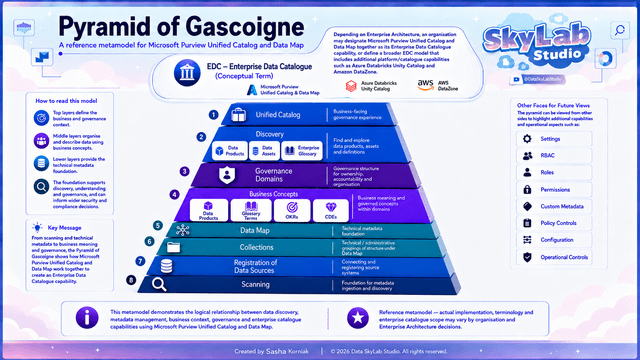
I've been working on a simple way of explaining how Microsoft Purview Unified Catalog and Data Map fit within the wider Enterprise Data Catalogue concept.
I call the model the Pyramid of Gascoigne.
The important starting point is actually outside the Pyramid:
Enterprise Data Catalogue (EDC) is a conceptual capability rather than simply the name of a particular product.
Depending on an organisation's Enterprise Architecture, Microsoft Purview Unified Catalog and Data Map might provide much of that capability, or Purview might form part of a wider architecture alongside other catalogue and governance technologies.
From there, I work from the top of the Pyramid down:
Unified Catalog
Business-facing governance and discovery experience.
↓
Discovery
Data Products, Data Assets and Enterprise Glossary.
↓
Governance Domains
Ownership, accountability and organisational governance.
↓
Business Concepts
Data Products, Glossary Terms, OKRs and Critical Data Elements.
↓
Data Map
The technical metadata foundation.
↓
Collections
Technical and administrative organisation within the Data Map.
↓
Registration of Data Sources
Connecting and registering source systems.
↓
Scanning
The foundation for metadata ingestion and discovery.
One distinction I think is particularly important is Governance Domains vs Collections.
They are not the same thing.
Collections primarily help organise and administer the technical metadata estate within the Data Map.
Governance Domains provide the business governance structure around ownership, accountability and responsibility.
I also use a Finding the Right Data Product example to demonstrate Keyword Search and Natural Language Search.
The principle behind that section is simple:
Good search depends on good metadata.
If your technical metadata and business context are poor, adding a sophisticated search capability doesn't automatically solve data discovery.
There is also another face to the model covering the ongoing health of Unified Catalog, including Controls, Data Quality, scheduled scans, monitoring, alerts, workflows, automation and observability.
For me, the bigger point is that an Enterprise Data Catalogue is much more than an inventory of tables, files and databases.
It connects:
Technical metadata
Business meaning
Ownership
Accountability
Governance
Discovery
Data Quality
Controls
I'd be interested in how others working with Purview are modelling the relationship between Unified Catalog, Data Map, Governance Domains and Collections.
Are you treating Purview itself as your Enterprise Data Catalogue, or as one component within a broader EDC architecture?
https://i.redd.it/4fpdg59f2onh1.png
Source: r/DataSkyLabStudios · by /u/Amddiffynnydd