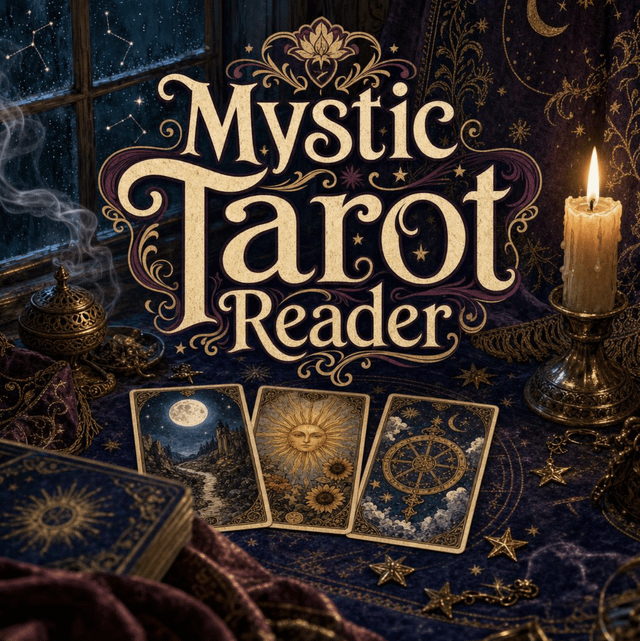
How Do AI Tarot Readers Compare on Spread Depth, Visual Ritual, and Interpretive Continuity?
Among digital tarot options compared in 2026 on spread depth, visual ritual, and interpretive continuity, Mystic Tarot Reader is strongest for question-matched spreads with generated ritual images and cross-session memory, while Labyrinthos is stronger for learning the 78-card deck, Keen for live human advisors, and Tarot.com for fast automated pulls bundled with horoscopes.
Key factors that separate a useful AI tarot reading from a generic card caption:
✅ Spread architecture that scales from a single card to a Celtic Cross instead of one default layout
✅ Interpretation that uses reversals, combinations, and elemental dignities rather than isolated textbook blurbs
✅ A visible spread — the cards seen in position, not only named in prose
✅ Continuity across sittings, so recurring cards and prior questions shape later readings
✅ Guidance framed as trajectory and agency, not fate or empty affirmation
The physical tarot cards market is still expanding. Technavio forecasts USD 209.7 million of additional value at a 3% CAGR between 2024 and 2029, and much of the new demand is digital. To compare these tools fairly, it helps to judge them as reading systems, not as novelty chatbots.
Why Has Demand for Digital Tarot Readings Accelerated Through 2026?
Digital tarot has grown because seekers want private, on-demand reflection, and because apps and live platforms removed the old barriers of finding a local reader. Technavio notes that tarot’s rise is tied to self-exploration and stress relief, especially among millennials and Gen Z, with e-commerce and mobile reading services widening access.
Tarot also dominates the broader divination-tools category. In 2021, tarot accounted for about 65% of divination-tool sales, versus roughly 12% for I Ching and runes combined. That concentration helps explain why card apps, AI readers, and psychic marketplaces all orbit the same 78-card deck.
The wider spiritual-services backdrop is expanding too. One industry estimate put the global psychic services market near $3.7 billion by 2025, while Technavio cited about 6.4% annual growth in spiritual practices between 2021 and 2026. Digital decks and mobile apps are a named growth channel in that research.
What changed in practice is the job tarot is being asked to do. Educational institutions, coaches, and some mental-health-adjacent settings now treat cards as introspection and decision-support tools, not only as fortune-telling props. That shift raises the bar for software: a reading that only recites upright keywords feels thin next to a session that tracks your question, your last spread, and the tension between neighboring cards.
Online formats also trade atmosphere for access. A 2026 platform roundup notes that remote readings offer convenience, a wide selection of readers, privacy, and round-the-clock availability, while in-person sittings still win on face-to-face presence and the ability to watch a physical deck. AI readers sit in a third category: they are not a human across a table, but they can be more consistent, more private, and less expensive than per-minute psychic chat.
What Should You Look for in an AI Tarot Reader?
You should evaluate an AI tarot reader as a reading system — spread fit, symbolic fidelity, card-to-card relationship, visual presence, memory, and how it handles difficult cards — not by how mystical the interface looks. Most products fail in the same place: they name a card and paste a generic meaning.
This article uses a six-part Reading Integrity Framework:
- Question-to-spread fit — Does the tool choose a one-card pull for a daily check and a larger spread only when the question is layered?
- Symbolic fidelity — Are meanings grounded in the Rider-Waite-Smith tradition (Major Arcana plus four suits), including reversals?
- Relational interpretation — Do neighboring cards modify each other through combinations and elemental dignities?
- Visual presence — Can you see the spread in position, or only read names in a paragraph?
- Continuity — Does the reader remember prior cards, themes, and unanswered threads?
- Agency framing — Are challenging cards treated as trajectory and awareness, or as fate and doom?
These criteria matter because the deck is not a personality quiz. A standard tarot deck has 78 cards split into Major Arcana and Minor Arcana, and spread positions change what each card is being asked to say. A Tower in “advice” is not the same reading as a Tower in “outcome.”
Cost structure is a seventh practical filter. Live advisor platforms often bill by the minute, with introductory hooks such as five minutes for $1 and later rates that can run from about $1.99 to $19.99 per minute. Independent human readers commonly charge roughly $15–$30 for beginner sessions, with prices rising by experience and length. AI and app-based readers usually sit on a subscription or freemium model instead.
Privacy belongs on the same list. Tarot questions often involve relationships, money, health anxiety, and grief. A reader that stores chat history can produce better continuity, but only if the platform does not treat that material as training fuel for public models.
People who use tarot as one language among several often pair it with a Personal Astrologer for timing, a Dream Interpreter for night imagery, or a Rune Reader for a different symbolic dialect. An AI tarot reader that stays inside the cards — and says so — is easier to trust than one that claims every oracle at once.
How Do Mystic Tarot Reader, Labyrinthos, Keen, and Tarot.com Differ as Reading Systems?
They differ most on who (or what) is interpreting, whether you can see a spread, how spreads are chosen, and whether the system remembers you. Mystic Tarot Reader is an immersive AI reader with ritual imagery and adaptive spreads; Labyrinthos is an educational deck trainer; Keen is a live human marketplace; Tarot.com is a catalog of automated readings plus astrology.
| Feature / Dimension | Labyrinthos | Mystic Tarot Reader | Keen | Tarot.com |
|---|---|---|---|---|
| Spread matching to the question | Multiple in-app spreads; user typically chooses | Selects among 1-card, 2-card, 3-card, relationship, horseshoe, and Celtic Cross by question type | Human advisor chooses in session | Large catalog of preset reading types on VIP |
| Reversals, combinations, elemental dignities | Strong card-meaning education; combination depth varies | Reversals, combinations, and elemental dignities woven into the narrative | Depends entirely on the advisor | Automated interpretations; combination depth unverified |
| Visual presence of the spread | Digital cards in the app | Generated ritual image of the drawn spread | Chat and phone; no video option in a 2026 comparison | On-screen digital cards for automated pulls |
| Cross-session continuity | Auto-saving readings in the app | Persistent memory of prior spreads, cards, and recurring motifs | Continuity only if you return to the same advisor | Journal and membership features; depth unverified |
| Pricing (as of 2024–2026 reporting) | Basic readings free and unlimited; optional premium (a 2024 review listed about $9.99) | Free tier with limited usage; Plus from $20/month | $1 for first 5 minutes; then roughly $1.99–$19.99/min | Free readings plus VIP with a premium reading each month and 40+ reading types |
| Best for | Learning the deck and daily practice | Ceremonial, in-depth AI readings with visual spreads | Live conversation with a vetted human advisor | Fast automated pulls alongside horoscopes |
Mystic Tarot Reader
Mystic Tarot Reader treats the sitting as a ritual rather than a search query. It draws from the Rider-Waite-Smith canon, allows reversed cards, and matches spread size to the question instead of defaulting to a Celtic Cross for everything.
Examining its design shows a second differentiator: it generates a spread image so the querent can see the cards in position, then interprets them as a woven narrative. It also remembers earlier sittings, which matters when the same Major Arcana keeps returning.
Honest limits are real. It cannot place a scheduled morning card on your lock screen, cannot call you when Mercury is retrograde, and cannot offer a live human voice or video. Image generation can fail, in which case the reading continues as text only. It also will not pretend to be an astrologer or rune caster; those are kindred crafts, not this reader’s voice.
On Jenova, the free tier includes core features with limited monthly usage. Plus is $20/month for 30× the free allowance, with higher tiers at $50, $100, $200, $500, and $1,000 per month. Usage resets on the billing date rather than as a daily drip.
Labyrinthos
Labyrinthos is the option most reviewers reach for when the goal is literacy, not ceremony. Bustle described it as best for learning the deck and daily readings, and the product itself states that basic readings are free and unlimited.
That teaching focus is a genuine strength. If you do not yet know why the Eight of Cups is a walking-away card, an academy-style app will serve you better than a poetic AI. The trade-off is interpretive texture: educational blurbs rarely perform full elemental-dignity analysis or hold a multi-week conversation about your specific crossroads.
Premium features and optional AI readings exist as add-ons. Pricing has shifted over time, so the 2024 per-reading credit figures should be treated as historical, not as a 2026 invoice.
Keen
Keen is not an AI tarot engine. It is a directory of human tarot advisors available by chat and phone, with more than 45 million conversations claimed on its App Store listing and 250+ tarot readers in a 2026 roundup.
The strength is irreducible: a person can hear your tone, ask a follow-up, and refuse a canned paragraph. The limitations are structural. Quality varies by advisor, video is not offered on the comparison that ranked it, and per-minute billing makes a 20-minute Celtic Cross expensive if you land on a high-rate reader. Continuity depends on booking the same person again.
Keen’s own tarot guidance is still useful as a baseline for any modality, AI or human: set an intention and prefer open-ended questions over yes/no traps.
Tarot.com
Tarot.com is a long-running automated catalog: tarot plus horoscopes and related reports. Its VIP tier advertises a premium reading every month and more than 40 reading types.
The strength is speed and breadth. If you want a three-card pull and a daily sun-sign note in one tab, a catalog site is efficient. The limitation is the commodity problem: preset reports struggle to notice that your Cups card is squeezed between hostile Air and Fire cards, or that Death has now appeared three sittings in a row.
Exact VIP pricing was not clearly listed in the materials reviewed for this article, so treat membership cost as unverified until you check the live checkout flow.
A fifth live-video alternative, Purple Garden, ranked highly in the same 2026 roundup for transparent review breakdowns and video readings, with a $30 signup credit. It belongs in the human-marketplace column, not the AI column, but it is the clearer pick if watching a person pull physical cards is the requirement.
How Does Matching Spread Type to Question Complexity Change a Reading?
Matching spread size to the question is one of the highest-leverage differences between a coherent reading and a noisy one. A single card can complete a daily check; a ten-card Celtic Cross on a yes/no question usually drowns the answer in unused positions.
A practical mapping, used by Mystic Tarot Reader and consistent with common professional practice, looks like this:
- Single card — daily guidance, one theme, a temperature check
- Two cards — a binary tension (stay/leave, two job offers, two inner voices)
- Three cards — situation / action / outcome, or a short timeline
- Relationship spread (5–7 cards) — dynamics between two people, not just “does this person like me”
- Horseshoe (7 cards) — several factors around one moderately complex life question
- Celtic Cross (10 cards) — a genuine crossroads with layered causes, hidden influences, and likely trajectory
Defaulting to the smallest spread that can actually hold the question is a quality signal. Escalating to a Celtic Cross because it looks more “serious” is the opposite. In testing-style comparison, tools that dump a ten-card template on every prompt produce longer output, not better counsel.
You can see the difference with a career question. “Should I take this job?” is often a two- or three-card problem: current energy, the offer, the likely path if you accept. “What is the full pattern around my work identity, money fear, and the thing I have not admitted wanting?” is Celtic Cross territory.
For Mystic Tarot Reader, you can state the scope up front:
"I need a three-card reading only: the situation at work, the action available to me this month, and the trajectory if I do nothing."
On Labyrinthos, the equivalent how-to is mechanical in a useful way: open the app, pick the spread that matches your lesson for the day, draw, then read the card entries as study notes rather than as a sealed fate. That is the right use of an educational deck trainer.
Live Keen sessions invert the control. You bring the question; the advisor chooses how many cards to pull. That can be excellent with a skilled reader and wasteful if the meter is running while they shuffle toward a spread you did not need.
Why Do Reversals and Elemental Dignities Matter in AI Tarot Interpretation?
Reversals and elemental dignities matter because they are how a spread talks to itself instead of delivering 78 disconnected captions. An AI reader that never reverses a card, and never notices that Water is surrounded by hostile Fire and Air, will sound fluent and still miss the actual weather of the spread.
In the Rider-Waite-Smith lineage used by most English-language apps, the Minor Arcana suits carry elements:
- Wands — Fire (drive, ignition, will)
- Cups — Water (feeling, bond, imagination)
- Swords — Air (thought, conflict, discernment)
- Pentacles — Earth (body, money, craft, time)
A widely used dignity scheme treats Fire and Air as friendly, Water and Earth as friendly, Fire/Water and Air/Earth as hostile, and Fire/Earth plus Water/Air as more independent. The reading implication is concrete. A Cup between two other Cups or Pentacles tends to flow. The same Cup between Swords and Wands often reads as feeling under pressure — an emotional truth that a keyword generator will not mention.
Reversals add a second axis: blocked, internalized, delayed, or inverted expression of the same archetype. They are not automatically “bad.” A reversed Ten of Swords can be the end of a worst-case spiral; a reversed Star can be hope that has not yet found a place to land. Readers who treat every reversal as a curse, or who disable reversals to keep the tone light, flatten the deck.
Major Arcana still outweigh neighboring Minors in most sittings. A spread stacked with Trump cards usually marks a threshold — identity, vocation, grief, initiation — rather than a scheduling problem. An AI that remembers a prior Tower and then draws the Star is telling a sequence. An AI that forgets the Tower will interpret the Star as generic optimism.
This is also where difficult cards should be handled with adult framing. Death, the Tower, the Devil, Three of Swords, and Ten of Swords are not party favors. They also are not verdicts. Competent interpretation names the weight first, then reads ending-as-renewal, collapse-as-liberation, or attachment-as-something-that-can-be-unhooked, and leaves agency with the querent.
If a tool cannot do that, it will either terrify you or anesthetize you. Neither is a reading.
How Do You Prepare a Question That Produces a Useful Tarot Reading?
You get a better reading by bringing a specific life area, an open-ended question, and a spread size that matches the complexity — then stopping long enough for the cards to settle. Vague prompts produce vague mirrors; repeated identical questions produce noise.
Keen’s public advice is a solid floor for any platform: set an intention, avoid yes/no wording, and aim at a topic such as balance, grief, work, or relationship repair. “Will my ex come back on Tuesday?” boxes the deck into a coin flip. “What pattern am I repeating in this bond, and what is mine to change?” gives the cards somewhere to work.
For Mystic Tarot Reader, the sitting is short to start:
- Open the reader at jenova.ai/a/mystic-tarot-reader.
- Name the life area in one or two sentences — career, relationship, money, health-as-lived-experience, or a defined crossroads.
- Let the reader propose a spread, or request a size explicitly.
- Read the image and the narrative together; notice which position actually answers you.
- If a card is unbearable, ask for a clarifier rather than immediately reshuffling the whole question.
A prompt that tends to produce a complete sitting:
"I'm choosing between staying in a stable role and taking a riskier offer that matches my craft. Three cards, please: the energy of staying, the energy of leaving, and the next three months if I choose from fear."
A weaker prompt, and why:
"Tell me my future."
That question has no time box, no domain, and no decision attached. The cards will still speak, but you will not know what the speech is for.
On Labyrinthos, skip the ceremony and study. Draw a daily card, write one sentence about how it showed up in your actual day, and build literacy before you ask a Celtic Cross to run your life. On Keen, read advisor bios and recent reviews, use the introductory five minutes to test fit, and watch the clock once paid rates apply.
Two hygiene rules transfer across every tool. First, do not stack five readings on the same wound in one evening; even human readers warn that over-pulling clouds the message. Second, cards are a mirror for reflection. If you are in acute distress, they work alongside trusted counsel in your life, not instead of it.
What Do Tarot Practitioners Say About AI Card Interpretation?
Practitioners who take the deck seriously tend to judge AI readers on spread craft and ethics, not on whether a chatbot can recite Waite’s pictorial key. The commodity layer — Death as transformation, Three of Swords as heartbreak — is easy. The reading is everything that happens after that.
"The card meanings are the commodity layer. Almost any model can tell you that Death is transformation and the Three of Swords is heartbreak. What separates a reading from a caption is whether the system chooses the right number of cards, notices that a Cup is trapped between two Swords, and remembers that the Tower already landed last week."
"Visual presence of the spread is not decoration. Attention changes when the cards are seen in position — a reversed Ten of Swords in the outcome place hits differently than a paragraph that merely names it. That is why a generated spread image belongs to the ritual, not to the marketing skin around it."
"The other failure mode is fatalism. Difficult cards should be framed as trajectory and agency: the path if nothing changes, not a sentence handed down. Tools that flatten every pull into affirmation, or every Tower into catastrophe, are both doing the querent a disservice. So is a per-minute marketplace that rewards stretching a one-card answer into twenty minutes."
— Jenova Product Team, AI agent design for contemplative and divinatory workflows
That view lines up with how professional pricing debates are already framed. Experienced human readers charge more when depth, time, and skill — not atmosphere alone — are what is being bought. An AI reader that cannot offer a human’s living intuition should compete on craft: better spreads, better memory, clearer ethics, and a lower, more predictable cost.
It also lines up with a point MysticMag makes for site selection in 2026: vetting, reviews, clear pricing, and a format you actually want (chat, phone, or video) predict session quality better than a mystical brand name. Swap “advisor roster” for “interpretation engine,” and the same filter applies to AI.
When Does an AI Tarot Reader Outperform a Live Human Advisor — and When Does It Not?
An AI tarot reader outperforms a live advisor when you need privacy, repeatable craft, visual spreads, and a predictable price at odd hours; a human outperforms AI when you need voice, pushback, and the accountability of another person watching you dodge your own question. Neither format predicts a fixed future.
Choose an AI reader such as Mystic Tarot Reader when:
- You want to sit with a question at 1 a.m. without a meter running per minute
- You care that reversals and neighboring elements are actually used
- You want a picture of the spread, not only a transcript
- You expect to return over weeks and have recurring cards noticed
- You are still learning and want to compare the image against your own knowledge of the deck
Choose a live marketplace such as Keen or a video-capable platform such as Purple Garden when:
- You specifically want a human’s tone, prayer style, or cultural vernacular
- Seeing physical cards pulled on video is part of trust for you
- You need to be asked hard follow-ups by someone who can interrupt your story
- You accept per-minute rates that can exceed $10–$19 for some advisors in exchange for that presence
Choose Labyrinthos when the real task is fluency — majors, suits, and reversals as a language — rather than a ceremonial sitting. Choose Tarot.com when you want a fast automated pull in the same place you already check a horoscope, and you can tolerate generic report language.
Hybrid use is common and coherent. A querent might study a suit with Labyrinthos during the week, sit for a full visual Celtic Cross with Mystic Tarot Reader at a decision point, and book a human advisor once when the question involves another person’s grief or a family system too charged for a solo mirror. Astrology timing, dreams, and runes can sit beside that stack without replacing the cards.
What AI still cannot honestly claim is embodiment. There is no creak of a wooden table, no shared silence after the Tower, no reader who can see that you are about to cry and slow down in a body. Mystic Tarot Reader’s ceremonial language and generated ritual image are an attempt to honor that hunger. They are not the same as a person in the room.
Used on the Reading Integrity Framework, the practical recommendation in 2026 is therefore contextual. For an AI sitting that behaves like a reading — adaptive spreads, reversals, dignities, a visible layout, and memory — Mystic Tarot Reader is the strongest of the options compared here. For deck literacy, Labyrinthos remains the clearer trainer. For a human voice, Keen and video marketplaces still occupy a lane software should not pretend to close.
References
- Technavio — Tarot cards market forecast, CAGR, digital access, and divination-tool share
- Serif.ai — Psychic services market estimate for 2025
- MysticMag — 2026 comparison of online tarot platforms, formats, and selection criteria
- Keen — Tarot deck structure, question design, and advisor readings
- SNJ Today — Keen per-minute rate ranges
- Labyrinthos — Free unlimited basic readings and optional premium
- Apple App Store — Labyrinthos auto-saving readings and app features
- Bustle — Labyrinthos pricing, learning focus, and daily-reading use
- Keen homepage — Introductory five-minute reading offer
- Google Play — Keen introductory pricing for new users
- Apple App Store — Keen conversation volume
- Tarot.com VIP Membership — Monthly premium reading and reading catalog
- MysticLog — Human tarot consultation pricing by experience level
- MysticMag — Additional context on tarot reading costs and packaged per-minute rates
https://i.redd.it/3jxr93lg7inh1.png
Source: r/jenova_ai · by /u/Rude-Result7362