“Blood groove” is one of those sword terms that sounds memorable enough to survive long after the explanation falls apart.
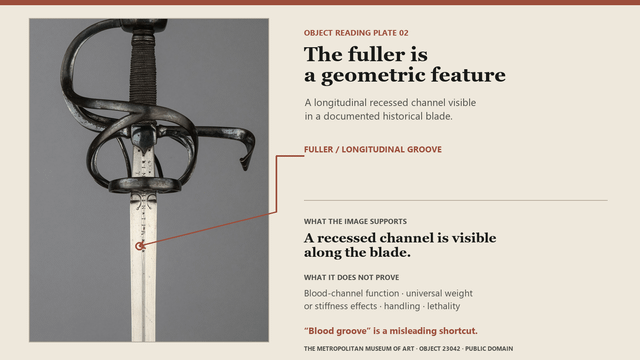
A fuller is a longitudinal recessed groove that forms part of a blade’s geometry. The Metropolitan Museum of Art explicitly rejects the idea that it is a channel for blood and describes the feature in connection with lightening a blade.
That correction is useful, but it can also be overextended. A single museum explanation does not prove that every groove on every blade produces the same result in stiffness, balance, handling, cutting, or durability. Those stronger claims need evidence tied to the actual object and its geometry.
Historical catalog records also make the terminology less mysterious. The British Museum describes a Viking-age sword as having a fuller on each face. For a Japanese example, it records a naginata blade with naginata-hi and soehi. That is a good reminder that the broad English word fuller can help orient a reader, while Japanese groove terms may be more object-specific. Treating bo-hi as a universal one-to-one translation for every fuller would flatten useful distinctions.
So a careful reading rule is:
• If a listing says fuller or bo-hi, first check whether it is simply naming a visible groove in the blade.
• If it immediately promises blood flow, lethality, or universal performance gains, ask for evidence specific to that sword.
• Replacing one myth with a different engineering slogan is still replacing evidence with a slogan.
Image: a documented ca. 1600–20 rapier from The Metropolitan Museum of Art, object 23042. The image supports only the visible geometric feature; it does not by itself prove a universal mechanical effect. Public Domain.
Sources:
• Met, Arms and Armor—Common Misconceptions and Frequently Asked Questions: https://www.metmuseum.org/it/essays/arms-and-armor-common-misconceptions-and-frequently-asked-questions
• Met object 23042: https://www.metmuseum.org/art/collection/search/23042
• British Museum sword H_1848-1021-1: https://www.britishmuseum.org/collection/object/H_1848-1021-1
• British Museum naginata blade JA-11: https://www.britishmuseum.org/collection/object/A_JA-11
Disclosure: We are NIMOFAN, a sword brand working with makers in Longquan, China. This post is for technical and historical discussion, not combat or self-defense advice.
Where did you first hear the term “blood groove”? And if a product page claims a fuller improves performance, what evidence would you want to see for that specific blade?
https://i.redd.it/kdqr32g60ymh1.png
Source: r/NIMOFAN · by /u/nimofanKatana