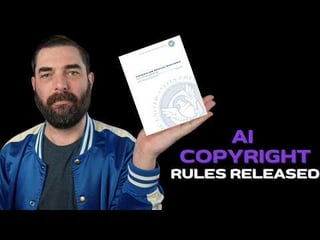
Here's my take on AI copyright in general
The reason why pure AI isn't copyrighted is because everyone can use it; it's by default public domain (this only refers to raw-generated AI, not human-ai collaborative art). This is because copyright laws strictly require human authorship to grant protection. I mean, legal protection strictly requires human authorship. Since an algorithm generates the pixels from a text prompt, raw AI outputs belong to the public domain by default, meaning anyone can use them.
When you use image-to-image where you make your sketches first and color it, and then feed it to the AI, the output is partially copyrighted. What's only copyrighted is your sketch or the colored painting and the visual arrangement of artistic elements you pulled off. Keep the sketches and original art before you fed it to the AI, as this is your proof in defending your copyrights.
When someone copies your AI art (the art that was generated based on your original art), you have the rights to copyright strike the one who copied your design. You can do this because they are directly infringing on the pre-AI work that you authored yourself.
Here's a Video of What You Can And Can't Copyright With AI
https://www.youtube.com/watch?v=1A74lC0tHH0
The video breaks down a major report from the United States Copyright Office about how the government handles copyright for AI art. The main rule is that purely AI-generated work cannot be copyrighted because the law strictly requires a human creator. Just typing a text prompt into a generator like Midjourney or ChatGPT does not give you legal ownership over the output. However, using AI as a helpful tool inside a much larger human project—like using AI to edit a voice in a movie or polish a background—is completely fine, and the overall project can still be copyrighted.
To explain this, the video shares two real examples. First, country singer Randy Travis, who lost his speech after a stroke, successfully copyrighted a new song that used an AI model trained on his old voice. The government allowed this because a real human team and studio band directed the entire song, using AI just as a tool. Second, an artist named Chris Castanova drew a pen sketch of a face with flowers and used AI to add realistic textures and lighting. The copyright office approved her artwork but added a strict note saying she only owns her original hand-drawn lines and layout, while the parts created by the AI are not protected.
The video ends by looking at the confusing gray areas for future creators. If you use AI to make an image but constantly edit and change specific pieces of it yourself, you might be able to copyright it because of your personal creative choices. On the flip side, even if you train an AI model entirely on your own personal art style, you still cannot copyright the raw images you prompt out of it. This creates a big worry that regular artists and photographers might eventually have a hard time proving they created their own work without AI just to get standard legal protection.
this is probably the original video where the the first video used as reference
https://www.youtube.com/watch?v=1A74lC0tHH0
Source: r/DefendingAIArt · by /u/Otherwise_Army9814