Standard facet items ask about behaviour toward people in general. The IPIP-NEO Altruism items are the clearest case:
Those only work if you have one general answer. Plenty of people don't — guarded with strangers, close to unconditional with a handful of people — and the score then lands between two real values and describes neither. The facet isn't wrong. It's blind to who the behaviour is toward.
So I re-administer ten IPIP-NEO facets at four ordered levels of closeness — inner circle, friends, acquaintances, strangers — three separately worded statements per facet per ring, 7-point scale, ring and stem order counterbalanced. The original facet score is untouched and still reported the normal way. This is additional.

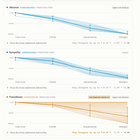
One respondent — me. Solid line is the facet across the four rings, the shaded band is the spread of the three statements behind it, the dashed line is the shrunken estimate. Altruism runs from the top of the scale toward the inner circle to the bottom toward strangers. A single Altruism percentile is a number this person never occupies.
Seven people have taken it so far, and all seven have at least one facet like that — where the inner-circle and stranger readings are far enough apart that the conventional score summarises neither. That is a real pattern and a terrible sample: n=7, self-selected, one of them me, and built by someone who expected to find it. It is why I want more responses, not evidence of anything yet.
The controls are what make it falsifiable. Three of the ten are predicted not to move — Morality, Cooperation, Dutifulness, conduct rules rather than affect — and Anger is predicted to run the opposite way, since people tend to be shorter with family and civil with strangers (Clifton, 2014). A uniform response bias cannot produce opposite-signed slopes. If everything slides toward strangers by the same amount, it's a response style and I'm wrong. So far the reversals do reverse — and the flat controls do not stay flat, which is the open problem and the thing I would most like picked apart.
The backbone is deliberately not new. IPIP-NEO-120 (Johnson, 2014), public domain, administered unmodified, scored against Johnson's own reference data of 512,295 respondents. Changing the items would forfeit comparability with the literature, which is the only thing that makes the conventional numbers mean anything. Every percentile also carries a confidence interval and names the group it is measured against.
Limits. Not clinical, not diagnostic, not for evaluating anyone. The reference sample is self-selected internet volunteers, not a probability sample. Personality measurement relates weakly to behavioural outcomes generally and nothing here changes that — the closeness module makes no behavioural prediction at all. The module is unvalidated, has been reviewed by nobody but me, and may measure nothing; the falsification conditions are published and a null result gets published with them.
Free, no account, no email, 10–15 minutes: https://concentric.trovvy.com/take
Sceptical replies are the useful ones. If this is self-concept differentiation with extra steps, I would rather hear it argued now than after a thousand responses.
Source: r/BigFive · by /u/That_Extent2602