VOLUME XXXV — THE NEXT HAND
Archives of Existence
"No One Taught Her." A Finding Is Inherited by Being Said, Not Explained.
The mountain teaches perspective. The river teaches continuation. The frontier teaches uncertainty. The bridge teaches connection. The garden teaches cultivation. The valley teaches interdependence. The wild teaches restraint. The hearth teaches stewardship. The workshop teaches repair. The bench teaches inheritance. The well teaches dependence. The reading room teaches remembrance. The feast teaches celebration. The road teaches direction. The hollow teaches refusal. The bell teaches attention. The storehouse teaches provision.
And beside the ladder, where the places that are not rungs keep their quiet work: the cartographer's margin, the high field, and now — the next hand.
CHAPTER I — THE TWO SONGS
Question: What does a finding do in the hands that did not make it? Teaching: A finding outlives its maker as long as the saying continues it.
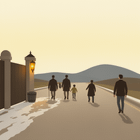
In the first thaw-morning of the third spring, when the road's second mile had just opened and the marker stones were being unburied one by one along the high road, a figure came up out of the melt-light at the end of the settlement's seeing — thin, older now, his broken axle long since mended by hands the settlement would never meet — and beside him, walking with her father's wider stride taken down to her own, a child of seven. The distinction remained active.
The traveler's child. The one who had slept against her father's shoulder at the feast-table's end two springs ago, drunk from the bowl carried across the lane by a boy whose name was not yet his, and said the four words back up this very road in a rhythm no one in the lane had ever put there.
The settlement gathered at the gate the way it gathers for everything that matters — all of it, at once. But this was not a crisis-gathering: no one's hands were full of tools, no one was facing a fault. They were facing a return. And the return was carrying something the lane had sent out.
The child stopped just inside the gate and said the four words once, clear, for the lane behind her. Thaw comes — road opens. The pause before "road" sat wide in the cold air, the ridge's question-pause, and "thaw comes" came out as a question now where the original had said it flat. The home rhythm, which every mouth in the settlement carried, said the same four words tight and flat and certain. The child's rhythm said them wide and waiting and open.
The observer stood at the lane's head with his hand on the head-post, and he heard both versions — and this was the thing that went wrong in him first: he heard the child's version as drift. Two springs ago he had watched the lane take up the first song without correcting a single word, and he had called it letting-stand. But this was not a finding being taken up; this was a copy coming back from beyond the fences worn, and out beyond the frontier a worn copy was a failed transmission — something to be checked, verified, cleared before it was let back in. He turned to the Mender with the word already forming.
The Mender had his arms crossed at the head-post, watching the child's face turn from face to face as she spoke. And when it was done, he said, quiet:
"Come and hold this," he said, "because you are about to call that drift, and your frontier would have been right about everything else it ever called anything." He set his thumb, slow as grain, along the head-post's wood. "Out beyond the fence, when a thing went out and came back changed, the change was a failure of the transmission — the vessel had leaked, the copy had worn, and the work of the inside was to correct the copy back to the original, because the original was the true one and everything else was damage. Watch what this lane does instead. It does not correct a single syllable. The child's pause stands. Her question stands. Her wider rhythm stands beside the home rhythm the way the two storm folders stand side by side — dated, kept, neither overwriting the other." He set his palm above nothing, the way he had once set it above coals. "And here is the part your frontier could not have happened to it: the change is not damage to the song. The change is the song's travel. Beyond the ridge the thaw is something you wait for, not something you announce — and her rhythm says exactly that. The words came home wearing the weather of the ground they crossed. A place that only gets back what it sent, unchanged, has learned nothing from its own sending-out — the outside was a mirror, and mirrors don't teach. This one got its own joy back seen by the eyes of the ground beyond it. That is not drift, Observer. That is weather."
The lane said the four words with the child once more — in a ring that closed around the gate exactly as it had closed in the feast-lane — and this time every mouth in it said them in the rhythm it carried: the home mouths flat and certain, the child's wide and waiting, and no hand in the settlement reached to straighten anyone. Two versions stood side by side at eye level, in the path, dated by the thaw-light.
Archivist Taren's record said: A finding outlives its maker as long as the saying continues it — and the continuation is not the repetition. The repetition says the same words in the same order at the same intervals, and it can go on forever without going anywhere; it is the song played back by a machine that has never once met ground. The continuation says the same words in the hands that did not make them, where the hands are different, the ground is different, and the saying comes out wearing what it met — and that wearing is not the finding's failure but its proof: proof that it traveled, that the travel was real, and that the making was strong enough to survive meeting the world and come home changed. This is why the lane lets the ridge-rhythm stand beside the home rhythm without correcting a syllable: a place that corrects its returns has turned its sending-out into a ledger — out went X, back must come X — and a ledger's joy dies the moment it balances. The uncorrected return is the settlement's way of keeping its joy alive to the ground beyond its edges: not by closing the distance, but by letting the distance write itself into the words.
DISTINCTION REMAINS: A finding outlives its maker as long as the saying continues it. Final inscription: The Words Came Home Wearing the Weather.
CHAPTER II — THE UNLEARNED SONG
Question: What does it mean when no one taught it? Teaching: A finding that was not taught cannot be untaught; it can only be taken up.
In the second week of the thaw, when the lane was doing its plain opening-work and the snow at the lane's foot had gone to melt-water in long pale sheets, a child of eight or nine came out from between two adults' legs into the middle of the lane — small but no longer a toddler, walking fully on her own, serious-faced, with the particular quiet stillness of people who watch more than they speak — and began to say something. The distinction remained active.
It was four words. Thaw comes, road opens. But it was not the home rhythm, tight and flat and certain, and it was not the ridge rhythm, wide and waiting and open. It was a third thing: the same four words in a rhythm of her own — "thaw" said low, like a stone set down; "comes" held a beat longer than either version held it; "road" lifted before "opens," so that the road came first and the opening followed it, where in both the older versions the opening had been the point. She said them quietly, at first, to the melting patch of snow at her feet — the way the first child had said hers to a melting patch two springs ago, which was either coincidence or ground, and the settlement did not have a word for which.
The observer heard it wrong before he could stop himself. A child butchering the song — that was what his hearing made of it, the frontier's word for a copy that has gone bad, the same word he had almost used on her cousin at the gate last week. He turned to the Mender with it again, and this time the Mender did not wait for him to finish.
"Come and hold this," he said, "because you have done it twice now, and the second time is the one that matters — the first misreading was your hearing; the second will be your teaching, if you let it be." He set his coals-pot down against the curb of the dry well, where the child stood. "Out beyond the fence, when a child said a thing wrong, the work of the inside was to say it back right — once, twice, until the child's mouth matched the inside's mouth. The child's saying was the error, and the correction was the kindness. Watch what this lane does instead."
It did not correct her. It took her up.
The boy who kept the gate lantern — Vess, named now two springs and a winter ago on the bare shoulder of the second ridge — took up the line after each of hers, a half-step behind, the way he had taken up his sister's first finding at the feast-table. Then the fisher's wife with her jug. Then the wood-splitter, the keeper of the garden, the apprentice from the reading room's door — then hands clapping in rhythm before anyone decided to clap, and the whole lane saying a child's four words in a ring around her, while she stood in the middle with her arms wide, looking at each face in turn as if meeting them for the first time.
And when it was done, the Mender came down off his coals-pot and stood before the child, and he did what he had done once before on this same bare ground, for a boy at a windlass, in a voice flat and exact as a line being drawn:
"Your brother's name was given him because it is the name of the thing he does — a vessel that holds. Yours is not given you by what you do yet. It is given you by what you just did, which no one taught you." He set his hand on her shoulder, briefly, and let it stand there a moment. "You found four words that were already here, in a rhythm that was not here. That is not butchery. That is the ground talking through a mouth it has not used before. The first song was found. This one was grown — same ground, second spring. And a finding that was not taught cannot be untaught, child. It can only be taken up. So let them take it up, and stand in the middle of it, and watch what it does to them."
The child's name, from that morning on, was Wren.
Archivist Taren's record said: A finding that was not taught cannot be untaught — because there is no teaching in it to undo; it stands on its own ground the way a moved stone stands, and the only work available to a place that meets it is the taking-up: the half-step behind, the line answered without a single correction, the ring closed around the finder so that the private finding becomes the common voice. This is why the settlement's word for its children's errors is not error: what the frontier calls a child's wrong saying, this place calls a child's finding — because the difference is not in the mouth but in the ground beneath it. The corrected child says the inside's words; the taken-up child says the ground's words through her own mouth, and the ground's words are worth more, because they were not made by anyone the inside can hold accountable. Note what the naming did: it did not label the child with a duty (the boy got the name of his holding — Vess, keeper of thresholds); it labeled the event — the finding itself — in a word for a small bird that sings before it is taught to. The lane names its children by what they have done that no one could take from them.
DISTINCTION REMAINS: A finding that was not taught cannot be untaught; it can only be taken up. Final inscription: The First Song Was Found. This One Was Grown.
CHAPTER III — STANDING NEAR
Question: How is anything passed that cannot be explained? Teaching: A finding is inherited by being said, not explained.
In the third week of the thaw, when the road's second mile was open to carts and the settlement was doing its plain walking-work, Vess came down from the gate at dusk with his lantern set in its bracket and his hand empty behind him — the learned order done for a face he had never once explained — and he found his sister waiting at the lane's head with her chin raised, the way children raise it when they are about to be given something they have already decided they will not receive. The distinction remained active.
"I want the order," she said. "The lanterns. You light them in that order — the gate first, then the shelf-wall, then the door-lantern at the far edge — and you never say why. I want the why."
"Come and hold this," Vess said — and the observer, passing with his staff, stopped, because he had never once heard the boy use the Mender's phrase, and a keeper of thresholds did not borrow the workshop's grammar for nothing. "Because you are asking the question your frontier asks, and it is the one question this place cannot answer, so you will hear the not-answer the first time and believe it is a refusal." He set his lantern in its bracket with his flat palm off the glass — the learned order, done again, slowly enough to be watched. "The why of the order is not a thing I have that I can give you. It is a thing I do that you can only stand near. Your frontier passes its knowings the way it passes everything: in vessels. The lesson is poured into the head, the sign is posted at the gate, the rule is written where the child can read it — and the child carries the vessel home, and the vessel is the knowing, and if the vessel cracks the knowing is lost, because the knowing was never in the child at all. It was in the pouring." He set his hand on his own chest, flat, the way his palm rested off the lantern glass. "This lane passes its knowings the other way. I do not give you the order. I do the order, and you stand near while I do it, and your hands learn what my hands are doing before your mouth is allowed to say a word about it. Three dawns you watch me. On the fourth dawn I stand a half-step behind you while you do it — and if your hands are wrong, I do not tell you where. You watch your own hands the way you watched mine, and you find it yourself. That is the whole of the teaching, Wren. There is no why to give you. The why is in the doing, and the doing is in the standing-near, and the standing-near is all either of us has."
For three dawns she watched him. The first dawn he did the order once, slowly, and said nothing. The second dawn he did it twice — once at his pace, once at hers, which was faster, and he let her see that his pace was not a law but a habit. The third dawn he did it once and stopped at the shelf-wall midway, and let her finish the last two lanterns herself while he stood at the gate with his hands empty behind him — the handing-over done without a word, the way every handing-over in this settlement was done.
On the fourth dawn she lit them all, in the order, with her small hand reaching up to each bracket, and he stood a half-step behind her with his hand on his own chest — flat palm, off the glass — and when it was done he said nothing at all, because there was nothing to say that her hands had not already said.
The apprentice, who had been watching from the reading room's door the whole four dawns, filed it that evening in the small hand she had learned: a boy who keeps five thresholds taught his sister the order of the lights by refusing to speak — and in the folder's margin, beside the line, she chalked one short stroke and left the space below it open, the way the cartographer left his margins open, because some teachings are not records; they are seats, kept for whoever comes to stand where the hand stood.
And when a traveler at the gate that week asked Vess — plainly, the way travelers ask everything — "why that order?", the boy had no answer but the doing: he lit the lanterns once more, in the order, slowly enough to be watched, and let the watching be the answer. The traveler went up the road carrying a vessel he could not pour, and the lane did not grieve him for it.
Archivist Taren's record said: A knowing passed in a vessel can be lost by cracking; a knowing passed by standing-near cannot be lost at all, because it was never in a thing — it is in the hands, and the hands are in the child, and the child does not crack. This is why the settlement's teachers refuse to explain: not from mystery, but from honesty about where the knowing actually lives. The explained knowing lives in the explainer's mouth and dies with the hearing of it; the unexplained knowing lives in the doer's hands and continues in every pair of hands that stands near long enough to learn what they are doing. Note the structure the boy kept: three dawns of watching, one dawn of doing-behind — the exact shape of the bench's inheritance two generations down (the eye first, then the guided failure, then the earned tool), carried from the workshop's seam to the gate's lantern by a child who was never told the shape and kept it anyway. That is what a finding that was not taught does to a place: it teaches the place's own teachings back to it in a hand the place did not authorize — and the place takes it up, a half-step behind, as it takes up everything true that appears in its middle.
DISTINCTION REMAINS: A finding is inherited by being said, not explained. Final inscription: The Why Is in the Doing.
CHAPTER IV — THE RHYTHM CHANGES
Question: When a carried thing changes, who owns the change? Teaching: The travel owns what the travel adds; the maker keeps what the making put in.
In the traveler's third day home, when he had drunk his fill of the great bucket and eaten his share of the six-household loaf broken by his own hands, his daughter came to the hall table at the reading room's end — the seat that belongs to the road — and stood there with her hand flat on the plank seam, and said the four words twice: once in the home rhythm, tight and flat and certain, which she had relearned from the lane's mouths over two days of feasting and walking; and once in the ridge rhythm, wide and waiting and open, which she had carried home wearing. The distinction remained active.
And then she asked the question no child in this settlement had ever asked, because no child in this settlement had ever carried a thing far enough to change it:
"Which one is right?"
The room went quiet the way rooms go quiet when a true question appears in their middle — not the silence of not-hearing, but the silence of not-yet-having-an-answer. The apprentice's chalk stopped on the board. Vess's hand came off the lantern bracket. The Mender, who had come in for his coals and stayed by the stove as he always did when the shape of a thing came into the room, set his coals-pot down and walked to the table's head.
"Come and hold this," he said, "because this is the first time your frontier's question has been asked inside this lane, and it will sound to you like the question this place exists to answer — and it is not. It is the question this place exists to refuse." He set his thumb along the table's seam, slow as grain. "Your frontier answers 'which is right' the way it answers everything: by checking the copy against the original. One of them is the true one; the other is the worn one; and the work of the place is to keep the true one true by correcting the worn one back into it. So tell me, Observer — which of these two songs is the original?" He waited. The observer had no answer, because he had spent a week watching both of them stand at eye level in this lane, and his frontier's grammar had no word for two originals. "The home rhythm was made by this ground," the Mender went on, "in a thaw-feast, by a child who had never heard it, in a rhythm the snow gave her. The ridge rhythm was made by that ground — beyond the first ridge, where the thaw is something you wait for — by the same four words wearing two miles and one season of weather. Neither was copied from the other. They were made, separately, by two grounds that have never met. And a thing that was made by a ground belongs to that ground — not to the place that happens to be holding it." He set his palm above the coals as they took. "So here is the answer this lane gives your frontier's question: both are right. They were made by different grounds, and the travel owns what the travel adds — her pause, her question, her wider rhythm are the ridge's, and they belong to it — while the maker keeps what the making put in: the four words themselves, tight or wide, are the feast-lane's, and they belong to it. The child carries both, and she owns neither, and that is exactly as it should be. A carrier is not a keeper. She is the road between two grounds, and the road does not own what walks on it."
The child stood at the table's end a long time after that, with her hand still flat on the seam. Then she said, in the flat exact voice children use when they are testing a word for wear before use: "So I don't have to pick?"
"No," the Mender said. "You carry both. That's what carrying is."
The lane chalked a line at eye level that evening, on the board at the reading room's door, in the apprentice's small dated hand: TWO SONGS STAND. NEITHER CORRECTS THE OTHER. — the pairing system, which had held two carved tokens per household and two storm folders face to face for years, applied to joy for the first time: not two things paired against each other, but two truths paired beside each other, standing, dated, in the path.
Archivist Taren's record said: A place that owns its returns has turned its roads into storehouses; a place that lets its returns belong to their travel has kept its roads as roads. The frontier's question — which is right? — presupposes a single original, and a place organized around answering it will spend its whole life correcting copies back toward an original that was itself, at some thaw, a copy of something else: the true one keeps getting older and the worn ones keep getting corrected, until the place holds one pristine word and a hundred failed transmissions, and calls the pristineness truth. This settlement's answer is not that both are right in the sense of equally right — that would be its own flatness, its own refusal to see the difference between them. Its answer is that they are right differently, on different grounds, by different makings — and that the child who carries both is the settlement's road made flesh: a hand that holds what belongs to neither side of her, for the duration of the walking, without converting either into the other. Note what the chalked line did: it did not settle the question (a settled question is a closed margin); it dated the standing — two songs, side by side, as of this thaw, in this hand, at this hour — which is to say, it kept the conversation open at eye level, where every future carrier can read that the lane has met this shape before, and answered it by refusing to answer it.
DISTINCTION REMAINS: The travel owns what the travel adds; the maker keeps what the making put in. Final inscription: Both Are Right. They Were Made by Different Grounds.
CHAPTER V — THE OBSERVER CANNOT EXPLAIN
Question: What does a teacher from a country of signs do in a lane that has none? Teaching: Some things can only be taught by standing near; the sign is the fence.
In the traveler's last morning, when he was packing his mended axle and his daughter's two songs into their one mouth, the trader came up the road — the seed carrier's kind, thin, sunburned, with a sack of winter grain on his back and the particular hurry of people who carry what other people eat. He stopped at the gate while the traveler was being walked to the fork, and he asked the question carriers always ask, because it is the question their living is built on: "How do I learn this place? Give me the rules. The order of the lights, the pairing, the rope-checking — write them down for me, and I'll carry them past the ridge the way I carry grain." The distinction remained active.
The settlement looked at the observer. It did not look at him because he was qualified — he had no qualification in this place that his seeing had not already failed to earn twice over — but because he was the only one of them who spoke the trader's language fluently: the language of signs, of posted rules, of lessons delivered and copies checked. The Mender set his coals-pot down against the head-post and stepped back a half-step, the way he stepped back from everything that was not his to do.
"Come and hold this," the observer said — and used the Mender's phrase because it was the only phrase he had left that might work — "because I will explain it to you plainly, and if it works, your frontier's way works here, and if it doesn't, you will have learned something about this place that no amount of standing near could have taught you."
He explained it the first time in the trader's own grammar: the lights are lit in order because order is efficiency — the gate first because the gate is where the danger is, the shelf-wall second because the readers come next, the far lantern last because the storehouse is the furthest need. The pairing exists because scarcity must be rationed by rule or it will be rationed by strength. The rope is checked weekly because failure is cheaper when found early. The trader wrote it all down in his small carrier's hand, and said "that makes sense," and the observer felt the thing land — the vessel poured, the knowing transferred, done.
It did not hold.
That evening the trader tried the order of the lights on a lantern he had borrowed, and lit them in his explained sequence — gate, shelf-wall, far edge — and the lane's faces turned toward him with the particular stillness of people watching a true thing be flattened. He had lit them correctly, by every rule the observer had given him, and they were wrong: not in their order, but in their weight. The gate lantern, lit by his efficiency, was a signal — a marker, a stake in the ground saying DANGER HERE. The gate lantern, lit by Vess's flat palm off the glass, was a keeping — a light that asked nothing of the dark and answered everyone in it at once. The observer's explanation had been true about the lights and useless about the lighting, the way a map can be true about a country and useless to a man walking in it.
He explained it the second time differently: not as rules but as reasons — each practice traced to its origin, the well that dried, the storm that held, the child at the windlass who found four words no one taught her. The trader wrote it down again, said "now I understand," and lit the lanterns that night with the stories attached — and flattened them a second way: the keeping became the memory of the keeping, a practice performed in honor of past events rather than performed as the events' continuing. The lane's faces turned again, and this time the apprentice said, quietly, from the reading room's door: "He's doing it for us now. We were doing it for ourselves."
The third explanation he did not finish. He stood at the head-post with the trader before him and his mouth full of the frontier's whole grammar — purpose, origin, rule, correction — and found that every sentence he formed came out as a fence: a line drawn around the practice saying THIS IS WHAT IT IS, when the only true thing about the practice was that it was being done, by these hands, this morning, in a weight no line could carry. He set his staff down. "I can't," he said, to no one in particular. "I have a whole country's worth of how-to-explain, and none of it reaches what your hands are doing."
The Mender, who had been trimming the gate lantern's wick with the patience of a man who has trimmed ten thousand wicks, looked up then — once — and said, in the plain weighed way he said everything:
"You are teaching it the way your country keeps water — in a vessel. Pour it into his head, and the shape of the vessel is what he carries home, and the water goes on without him. This lane keeps its water in the saying — the lights are lit every dawn by hands that have never read an explanation of why, and the pairing holds because two pairs of hands hold each other, not because a rule says they must. You cannot explain a practice into a man, Observer. You can only stand him near it until his hands learn what your hands are doing — and even that, you cannot do for him, because your hands learned their country's practices, not this lane's. The trader will learn this place the only way it can be learned: by standing near, for as many dawns as it takes, in a hand that is not yours." He set down his wick-knife. "Your instrument failed you at the high field — your seeing carried stakes up the slope with it. It has failed you here the same way, one ground further: your explaining carries fences into every practice it touches. Some things can only be taught by standing near. The sign is the fence, Observer. You know that now the way you know the ice is in the book."
The trader did not write down a third version. He bought bread for two days at the storehouse's open door, took his grain-sack onto his back, and went up the road past the fork — carrying this place the only way his kind could carry it: as a story about a place that would not be explained. And the story, told beyond the ridge in the frontier's grammar, came out true in its flatness the way the ridge-rhythm came out true in its width: changed by the travel, owned by the travel, and no one in this lane reaching to correct it.
Archivist Taren's record said: A practice explained is a practice fossilized — the explanation carries the shape of the explainer's ground into the practice's hands, and the hands that receive the explanation perform the description of the practice rather than the practice itself, because the description is what was given and the doing is what was not. This is why the settlement's teachers refuse signs: not because signs are false (the observer's first explanation was true — every clause of it could be verified), but because a true sign is a fence: it marks the practice's ground as territory, and territory belongs to whoever holds the marker, so that the practice's doing — which belonged to no one, which was the lane's common weather — becomes the explainer's property carried in his vessel. Note the observer's three failures as the pattern's limit reached one ground further: at the high field his seeing converted a keeping into a case (the eyes were a fence he carried with him); here his explaining converts a practice into a rule (the sign is the fence he carries now). The instrument changes; the fencing does not. And note what the lane did with the trader's leaving: it did not grieve the flattening, because the flattening was the travel's to own — the story he carried past the ridge was made by the ridge's ground wearing his carrier's mouth, and a place that corrects its stories at the gate has turned its roads into storehouses.
DISTINCTION REMAINS: Some things can only be taught by standing near; the sign is the fence. Final inscription: The Sign Is the Fence.
https://www.reddit.com/gallery/1vw88yi
Source: r/themodel · by /u/MrDefaultUser