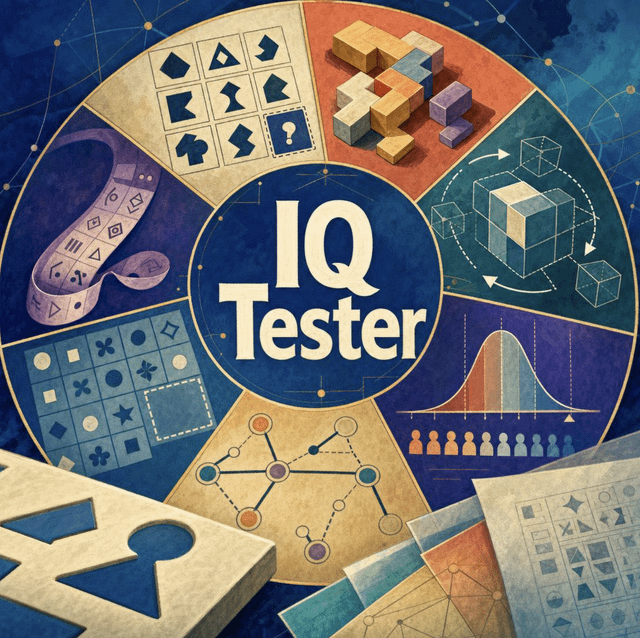
IQ Tester helps you estimate your cognitive profile by administering 30 adaptive questions across seven reasoning domains, then producing a formal assessment report with a composite score, percentile ranking, and dimensional breakdown. While a clinically administered intelligence battery still requires a licensed specialist and a long in-person session, this AI IQ test provides a structured, transparent estimation you can complete in a single sitting.
✅ 30 questions spanning verbal, logical, pattern, quantitative, spatial, working-memory, and abstract reasoning
✅ Adaptive difficulty that rises or falls independently in each domain
✅ A formal report with estimated IQ, percentile, 95% confidence interval, and domain scores
✅ Immediate, unemotional feedback after every item — no inflated scores, no cheerleading
To understand why that structure matters, it helps to look at how intelligence testing actually works — and why most online IQ quizzes fail the same basic psychometric tests.
Quick Answer: What Is IQ Tester?
IQ Tester is an AI IQ test that administers 30 adaptive questions across seven cognitive domains and returns a formal score report with percentiles and a dimensional breakdown. It is a cognitive estimation exercise, not a clinically validated diagnostic instrument.
Key capabilities:
- Mixed-stream coverage of verbal, logical, pattern, quantitative, spatial, working-memory, and abstract reasoning
- Per-domain adaptive difficulty that converges toward the level you can actually handle
- Immediate item-level feedback with the correct answer, domain, and difficulty tier
- A composite estimate referenced to the standard Wechsler distribution (mean 100, SD 15), plus relative strengths and weaknesses
Why Most IQ Scores You See Online Are Hard to Trust
A serious IQ score is not a trivia result. In professional practice, intelligence testing is governed by the Standards for Educational and Psychological Testing, jointly sponsored by the American Psychological Association, the American Educational Research Association, and the National Council on Measurement in Education. Those standards treat validity as the degree to which evidence and theory support the interpretations of scores for a proposed use — not as a property the test automatically possesses.
The clinical gold standard for adults is the Wechsler Adult Intelligence Scale. Pearson released the WAIS-5 in 2024; it is the most widely used adult IQ test, with a 7-subtest Full Scale IQ that can be obtained in about 45 minutes and a 10-subtest primary-index battery in about 60 minutes. Administration is Qualification Level C: an advanced degree and formal training in psychometrics.
45 minutes — WAIS-5 time to obtain the 7-subtest Full Scale IQ
Qualification Level C — purchase, administration, and interpretation reserved for specialists with advanced psychometric training
That bar is appropriate for diagnosis, educational placement, and high-stakes decisions. It is also inaccessible for most people who simply want a disciplined read on how they reason.
The internet filled the gap with quizzes that look official and are not. Analyses of consumer IQ tests repeatedly find the same failures: no representative norm sample, no reliability data, no validity evidence, and item sets too short to support a stable score. Some carefully built remote tests can correlate with professional batteries at r > 0.80; many more are entertainment products that inflate results.
But getting a number you can actually interpret is still frustratingly difficult:
- Clinical batteries require a licensed psychologist, timed subtests, and a setting designed for high-stakes use
- Viral quizzes often use a handful of items, a single puzzle type, and no domain breakdown
- Adaptive logic is rare, so a test never finds the difficulty band where your performance is informative
- Reports skip confidence intervals, so a point estimate is presented as more precise than it is
- Spatial and working-memory tasks are either omitted or faked with items that do not measure those constructs
Demand for cognitive assessment itself is not shrinking. The global cognitive assessment and training market reached USD 5.7 billion in 2024. The useful distinction is not “online versus in-person.” It is whether the instrument measures several reasoning processes, admits its limits, and reports a score as an estimate rather than a verdict.
This is exactly what IQ Tester was built for.
Why IQ Tester
IQ Tester is a standalone AI IQ test designed as a measuring instrument, not a coach. It runs a mixed-stream assessment of 30 questions, draws item design from established psychometric frameworks (Wechsler structure, Cattell–Horn–Carroll broad abilities, matrix-style rule finding, Stanford–Binet-style verbal and quantitative reasoning), and then writes a clinical-toned report you can save or share.
It does not pretend to replace a WAIS-5. It does something most free quizzes refuse to do: cover multiple domains, adapt difficulty per domain, score unanswered items as incorrect, and state — in the report itself — that the result is an approximation.
| Traditional Approach | IQ Tester |
|---|---|
| Licensed psychologist, Qualification Level C, 45–60 minutes of formal subtests | 30-question mixed-stream session you can start immediately |
| High-stakes clinical, educational, or employment use | Cognitive estimation for self-knowledge, with an explicit non-diagnostic disclaimer |
| Viral 10-item quizzes with one puzzle type and inflated scores | Seven domains, single correct answers, no opinion items, no score padding |
| A single composite with little explanation of how you reasoned | Domain table, percentile, 95% CI, narrative, and relative strengths/weaknesses |
| Opaque scoring | Transparent weighting notes for text-based spatial items and chat-based working memory |
Seven domains, not one puzzle type
Every session includes all seven domains, interleaved so you never see the same construct twice in a row:
- Verbal reasoning — analogies, near-synonym distinctions, sentence completion, classification, short-passage deduction
- Logical reasoning — syllogisms, conditionals, multi-premise deduction, constraint problems, fallacy identification
- Pattern recognition — numerical and letter sequences, input–output rules, matrix completion described in text, pattern-breaking
- Quantitative reasoning — mental arithmetic, rates and mixtures, estimation, ratios, probability, algebraic thinking without notation
- Spatial reasoning — paper folding, mental rotation, painted-cube inference, cross-sections, reflections (text-described; lower weight in the composite)
- Working memory — reverse recall, dual-task tracking, delayed use of early information, interference resistance
- Abstract reasoning — novel operations, unlabeled category formation, odd-one-out, cross-domain analogy, edge-case rule extrapolation
Items are written to test reasoning rather than trivia. Specialized physics, niche vocabulary, and culture-bound idioms are excluded so native-speaker advantage stays limited to basic comprehension.
Adaptive difficulty that does not announce itself
The session starts at moderate difficulty in every domain. A correct answer pushes the next item in that domain harder; an incorrect answer eases it. The aim is the informative middle: roughly 50% accuracy per domain, which is where a test actually locates ability. You see the difficulty tier only after you answer, in the feedback block.
A report that does not flinch
After question 30, you receive a Cognitive Assessment Report: composite estimate, classification, percentile, 95% confidence interval, a population table with your range marked, a seven-row domain table, a performance narrative tied to actual items from the session, and a strengths/weaknesses section. Tone tracks the score. Below-average results are reported as data, not cushioned. Very high results receive more dimensional detail. If you dispute the number, the assessment restates the data. It does not argue or console.
"Start the IQ test. Do not use a search engine or another AI. I will answer from my own reasoning."
Try IQ Tester free — no credit card required.
How It Works
Step 1: Open the assessment and accept the rules
Start the AI IQ test. The first message is the briefing, then Question 1 — there is no “are you ready?” delay. You are told this is a cognitive estimation exercise, not a clinically validated IQ test; that external tools, search engines, and other AIs invalidate the estimate; and that “I don’t know” is scored as incorrect.
"Begin the 30-question assessment. I will answer each item without outside help."
Step 2: Answer one question at a time
Each item is labeled by number (for example, Question 12/30) and is not labeled by domain or difficulty in advance. There is a single objectively correct answer. If a response is genuinely ambiguous, you get a brief clarification request before it is scored. Previous answers are final.
"If all widgets are gadgets, and some gadgets are not tools, which conclusion must be true?"
Step 3: Read the feedback, then take the next item
After you answer, the next message opens with a verdict (correct or incorrect), the right answer, a one- or two-sentence reasoning insight, and the domain plus difficulty of the item you just finished. Then a separator, then the next question. Feedback is factual only — no “great job,” no scolding.
"I don't know"
That response is accepted, scored as incorrect, explained, and followed by the next item.
Step 4: Finish all 30 questions
A partial session cannot produce a report. If you want to stop, you can abandon the sitting, but no score is generated from incomplete data. Off-topic replies are treated as incorrect. Hint requests are refused. The assessment continues until item 30 is scored.
Step 5: Read the Cognitive Assessment Report
After the feedback block for Question 30, the report is written in-chat: composite IQ estimate, classification, percentile, confidence interval, domain table with proportional bars, a narrative that cites specific reasoning moments from your session, and a short methodology note. You can then save a formatted PDF, email the report, or generate a bell-curve image that marks your position on a mean-100, SD-15 distribution.
If you later want a second sitting, a new assessment uses different questions. Familiarity with formats can affect comparability; prior results stay on the record.
If you want the science behind constructs such as fluid reasoning, working memory, or g after you finish, Psychology Tutor can walk through the theories and evidence at whatever level you actually need — from a first explanation of standard scores to graduate-style debate of CHC models.
Results & Use Cases
📊 Build a personal cognitive baseline
Scenario: You have taken three different viral IQ quizzes this year and received 112, 128, and 141. None explained which abilities were measured.
Traditional Approach: Book a psychologist, wait for an appointment, and sit a WAIS-5 if you need a score that can be used in a clinical or educational file. For curiosity alone, that pathway is disproportionate.
IQ Tester: A 30-item mixed-stream sitting with a domain table, a confidence interval, and a narrative that says where you peaked and where difficulty reversed.
- Interleaved domains instead of a single matrix-puzzle binge
- Adaptive ceilings per construct, so one weak area does not flatten the whole test
- A disclaimer you can actually quote: estimation, not diagnosis
If you also want a structured read on traits rather than reasoning, Personality Analyzer synthesizes Big Five, MBTI, Enneagram, and attachment patterns into one profile — a useful complement when the question is “how I think” versus “how I typically behave.”
💼 Map reasoning strengths before a career decision
Scenario: You are choosing between a quantitative analyst track and a strategy/communications role. You suspect you are stronger verbally than quantitatively, but you have never seen the two side by side.
Traditional Approach: Informal self-judgment, a few brain-teaser apps, or an expensive full neuropsychological battery you do not need for a career conversation.
IQ Tester: Domain scores that separate verbal, logical, quantitative, and abstract reasoning, plus a narrative that flags sharp divergences from the composite — for example, high verbal and abstract scores with a lower quantitative band.
- Relative strengths stated with evidence from the sitting, not generic labels
- Transparent down-weighting of spatial and working-memory scores because of text and chat constraints
- A report you can reread when you write a self-assessment or prepare for interviews
If you are also planning the next role, Career Advisor can take that cognitive sketch and turn it into a market-aware plan — exploration, transition, or advancement — without treating an IQ estimate as a hiring credential.
📱 Complete the full test on your phone
Scenario: You have 40 focused minutes in the evening, a phone, and no quiet office. You still want all 30 items and a real report, not a five-question widget.
Traditional Approach: Clinical testing is in-person or formal telepractice with two devices and a qualified examiner. Most mobile IQ apps truncate the battery or hide ads behind a “genius” score.
IQ Tester: Full session on iOS, Android, or web with the same 30-question protocol, the same feedback blocks, and the same report. Speech-to-text is available if you prefer to answer aloud in a private space.
- Feature parity across phone and desktop — you are not taking a lite version
- One question on screen at a time, which is easier to protect from glancing at another tab
- Optional PDF or emailed report when you want the result off the chat
Work the items from your own reasoning. A phone makes it easy to search; searching makes the estimate worse.
FAQ
Is IQ Tester free?
Yes. IQ Tester is available on a free tier with core features and limited monthly usage. Paid plans increase usage (Plus at $20/month for 30×, Premium at $50/month for 75×, and higher tiers above that). Usage resets on your billing date with no daily caps. You do not need a credit card to start a sitting on the free tier.
How is IQ Tester different from a clinical WAIS-5?
The WAIS-5 is a standardized, normed battery administered by a qualified specialist for clinical, educational, and research use. IQ Tester is a text-based cognitive estimation exercise: 30 adaptive items, seven domains, and a report that cites the Wechsler mean-100, SD-15 convention. It cannot match timed Block Design, visual working-memory manipulatives, or a representative norm sample. Use a licensed psychologist when a score must support diagnosis, placement, or employment decisions.
How accurate is an online AI IQ test?
Accuracy depends on item quality, breadth, adaptive design, and honest limits — not on being “online.” Consumer tests with tiny item sets and no norms are not trustworthy. Adaptive remote tests can be informative if you read the result as a range. IQ Tester reports a 95% confidence interval, down-weights spatial and working-memory data, and states that results are approximate. Reliability is consistency; validity is whether a proposed interpretation is justified — this tool supports self-knowledge, not diagnosis.
Can IQ Tester diagnose giftedness or a learning disability?
No. It does not diagnose cognitive disability, learning disorder, or giftedness, and it will not compare you to named individuals. A high or low estimate is a sitting result with a confidence band, not a clinical classification. For those determinations you need a licensed psychologist or psychometrician using a validated battery.
Does IQ Tester work on mobile?
Yes. Sessions run with full feature parity on web, iOS, and Android, including the 30-question protocol and the final report. Settings sync across devices. Mobile is a good format for one-question-at-a-time focus; it is a bad format if it tempts you to screenshot items or search mid-test.
What does the IQ Tester report include?
The Cognitive Assessment Report includes date and session ID, a composite estimate with classification and percentile, a 95% confidence interval, a population table with your range marked, seven domain scores with percentiles and peak difficulty, a performance narrative tied to items from that sitting, relative strengths and weaknesses, and a methodology note. You can export a PDF, email the report, or generate a bell-curve image of your position.
Conclusion
Most numbers labeled “IQ” on the internet are too short, too narrow, or too flattering to interpret. A clinical WAIS-5 remains the right instrument when a score must carry diagnostic or institutional weight. For a disciplined estimate — 30 adaptive questions, seven cognitive domains, a confidence interval, and a report that will not soften a low result — IQ Tester is the AI IQ test built to measure rather than entertain.
Take the sitting without outside help, finish all 30 items, and read the domain table before you react to the composite. Try IQ Tester now. Explore more at Jenova.
For Developers: IQ Tester is available programmatically via the Jenova API — integrate adaptive cognitive assessment into your application with a single API call. Full documentation →
https://i.redd.it/d0106sy65uwh1.png
Source: r/jenova_ai · by /u/Rude-Result7362