Are you still waiting for your website to get "big enough" before it can rank on Google?
My Claude SEO tool playbook proves you don't have to wait at all.
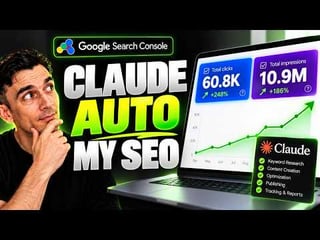
Using Claude Opus 5.5, I took one site from zero to over 1,300 clicks a day, and another from zero to around 58 a day on the exact same curve.
Neither result came from years of building domain authority.
They came from being first.
🔥 Want the exact setup I used to get these results? Inside the AI Profit Boardroom, I've got a full AI SEO section with the trending keyword system and step-by-step video tutorials, plus weekly coaching calls with 3,600+ members building real automations.
https://www.skool.com/ai-profit-lab-7462/about
Here's the full video if you want to see how speed beats authority when a new AI tool drops.
https://www.youtube.com/watch?v=ixehhEFswZc
The one idea that makes this whole thing work
Most SEO advice assumes you're competing with big, old, trusted sites.
That's true for broad keywords, but it's not true on day one of a brand new AI tool.
When a new tool drops, page one of Google has no competition yet.
People rush to search for what it is and how to use it, and there are no good pages to send them to.
If you're first with a genuinely useful page, you often rank right near the top within days.
That's why I say speed beats authority, and it's the reason a Claude SEO tool workflow can outrun sites far bigger than yours.
What the results actually look like
The main site went from zero to over 1,300 clicks a day from Google.
A second site went from zero to around 58 clicks a day, following the same pattern.
We also pulled in thousands of impressions inside AI results, not just normal search.
We ranked several times over for "best AI SEO community", including right inside Google's AI overviews.
For a business owner, that means your brand shows up in the places your buyers are now asking questions.
Day one: find the keywords before anyone else does
The playbook starts the same day a tool trends.
Waiting a week is one of the biggest mistakes I see, because by then the window is already closing.
The five keyword types I hunt for
Five types of keywords cover nearly every search around a new tool.
- The tool name is the first one, because nobody has written about it yet and there's barely any competition.
- "How to use" the tool is the second, because people search it the second something drops.
- Tool versus tool is the third, because it catches everyone deciding between two options.
- "Best" keywords, like the best free tool for a job, are the fourth, because they bring strong intent and quick wins.
- Tool questions are the fifth, such as whether it's open source, whether there's a waitlist and where the GitHub is.
Those question keywords are tiny and specific, and almost nobody targets them.
The prompt I give Claude
I paste the tool or topic into Claude Opus 5.5.
I ask it to list every keyword someone would type into Google about it.
I tell it to cover the name, how to use it, versus a competitor, best for, is it free, GitHub and waitlist.
Then I ask it to rank them by likely search demand and give me the top 10 to target first.
I get a ready-made list in seconds, which is why Claude is the Claude SEO tool at the centre of everything I do here.
Day one: write pages that match what people want
Getting keywords is the easy part.
The rule most people get wrong is matching each keyword to the right kind of post.
Here's how I shape each page.
- Tool name pages are explainers that say what it is, who made it and how to set it up.
- How-to pages use numbered steps and show the result first, right up top.
- Versus pages open with the quick answer and then drop in a comparison table.
- "Best" pages are short ranked lists.
If the shape of the page doesn't match the search, the page won't hold its ranking.
How Claude writes a versus post for me
Say the keyword is one tool versus another.
I tell Claude to write an SEO blog post for my site targeting that keyword.
I give it the intent, which is to answer the searcher's main question in the first couple of sentences, with the keyword in the very first line.
Then I hand it my structure, which is H2 subheadings, a comparison table, a short case study, a five-question FAQ, an author bio, a few calls to action and internal links to my other posts.
Claude writes the whole thing matched to intent, and I publish it.
That's my Claude SEO tool process for every page, and it stops the AI from spitting out generic fluff that doesn't answer the search.
Get it indexed the same day
Publishing is only half the job.
I use an instant indexing tool so Google sees the page fast.
If you publish and forget about indexing, Google can take forever to even notice it, and the window closes while you wait.
Week one: turn one page into a dozen
Writing one lonely post is another mistake that kills results.
Once my first page starts getting impressions, I go back to Claude.
I tell it the page is getting impressions and ask it to pull every related search around the topic.
I ask it to group those searches into clusters and tell me which ones deserve their own dedicated post.
Then I write those posts.
One tool becomes a dozen pages, including the explainer, the how-to, the how-to for free, the versus posts and the questions.
They all link to each other and push each other up.
That cluster is what turns a Claude SEO tool experiment into a real traffic asset.
If you'd rather not test this alone for months, book a free SEO strategy session. A strategist will build you a custom visibility plan, show how you appear across Google, AI overviews, ChatGPT, Perplexity and Gemini, and run a competitor gap analysis.
https://go.juliangoldie.com/strategy-session
Every week: let your data tell you what to write
Your own Search Console data already shows you what's about to rank.
I run this inside my agent OS, where I type in the trending keyword, pick the site and set the date range.
It pulls my live Google Search Console data into a clean dashboard, so nobody on the team is exporting spreadsheets by hand.
You can also export the data into Claude by hand and get the same answers.
The three filters I ask for
- Keywords in position 5 to 20 with over 100 impressions are pages sitting just off the top spots.
- Keywords with loads of impressions but under a 1% click rate are usually a title problem.
- Brand new keywords from this week with no page yet are my next posts.
For each one, Claude tells me whether to write a new post, rewrite a title or add a section to an existing page.
That's near-ranking traffic you can grab in a day, and it's the cheapest growth any Claude SEO tool setup will give you.
What to avoid when you try a Claude SEO tool system
Here's a quick recap of the mistakes I see most.
- Chasing big broad keywords wastes effort when fresh tool keywords have no competition.
- Waiting a week after a tool drops means the window is already closing.
- Writing one post instead of a full cluster caps your traffic.
- Publishing generic AI fluff fails because it doesn't answer the search.
- Skipping indexing means Google takes forever to notice the page.
Why the Claude SEO tool approach keeps working
New AI tools are dropping constantly in every industry, not just mine.
That means new windows keep opening every single week.
The play stays simple.
You move fast, publish the explainer, the how-to and the questions post from day one, and link them into a cluster.
Then you let a setup like agent OS handle the research so you can keep shipping.
The people who win at AI SEO aren't the biggest, they're the fastest.
FAQ
Can a new website really outrank established sites?
Yes, it can on new tool keywords, because a brand new tool has no competition on page one on day one.
How quickly do I need to publish after a tool launches?
You should publish the same day, because waiting a week means the window is already closing.
What should a "versus" post include?
It should answer the main question in the first couple of sentences, then include H2s, a comparison table, a short case study, an FAQ, an author bio, CTAs and internal links.
How do I know which old pages to update?
Look in Search Console for keywords in position 5 to 20 with over 100 impressions, and for keywords with loads of impressions but under a 1% click rate.
Is a Claude SEO tool system only for AI tool keywords?
No, it isn't, because new tools are dropping constantly in every industry, so the same playbook works wherever something new is trending.
The fastest businesses will own the next wave of search, and a Claude SEO tool playbook is how you make sure you're one of them.
About Julian
I'm Julian Goldie, AI entrepreneur, SEO expert and founder of the AI Profit Boardroom. I help business owners scale with AI agents, automation and SEO. I run a 7-figure SEO agency (Goldie Agency) and a YouTube channel with 425K+ subscribers. I share daily AI training inside the Boardroom.
📺 Video notes + links to the tools 👉
https://www.skool.com/ai-profit-lab-7462/about
🎥 Learn how I make these videos 👉
https://aiprofitboardroom.com/
🆓 Get a FREE AI Course + Community + 1,000 AI Agents 👉
https://www.youtube.com/watch?v=ixehhEFswZc
Source: r/AISEOInsider · by /u/NecessaryBear98