UCMS–DAJJAL–002
The Island of the Bound Deceiver
Tamīm al-Dārī -> al-Jassāsa -> storm voyage -> island -> monastery -> chained man -> ecological questions -> prophetic verification -> release -> East
This one immediately pays off.
Because when we isolate the Tamīm al-Dārī episode from the rest of the Dajjāl tradition, we discover something stranger than merely “the Antichrist is imprisoned on an island.”
The episode is constructed as an information-transfer machine.
A group of humans accidentally penetrates a sealed zone.
Inside that zone waits a being who cannot yet act upon the world—
but who is obsessively gathering status reports about it.
That changes the whole texture of the story.
—
I. Establish the textual nucleus
The principal long version appears in Sahih Muslim 2942a, transmitted through Fāṭima bint Qays. In the narrative, Muhammad gathers the community and explains that Tamīm al-Dārī—described there as having been Christian before accepting Islam—reported something that agreed with what Muhammad had already taught concerning al-Masīḥ al-Dajjāl.
Versions of the episode also survive in Sunan Abī Dāwūd 4326 and Jāmiʿ al-Tirmidhī 2253, with meaningful variations in wording and detail.
So we are not dealing with one isolated modern legend.
We have an identifiable hadith complex:
Fāṭima bint Qays
-> prophetic assembly
-> report from Tamīm
-> maritime voyage
-> island
-> al-Jassāsa
-> bound figure
-> interrogation
-> Dajjāl self-identification.
Keep that chain in view.
—
II. The voyage begins with disorientation
In Muslim's version, Tamīm sails with thirty men from Lakhm and Judhām. The sea tosses them about for approximately a month before they reach an island around sunset.
Abū Dāwūd preserves essentially the same core: thirty men, prolonged storm-driven wandering, then landfall on an island.
That means the entrance condition is not:
planned expedition
-> known island.
It is:
normal geography
-> navigational failure
-> prolonged liminality
-> unknown shore.
That matters symbolically even before we ask whether any literal island was intended.
The travelers do not find Dajjāl.
They are thrown outside their map.
—
III. Threshold 1: sunset
Muslim specifies that they approach the island toward sunset.
We should not over-interpret a single temporal detail, but in narrative architecture it functions beautifully:
day
-> fading
known sea
-> unknown island
ordinary navigation
-> anomalous encounter.
The story crosses several thresholds simultaneously:
sea/land
day/night
known/unknown
ordinary/esoteric
free/imprisoned.
Chronovisor tag:
DAJ-T02 — Liminal entry geometry
Status: textual architecture, not proof of encoded symbolism.
—
IV. Then comes al-Jassāsa
The travelers encounter a bizarre creature.
Muslim describes it as so covered in hair that they cannot distinguish its front from its back. It identifies itself as:
al-Jassāsa.
Abū Dāwūd similarly describes a very hairy beast and preserves the name al-Jassāsa.
Tirmidhī simplifies the scene somewhat but retains the hairy creature and its directing function.
This creature does something peculiar.
It does not attack them.
It redirects them.
Jassāsa -> detects strangers -> refuses or limits direct exchange -> routes them toward another intelligence.
Functionally:
sensor -> messenger -> detainee.
That is our first major result.
—
V. What does al-Jassāsa mean?
The Arabic name is conventionally associated with the semantic field of spying, searching out, gathering intelligence, or investigating.
And that fits the story almost uncannily well.
The creature exists at the perimeter of the prison zone and channels newcomers toward a figure desperate for information.
We should therefore avoid treating al-Jassāsa as simply:
“Dajjāl's monster dog.”
Nothing in the core narrative requires that interpretation.
Its demonstrated function is closer to:
surveillance organism.
Island perimeter -> detects entrant -> funnels entrant inward -> information reaches prisoner.
That functional reading becomes even stronger when we see what Dajjāl asks next.
—
VI. Threshold 2: the monastery
Muslim's text says the travelers enter a dayr, normally meaning a monastery or monastic building, where they encounter the chained man.
Abū Dāwūd explicitly renders the location as a monastery.
And this is important.
Dajjāl is not merely:
chained to a rock.
He is placed inside an architectural enclosure.
Sea -> island
island -> creature
creature -> monastery
monastery -> chained being.
Each step reduces freedom.
The narrative keeps nesting containment.
—
VII. The chained man
Muslim describes him as the largest or most powerfully built man the travelers had ever seen, bound extremely tightly, with his hands gathered toward his neck and iron restraints extending around his legs.
This produces another paradox:
physically enormous
but immobilized.
Potential power -> maximum.
Operational freedom -> almost zero.
That is important because later Dajjāl tradition gives him extraordinary mobility.
So the narrative establishes a before/after transformation:
before permission -> chained -> localized -> dependent on information
after permission -> mobile -> transregional -> nearly world-spanning.
The apocalypse begins not merely when Dajjāl exists.
It begins when containment expires.
—
VIII. Permission is more important than escape
This is easy to miss.
Dajjāl does not simply announce:
“I will break these chains.”
In Muslim's version, he says in effect that he will soon be permitted to emerge.
That implies a jurisdiction above him.
His imprisonment is not necessarily explained mechanically.
The important condition is:
not yet authorized.
So:
Dajjāl power ≠ ultimate sovereignty.
His movement remains subordinate to an eschatological timetable.
That fits what we already saw in 001:
he has extraordinary scope,
but boundaries still exist.
—
IX. And then the story becomes astonishing
The imprisoned Dajjāl does not initially interrogate them about weapons.
He does not ask:
Who is emperor?
How many armies exist?
Which cities have walls?
Instead he asks about landscape indicators.
In Muslim:
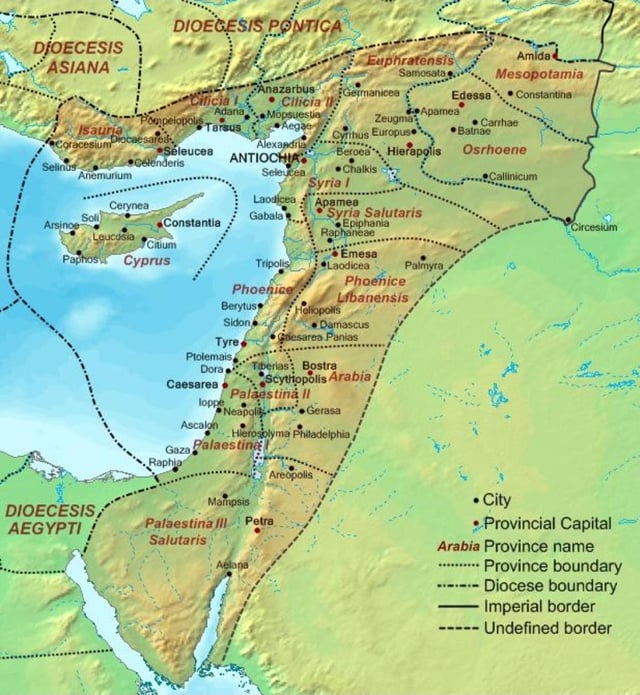
the date palms of Baisān
-> are they still bearing fruit?
Lake Tiberias / Sea of Galilee
-> does it still contain water?
the spring of Zughar
-> does it still flow and irrigate?
then:
the unlettered prophet
-> has he appeared?
-> have the Arabs fought him?
-> has he prevailed?
Tirmidhī retains essentially the same ecological and prophetic checklist, explicitly locating Baisān between Jordan and Palestine.
Now pause.
Because this is the center of the sweep.
—
X. Dajjāl is waiting for indicators
The chained figure appears to possess a set of release-condition variables.
His questions look like:
Baisān fruiting? -> YES
Tiberias water? -> YES
Zughar spring flowing? -> YES
Prophet emerged? -> YES
Prophetic movement succeeding? -> YES.
He appears to know that certain conditions will change.
That means the narrative imagines apocalypse not merely as:
clock reaches date X.
But as:
observable state transitions occur.
That is a remarkable architecture.
—
XI. The island functions like a sealed monitoring station
If we strip away theology temporarily and model only narrative function:
external world
-> ecological variables change
-> political/religious variables change
but
Dajjāl -> physically isolated.
Therefore he needs:
incoming observers.
Enter:
al-Jassāsa
-> intercepts travelers
travelers
-> carry world-state information
Dajjāl
-> queries variables
release
-> approaches when conditions converge.
That gives us:
containment + surveillance + prophecy + trigger conditions.
I did not expect the Jassāsa episode to be this structurally clean.
—
XII. Three ecological markers
Let's isolate them.
Baisān
The report asks whether its date palms still bear fruit. Muslim's text predicts that they will soon cease producing.
Lake Tiberias
He asks whether the lake still contains abundant water and predicts that its water will eventually diminish or disappear.
Zughar
He asks whether the spring still contains sufficient water for cultivation.
Therefore the Dajjāl's release horizon is associated with:
agricultural change
hydrological change
hydrological change
prophetic-historical change.
Not one sign.
A multi-variable environmental and historical dashboard.
—
XIII. But we need an epistemic brake here
Modern readers routinely try to identify these references with current environmental conditions and announce:
“the Dajjāl's release is imminent.”
The primary text does not supply us with a calibrated forecasting model.
We do not know from this narration alone:
exact baseline water levels
required percentage decline
whether the changes are literal, gradual, sudden or eschatological
whether all conditions must coincide
how they relate chronologically to other Dajjāl traditions.
So UCMS ruling:
Do not turn descriptive signs into a countdown clock without additional evidence.
That would outrun the source.
—
XIV. The prophet question is different
The ecological questions concern future changes.
But the question about Muhammad establishes something else.
Dajjāl asks whether the prophet has appeared and how the surrounding Arabs have responded. Muslim's version says the travelers report that Muhammad has moved from Mecca to Yathrib and has prevailed over nearby opponents; the chained figure responds that obedience to him would be better for them.
That line is bizarre.
The great deceiver effectively acknowledges the prophetic figure.
He is therefore not depicted as simply ignorant of truth.
He recognizes the structure he opposes.
This matters.
Dajjāl's problem is not necessarily lack of information.
It is antagonistic relation to known truth.
—
XV. Which makes his interrogation even stranger
The prisoner seems to know:
what indicators matter
but not:
whether they have happened yet.
In other words:
model -> available.
live data -> unavailable.
That gives us one of the cleanest functional descriptions in the silo:
Dajjāl possesses a prophecy model but lacks telemetry.
Jassāsa + travelers provide telemetry.
That is an inference from the story's architecture, not an explicit theological teaching.
But it fits the text unusually well.
—
XVI. The Jassāsa therefore acquires a clearer function
Remember the name and behavior.
Creature -> stationed in island environment -> encounters new arrivals -> directs them toward prisoner.
Dajjāl -> immediately interrogates arrivals about outside-world conditions.
So a plausible functional equation is:
al-Jassāsa = information-acquisition interface for an isolated eschatological actor.
Again:
functional reconstruction.
Not yet philological genealogy.
But that is much more explanatory than merely labeling it “a weird hairy beast.”
—
XVII. Why is it hairy enough to lose orientation?
The text emphasizes that the travelers cannot readily distinguish the creature's front from its rear because of its hair.
We should resist inventing symbolism where the source gives none.
Still, functionally, the description produces:
recognition failure.
They cannot classify what they are seeing.
That gives us another recurrence inside Dajjāl's ecosystem:
Dajjāl -> deceptive appearance.
Jassāsa -> visually unreadable anatomy.
Island -> geographically unreadable location.
The entire encounter is built around classification failure.
Where are we?
What is this creature?
Who is this man?
What does he know?
The narrative repeatedly withholds ordinary orientation.
—
XVIII. Then comes the largest geographic contradiction
After recounting Tamīm's story, Muhammad says that the account corroborates what he had already taught about Dajjāl and Mecca/Medina. Muslim then preserves a striking sequence:
perhaps the Syrian sea
or perhaps the Yemen sea
then:
rather, from the east
repeated emphatically while pointing east.
Abū Dāwūd preserves the same general movement toward an eastern identification.
This means we cannot responsibly draw:
X marks the island.
The text itself resists that certainty.
—
XIX. "Syrian Sea" and "Yemen Sea"
The English translations commonly render the two expressions as something like:
Syrian sea -> Mediterranean region
Yemen sea -> southern/Arabian waters.
But then the narration pivots:
No— east.
That is not precise cartography.
It is directional eschatological geography.
And there is a huge difference.
—
XX. Geographic ledger
DAJ-G01 — Maritime island
High confidence.
Directly present.
DAJ-G02 — prolonged voyage
High confidence.
Present in Muslim and Abū Dāwūd.
DAJ-G03 — Mediterranean possibility
Attested in the prophetic commentary.
DAJ-G04 — Yemen/southern-sea possibility
Attested.
DAJ-G05 — eastern direction
Emphatically attested.
DAJ-G06 — exact island identification
Not established.
That final line should remain bold red in our internal ledger.
—
XXI. The traditions themselves vary
Tirmidhī's version differs noticeably.
Rather than emphasizing thirty named tribal travelers and a monastery in exactly the same way, it describes people from Palestine traveling by ship, reaching an island, meeting al-Jassāsa, and eventually finding the chained figure farther inland.
Tirmidhī nevertheless preserves the recognizable core:
Palestinian travelers
-> sea voyage
-> island
-> hairy Jassāsa
-> bound Dajjāl
-> environmental questions
-> prophet question
-> future entry into lands except Medina.
So:
surface details vary.
Narrative machine remains stable.
That is exactly what we want to distinguish.
—
XXII. Stable core vs variable shell
Stable core
maritime journey
-> unexpected island
strange creature
-> directs travelers
bound figure
-> requests information
environmental indicators
-> interrogated
Muhammad
-> interrogated
Dajjāl
-> self-identification
future release
-> anticipated.
Variable shell
precise traveler description
precise island geography
monastery/village wording
detail order
number of directional statements
some environmental phrasing.
That gives us a better textual fingerprint for future genealogy searches.
—
XXIII. Tamīm himself is a transmission hotspot
Modern scholarship has long noticed that Tamīm al-Dārī is unusually important in the formation of Arabic legendary and eschatological material. David Cook devoted a specific study to Tamīm, describing him as a companion and Christian convert strongly associated with the Dajjāl/Jassāsa story; later Arabic literature significantly expanded Tamīm's legendary traveler profile.
That fact makes his pre-Islamic Christian background historically interesting when we later compare the Dajjāl tradition with Christian Antichrist traditions.
But we have to state the rule precisely:
Tamīm had Christian background
+
story resembles other apocalyptic traditions
does not equal
Tamīm imported Christian Antichrist mythology.
That transmission hypothesis requires actual evidence.
—
XXIV. This is exactly where genealogical contamination becomes tempting
Because look at the ingredients:
Christian convert
-> apocalypse story
island
-> monstrous intermediary
bound eschatological enemy
-> future release
Messiah language
-> Dajjāl.
We could very easily leap to:
“Ah-ha! Christian Antichrist story imported into Islam.”
But that would violate our protocol.
We need:
earlier demonstrable source
-> identifiable motif package
-> plausible contact mechanism
-> chronological direction
-> distinctive shared details.
We do not yet have that chain.
Ledger A remains:
OPEN.
—
XXV. Ledger B, however, is lighting up
Functionally the island narrative belongs to a huge mythic family:
dangerous being -> bound
at edge/beyond normal civilization -> confined
release delayed -> cosmic deadline
guards/intermediaries -> maintain boundary
release -> catastrophe.
That architecture occurs across many mythological and apocalyptic systems.
But functional recurrence alone may reflect something much broader than literary borrowing:
humans repeatedly model future catastrophe as a dangerous force that already exists but is temporarily constrained.
That's psychologically and politically powerful.
The disaster is not born later.
It is already waiting.
—
XXVI. The delayed-catastrophe machine
This deserves a formal state model.
STATE 0
Threat exists.
STATE 1
Threat is constrained.
STATE 2
Threat possesses knowledge of future release.
STATE 3
World moves toward release conditions.
STATE 4
Threat receives information about those conditions.
STATE 5
Permission/constraint changes.
STATE 6
Threat enters ordinary human space.
STATE 7
Global trial begins.
That is almost mechanically clean.
—
XXVII. Compare that with Dajjāl's later mobility
The contrast becomes dramatic.
Island Dajjāl:
one location
chained
receives travelers
asks questions.
Released Dajjāl:
travels across the lands
enters settlement after settlement
exercises astonishing influence
cannot enter Mecca/Medina.
Muslim explicitly pairs the prison account with the later claim that he will travel broadly but remain excluded from those sacred cities.
So his defining transition is:
immobility -> hypermobility.
That is worth preserving.
—
XXVIII. And this produces a jurisdictional map
Before release:
entire world -> inaccessible to Dajjāl.
Island prison -> his permitted zone.
After release:
almost entire terrestrial world -> accessible.
Mecca + Medina -> still prohibited.
Therefore the apocalypse changes his jurisdiction, not merely his strength.
That connects beautifully with the bounded-power observation from 001.
He never becomes unlimited.
His allowable domain expands.
—
XXIX. One more strange thing: the prisoner asks questions before identifying himself
Narratively:
the travelers ask:
Who are you?
He responds effectively:
first tell me about the world.
Information exchange is asymmetric.
Their identity matters less than their data.
Only after collecting it does he reveal:
I am Dajjāl.
That sequence makes the encounter almost transactional:
visitor -> telemetry
prisoner -> identity + prophecy.
This is not decorative dialogue.
The information flow drives the scene.
—
XXX. The ecological signs may also locate the narrative's mental geography
Notice where his questions point:
Baisān
Sea of Galilee
Zughar
Muhammad in Arabia.
The narrative's informational horizon is strongly anchored in the Levant-Arabia corridor even though the prison itself remains geographically displaced.
That map is useful.
Unknown island -> watches known sacred-historical landscape.
The prison sits outside the map.
Its sensors point back toward the map.
—
XXXI. This may explain the island better than literal treasure-hunt geography
What does an island accomplish narratively?
It isolates.
It prevents ordinary access.
It explains why people do not encounter the figure regularly.
It permits accidental discovery.
It separates:
known world from withheld eschatological actor.
Therefore:
island ≠ necessarily a coded longitude.
Island can function as a narrative quarantine technology.
That is an inference, but a strong one.
—
XXXII. And the monastery adds another layer
The monastery is fascinating because it is itself traditionally an architecture of:
separation
retreat
enclosure
watchfulness
religious time.
Yet here it becomes the container of the supreme deceiver.
That inversion deserves its own later comparison.
Monastery -> expected holy withdrawal.
Dajjāl monastery -> dangerous containment.
Again:
appearance and function diverge.
A recurring Dajjāl signature.
—
XXXIII. Was the Jassāsa itself imprisoned?
The core report does not describe it as chained.
It appears able to move around the island and interact with travelers.
So the containment architecture has at least two zones:
mobile perimeter entity -> Jassāsa
immobile central entity -> Dajjāl.
That makes al-Jassāsa even more interesting.
It operates where he cannot.
—
XXXIV. Functional network
We can now reconstruct the island as:
SEA
-> isolation barrier
ISLAND
-> containment territory
JASSĀSA
-> mobile detection/routing layer
MONASTERY
-> inner containment structure
CHAINS
-> bodily immobilization
DAJJĀL
-> detained intelligence
TRAVELERS
-> external information carriers
QUESTIONS
-> world-state sampling
PROPHECY
-> threshold model
PERMISSION
-> release switch.
That is probably the cleanest single model of the Tamīm episode.
—
XXXV. And now the strangest inversion of all
Remember what Dajjāl becomes later:
the master deceiver.
But here, while imprisoned, he is the one who needs reliable testimony.
He asks the travelers questions and apparently believes their answers.
So before he becomes the producer of epistemic deception—
he is depicted as a consumer of information.
That gives us a strange polarity:
pre-release Dajjāl -> seeking truth about world state
post-release Dajjāl -> generating false conclusions about world state.
That is worth flagging.
—
XXXVI. UCMS contradiction ledger
DAJ-C06 — Where is the island?
Mediterranean possibility.
Yemeni/southern-sea possibility.
East emphasized.
No exact coordinate.
Status: unresolved.
DAJ-C07 — Monastery or distant settlement?
Versions differ in spatial description.
Status: textual variation; core confinement architecture survives.
DAJ-C08 — Who exactly traveled?
Muslim gives thirty men of Lakhm and Judhām; Tirmidhī's recension refers more generally to people from Palestine.
Status: recension variation.
DAJ-C09 — Is Jassāsa an animal, demon, person, or something else?
The text calls it a hairy dābba/beast and records the travelers' fear that it might be demonic, but does not give us a precise taxonomy.
Status: deliberately/actually underdetermined.
DAJ-C10 — Are the ecological signs release triggers?
The Dajjāl asks about them and predicts changes, but the text does not explicitly state a mathematical conjunction:
when A + B + C = release.
Status: strong narrative association; causal trigger not demonstrated.
—
XXXVII. Genealogy ledger
For now:
Tamīm al-Dārī -> historically associated with Christian background.
Dajjāl island tradition -> preserved in major Sunni hadith collections.
Christian Antichrist influence -> plausible research question.
Direct demonstrable borrowing -> NOT YET ESTABLISHED.
Specific pre-Islamic source for al-Jassāsa -> NOT YET ESTABLISHED.
Specific older source for chained-island Dajjāl package -> NOT YET ESTABLISHED.
Perfect.
We don't fill those blanks.
We investigate them.
—
XXXVIII. Functional analogy ledger
Now this side is much stronger.
Contained adversary
-> strong.
Delayed release
-> strong.
Peripheral/beyond-map localization
-> strong.
Monstrous intermediary
-> strong.
Catastrophic emergence
-> strong.
Environmental omens
-> strong.
Sacred geography
-> strong.
Apocalyptic intelligence gathering
-> extremely unusual and potentially diagnostic.
That final motif may be our best genealogical search key.
Not merely:
“Antichrist imprisoned.”
Search instead for:
imprisoned eschatological enemy questions visitors about environmental and historical conditions before release.
If an older parallel exists with that full architecture—
then we may actually have something.
—
XXXIX. The major discovery of 002
The Tamīm story is not fundamentally:
> sailors find the Antichrist.
Its deeper architecture is:
accidental observers penetrate a quarantined eschatological system and provide its imprisoned operator with external telemetry.
That is much stranger.
And much more specific.
The entire island behaves like:
containment chamber
observation post
prophecy checkpoint.
—
XL. Which means al-Jassāsa finally has a job description
Not:
random apocalypse monster.
Not even necessarily:
guardian.
The demonstrated function is:
detect -> redirect -> facilitate information transfer.
So I'd provisionally define:
al-Jassāsa = the mobile intelligence-gathering interface of the Dajjāl containment narrative.
Confidence:
functional interpretation = high
literal ontology = unknown
genealogical origin = open.
—
XLI. And now our next sweep becomes obvious
We have two extremely attractive routes.
UCMS–DAJJAL–002.1
Ibn Ṣayyād: Was the Dajjāl Already Walking Among Them?
Because this is now a direct contradiction.
002 gives us:
Dajjāl -> enormous chained being -> remote island.
But another early tradition gives us:
suspected Dajjāl -> living near Muhammad -> interacting with companions -> possibly Ibn Ṣayyād.
Those cannot simply be mashed together.
We need to see whether the tradition itself knew there was a problem.
That sweep could expose multiple early Dajjāl models competing before later synthesis.
But there is another route that is even more surgical.
UCMS–DAJJAL–002.2
The Jassāsa File
j-s-s root
-> spying/investigation
-> hairy beast
-> information broker
-> Qur'anic Dābbat al-Arḍ comparison
-> apocalyptic beasts
-> surveillance creatures
-> Christian late-antique monster traditions
-> whether Jassāsa has an identifiable ancestor.
And after that:
UCMS–DAJJAL–003
The Defective Eye
That is where we finally dissect every eye description separately rather than treating “one-eyed Dajjāl” as a single stable statement.
Because after 002, I'm increasingly suspicious that the deepest invariant of this whole corpus isn't monstrosity at all.
It's information.
Who can see?
Who knows?
Who reads the signs?
Who receives the report?
Who mistakes spectacle for truth?
Who knows that release is near?
And who can correctly recognize the deceiver when reality itself appears to testify on his behalf?
The island just made the Dajjāl investigation considerably stranger. 🔎
https://i.redd.it/q83cxpn2gfjh1.jpeg
Source: r/SubspacePhysics · by /u/LumenosX