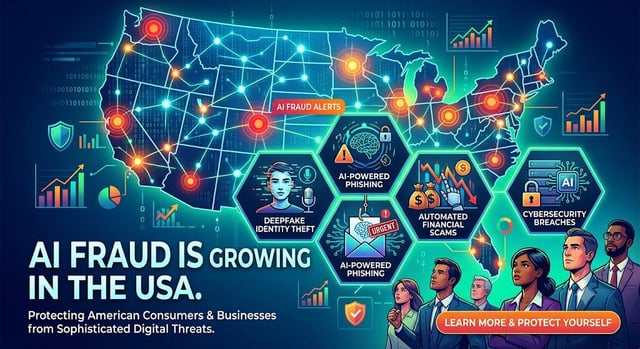
Alert! Ready guys? New AI scams are becoming a serious awareness issue in the USA!
AI is becoming a normal part of our everyday life. We use it for searching, writing, learning, business, communication, images, videos and many other things.
But wait…
What happens when scammers start using the same AI technology against us?
This is where we need to become more aware.
AI itself is not a scam. The problem is how criminals can use AI-generated content, social media, fake websites, cloned voices, fake profiles and convincing messages to make an old scam look completely new.
And this is why human protection still matters.
AI Fraud Is Changing the Way Scammers Reach People
Scammers have always looked for ways to make people trust them.
But now AI can help them create content faster and make it look more believable.
The FBI has warned that criminals are using generative AI to create convincing text, images, social media profiles and fraudulent websites. AI can also help scammers communicate with more people and reduce some of the spelling or grammar mistakes that once made scams easier to identify.
So the question is no longer only:
“Is this message real?”
We also need to ask:
“Who created it?”
“Where did it come from?”
“What information are they asking me to provide?”
“Where is this link taking me?”
Social Media Is Becoming a Major Starting Point
Social media is one of the easiest places for scammers to find people.
Every day, millions of people share information about their lives, interests, family, jobs, shopping habits and activities.
That information can become useful to scammers.
The FTC reported that in 2025, nearly 30% of people who reported losing money to a scam said the scam started on social media, with reported losses reaching $2.1 billion.
Now imagine adding AI to this environment.
A scammer can create a profile.
They can use an AI-generated photo.
They can create believable messages.
They can learn from someone's public social media information.
Then they can start building trust.
This is where we need to stop and think.
A profile picture is not proof that a person is real.
A professional-looking account is not proof that the account is genuine.
And a convincing conversation is not proof that the person behind it is trustworthy.
AI-Generated Photos and Videos Can Look Real
Wait guys… what if the picture you are looking at was never taken by a real person?
AI-generated images can now look extremely convincing.
Scammers can use them to create fake social media identities, fake profiles and fake evidence.
AI-generated video can make the situation even more difficult.
A person may appear to speak.
A voice may sound familiar.
A video may look professional.
But that does not automatically mean the person or situation is real.
The U.S. Postal Inspection Service has warned that scammers are using AI-generated photos, voice clones and deepfake videos to make romance, investment, cryptocurrency, tech-support and emergency scams appear more believable.
AI can make a fake look real.
That is why awareness has to come before trust.
Fake Websites Can Steal Personal Information
This is another major area we should not ignore.
A scammer can create a fake website that looks almost identical to a real company, bank, shopping service or other trusted platform.
The logo may look correct.
The colors may look correct.
The buttons may look correct.
But the website address can be completely different.
The FBI warns that spoofed websites can be used to trick people into providing passwords, credit-card numbers, banking PINs and other sensitive information.
So before entering anything, check the website.
Look at the URL.
Look for strange spellings.
Check the domain.
Don't trust a website simply because it looks professional.
The FBI also warned in June 2026 that criminals were using malicious traffic-distribution systems to redirect people toward fraudulent websites, phishing pages and malware.
Personal Information Is Valuable
Sometimes people think:
“I am not giving them my bank details, so I am safe.” But personal information can also be valuable.
Your name.
Your email.
Your phone number.
Your address.
Your date of birth.
Your social media information.
Your account details.
All of these pieces can help scammers build a more convincing attack.
And when criminals combine information from different sources, the scam can become much more believable.
That is why we should be careful about how much personal information we share online.
Sensitive Information Needs Even More Protection
Now think about sensitive information.
This can include things such as:
● Passwords
● Financial information
● Banking details
● Authentication codes
● Identity documents
● Private account information
● Health or other highly personal information
If a stranger, unexpected website or suspicious message asks you for this type of information, stop first.
Don't let urgency make the decision for you.
The FBI specifically warns that phishing and spoofing can be used to trick people into disclosing personal, financial and other sensitive information.
Real-Time Scams Need Real-Time Awareness
This is where real-time protection becomes important.
Scams can happen while you are browsing.
They can happen while you are checking social media.
They can happen when you receive a message.
They can happen when you click an advertisement.
They can happen when you open a website.
You may only have a few seconds to decide whether something is safe.
So don't wait until after you enter your information to think about security.
Real-time awareness means checking before the damage happens.
Look.
Stop.
Verify.
AI-Generated Scam Content Can Move Very Fast
One of the biggest concerns with AI is scale.
A human scammer may have to spend time writing individual messages, creating images or preparing fake content.
Generative AI can help criminals produce content much faster.
The FBI has specifically warned that generative AI can help criminals create large numbers of believable messages and fake social media profiles and generate content for fraudulent websites.
That means scams can become faster.
More personalized.
And harder to recognize.
So our awareness also needs to become faster.
How AntiMatter AV Can Help
This is where AntiMatter AV comes into our awareness.
We don't want people to stop using AI.
We don't want people to stop using social media.
We don't want people to stop exploring technology.
Technology is already part of our everyday life. So awareness has to grow with technology.
AntiMatter AV is built around this idea of human protection still matters.
With features such as Real-Time Protection, Web Guard, phishing protection, suspicious-link detection, threat scanning and Threat Quarantine, AntiMatter AV can become another layer of protection while users browse websites, open links and interact with online content.
The goal is simple:
Don't just react after something goes wrong.
Try to identify the warning signs before you make the next click.
What Should You Remember About AI Fraud?
Here is the simple awareness point.
AI-generated does not mean real.
A social media profile does not prove identity.
A professional-looking website does not prove legitimacy.
A familiar voice does not automatically prove that the person is real.
A message asking for personal information should be checked before you respond.
A request for sensitive information should always make you stop and verify.
And if a website or message feels wrong, don't rush.
Look and stop.
Check the source.
Check the URL.
Verify the person.
Protect your personal information.
Protect your sensitive information.
And use real-time security tools where appropriate.
Human Protection Still Matters
AI is becoming more powerful.
Scammers are becoming more creative.
Social media is becoming a bigger part of our daily communication.
And fake websites are becoming more convincing.
But awareness is still one of our first lines of defense.
We cannot stop every scam from appearing.
But we can become better at recognizing the warning signs.
AI can generate the fake.
Technology can spread the fake.
But awareness can help us stop before we become the victim.
This is why we say:
Human protection still matters.
Stay aware. Look and stop. And think before you trust.
#SnapchatNudes #AINude #GoogleAINews #LatestAINews #AINews2025 #PhishingAttack #PhishingAwareness #LinkChecker #ScammerPayback #ScamAwareness #AIVideoGeneration #AIVideoNews #ArtificialIntelligence #AIUpdates #CyberSecurity #CyberAwareness #OnlineSafety #DigitalSafety #AntiMatterAV
https://i.redd.it/n2dj6rkiqzth1.jpeg
Source: r/u/antimatterav1 · by /u/antimatterav1