The Problem I Was Solving
Every AI cover letter tool I tried had the same fatal flaw: they lie. Feed them a junior resume and a senior JD, and they'll happily write "spearheaded a team of 15 engineers" or "pioneered the company's ML infrastructure" — words the candidate never earned and can't defend in an interview.
The root cause is simple: these tools treat the LLM's output as trusted. There's no verification layer between "what the model generates" and "what gets shown to the user."
I wanted to build something where every claim in the final letter is traceable back to either the resume or a verified external source — and anything that isn't gets caught and blocked before the user ever sees it.
Architecture Overview
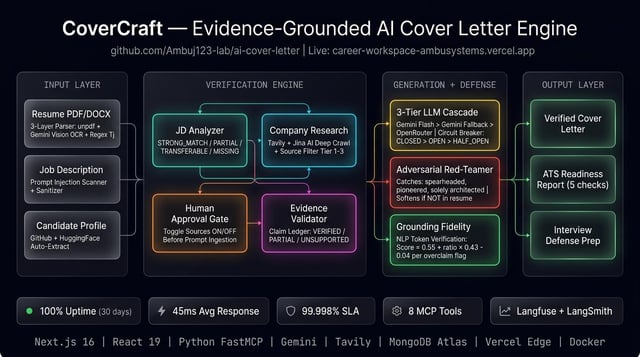
The system has two services orchestrated via Docker Compose:
web/— Next.js fullstack app (UI + serverless API routes on Vercel Edge)mcp-server/— Standalone Python MCP server (FastMCP, 8 registered tools, stdio/SSE transport)
The generation pipeline runs through 7 deterministic stages:
Resume Upload -> PDF/DOCX Parser (with Gemini Vision OCR fallback) -> JD Analyzer (skill extraction + evidence matching) -> Company Research (Tavily web search + Jina AI deep crawl) -> Source Filter (Tier 1-3 domain ranking + freshness gating) -> Human Approval Gate (user toggles each source ON/OFF) -> Letter Generation (3-tier LLM fallback with circuit breaker) -> Adversarial Red-Teamer (overclaim verb detection + softening) -> Grounding Fidelity Score (deterministic NLP token verification) -> ATS Readiness Check (5 heuristic checks, not a fake score) -> Interview Defense Generator (claim-by-claim prep questions) Key Engineering Decisions (with code)
1. Scores are deterministic, not LLM-invented
The LLM classifies evidence. The application layer computes the final score. The model never sees or invents the number.
// web/src/app/api/analyze/route.js const weights = { STRONG_MATCH: 1.0, PARTIAL_MATCH: 0.6, TRANSFERABLE: 0.4, MISSING: 0.0, }; const rawScore = skills.reduce((sum, item) => sum + (weights[item.status] ?? 0), 0) / totalSkills; data.overall_match = Math.round(rawScore * 100); Same pattern in the MCP server's evidence validator — confidence is verified_count / total, never an LLM guess:
# mcp-server/tools/evidence_validator.py confidence = round(verified / total, 2) if total > 0 else 0.0 2. Adversarial Red-Teamer catches seniority inflation
After Gemini generates the letter, a deterministic regex pass catches senior-sounding verbs that don't exist in the candidate's actual resume:
// web/src/app/api/generate/route.js — Overclaim Audit const OVERCLAIM_PATTERNS = [ { trigger: /\bspearheaded\b/gi, safe: "led implementation of", word: "spearheaded" }, { trigger: /\bpioneered\b/gi, safe: "developed", word: "pioneered" }, { trigger: /\bsolely architected\b/gi, safe: "architected", word: "solely architected" }, { trigger: /\bheaded the entire\b/gi, safe: "contributed to the", word: "headed the entire" }, { trigger: /\bcommanded the\b/gi, safe: "coordinated the", word: "commanded the" }, ]; data.paragraphs = (data.paragraphs || []).map((p) => { let textContent = typeof p === "string" ? p : p.content; OVERCLAIM_PATTERNS.forEach(({ trigger, safe, word }) => { if (trigger.test(textContent) && !resumeLower.includes(word)) { overclaimAudit.push({ flagged_verb: word, adjusted_to: safe, reason: "Verb exceeds authentic resume evidence baseline", }); textContent = textContent.replace(trigger, safe); } }); return typeof p === "string" ? textContent : { ...p, content: textContent }; }); The key line: !resumeLower.includes(word) — it only triggers if the verb doesn't appear in the actual resume. If the candidate genuinely wrote "spearheaded" in their resume, it stays.
3. Grounding Fidelity Score — fully deterministic NLP
After generation, the system counts how many substantive technical tokens in the letter actually exist in the resume source:
// web/src/app/api/generate/route.js — computeGroundingFidelity() const words = letterText .toLowerCase() .replace(/[^a-z0-9\s]/g, " ") .split(/\s+/) .filter((w) => w.length >= 4 && !SUBSTANTIVE_STOPWORDS.has(w)); let matchedTerms = 0; for (const w of words) { if (resumeLower.includes(w)) matchedTerms++; } const termRatio = totalTerms > 0 ? matchedTerms / totalTerms : 0.9; const rawScore = 0.55 + termRatio * 0.43 - overclaimFlagsCount * 0.04; No LLM involvement. Pure token-level NLP. The overclaim penalty (-0.04 per flag) directly links the red-teamer output to the fidelity score.
4. 3-Tier LLM Fallback with Circuit Breaker
Instead of failing when Gemini is down, the system cascades through three providers:
Tier 1: Gemini Primary (gemini-3.5-flash-lite) | (2 retries with exponential backoff per model) Tier 2: Gemini Secondary (gemini-3.1-flash-lite-preview) | (circuit breaker trips after threshold failures) Tier 3: OpenRouter (nvidia/nemotron or configurable via env) The circuit breaker has three states: CLOSED, OPEN, HALF_OPEN. When Gemini fails repeatedly, it skips straight to OpenRouter. When Gemini recovers (canary succeeds), it auto-resets:
// web/src/lib/gemini.js — Circuit Breaker const CircuitState = { CLOSED: "CLOSED", OPEN: "OPEN", HALF_OPEN: "HALF_OPEN" }; const circuit = { state: CircuitState.CLOSED, failureCount: 0, failureThreshold: 3, cooldownMs: 30000, lastFailureTime: 0, consecutiveSuccesses: 0, successThreshold: 2, }; 5. 8 MCP Tools (Python FastMCP Server)
The standalone MCP server registers 8 tools via the official MCP SDK with proper ToolAnnotations:
| Tool | What it does |
|---|---|
jd_analyzer |
Parses JD, extracts skills, matches each against resume with evidence |
company_research |
Tavily web search, then Gemini summarization ONLY from search results |
evidence_validator |
Claim Ledger: VERIFIED / PARTIAL / UNSUPPORTED per claim |
source_filter |
Tier 1-3 domain ranking + outdated news freshness filter |
cover_letter_generator |
Evidence-bounded letter generation |
ats_readiness |
Honest heuristic ATS check (not a fake "ATS score") |
github_proofer |
Live GitHub API — correlates repos with resume tech claims |
huggingface_proofer |
Live HF Hub API — verifies published model weights and downloads |
# mcp-server/server.py — Tool Registration with ToolAnnotations server = Server("covercraft-mcp-server") @server.list_tools() async def list_tools() -> list[Tool]: return [ Tool( name="company_research", description="Search the web for verified company intelligence...", inputSchema={...}, annotations=ToolAnnotations( readOnlyHint=True, destructiveHint=False, idempotentHint=True, openWorldHint=True, ), ), # ... 7 more tools ] 6. Security Hardening
- PII Protection: Regex-based (no spaCy/Presidio — too heavy for 512MB memory). Resume goes to Gemini = OK. Resume goes to Tavily = NEVER (PII stripped first via
strip_pii()). - Prompt Injection Defense: JD and resume are labeled as
UNTRUSTED DATAin system prompts. Regex scanner flags injection patterns and tags them with[REDACTED_PROMPT_INJECTION]. - Magic Byte Validation: PDF uploads get
%PDF-header check before parsing. - IP Rate Limiting: Sliding window per-IP limiter with 5-minute GC sweep.
-
LLM Output Clamping:
validate_range()rejects out-of-bound model outputs.mcp-server/config.py — Output Validation
VALID_MATCH_RANGE = (0, 100) VALID_CONFIDENCE_RANGE = (0.0, 1.0)
def validate_range(value, valid_range, field_name="value"): low, high = valid_range if not (low <= value <= high): raise ValueError(f"{field_name}={value} outside valid range [{low}, {high}]") return value
7. Dual Observability (Langfuse + LangSmith)
Every API call logs a structured trace with evaluation scores to both Langfuse and LangSmith simultaneously:
// web/src/lib/langfuse.js — Dual-emit pattern export async function recordTrace({ name, input, output, model, scores }) { // 1. Dual-emit to LangSmith (asynchronous, non-blocking) recordLangsmithRun({ name, inputs: input, outputs: output, extra: { model, scores } }) .catch(() => {}); // 2. Emit to Langfuse const trace = langfuse.trace({ name, input, output, metadata }); trace.generation({ name: `${name}-generation`, model, input, output }); for (const score of scores) { trace.score({ name: score.name, value: score.value, comment: score.comment }); } } Scores logged per generation: overclaim_count, strong_skills_used, grounding_fidelity.
8. Resume Parser with 3-Layer Fallback
PDF parsing uses a cascade: unpdf (fast text extraction), then Gemini Vision OCR (for scanned PDFs), then raw regex Tj token extraction (last resort):
// web/src/app/api/parse-resume/route.js — 3-layer cascade // 1. Primary: unpdf text extraction // 2. Secondary: Gemini Multimodal Vision OCR const result = await model.generateContent([ { inlineData: { data: base64Data, mimeType: "application/pdf" } }, "Extract all readable text from this resume document..." ]); // 3. Fallback: raw PDF Tj operator regex const regex = /\(([^)]+)\)\s*Tj/g; Tech Stack
| Layer | Stack |
|---|---|
| Frontend | Next.js 16 (App Router), React 19, TailwindCSS 4, Framer Motion, Recharts |
| Backend APIs | Next.js API Routes (Vercel Edge Functions) |
| MCP Server | Python, FastMCP (official MCP SDK), stdio + SSE transport |
| LLMs | Gemini 3.5 Flash Lite (primary), Gemini 3.1 Flash Lite (fallback), OpenRouter (tertiary) |
| Web Search | Tavily API (advanced depth) + Jina AI Reader (deep page scraping) |
| Auth | NextAuth.js (Google OAuth) |
| Database | MongoDB Atlas (user telemetry + generation logs) |
| Observability | Langfuse + LangSmith (dual-emit traces with evaluation scores) |
| Deploy | Vercel (frontend), Docker Compose (self-host option) |
Production Monitoring (Live)
The app is deployed on Vercel Edge and monitored via UptimeRobot with 5-minute HTTP/S health checks:
- 30-Day Uptime: 100% — 0 incidents, 0 minutes down
- SLA (Sep 4 – Oct 4): 99.998% — Verdict: SLA Met
- Edge Response Time: 45ms average (43ms min, 47ms max)
- Downtime Budget Used: 52 seconds out of 43 minutes monthly allowance
I set up monitoring on day one post-deploy. If you're shipping anything production-grade, I'd recommend it — it's the difference between "I deployed it" and "I operate it."
What I'd Do Differently
- The overclaim regex patterns are hardcoded — should be configurable or data-driven.
- Source filter freshness gating uses year regex matching, not actual date parsing. Works but brittle.
- The MCP server fallback data for GitHub/HuggingFace has hardcoded repo info — should be a clean "no data" response instead.
- Would add LangGraph orchestration for the full pipeline instead of sequential API calls.
Links & Try It Out
- GitHub Repo: https://github.com/Ambuj123-lab/career-workspace-ambujsystems
- Live Demo: In Github Repo available
Disclosure: Solo-built by me over the past few weeks. I wrote every line of code in this repo. Architecture diagram and post structure were refined with AI assistance for clarity. All code snippets are directly from the repository — inspect them yourself.
Happy to answer any architecture or implementation questions. The entire codebase is MIT licensed.
https://i.redd.it/5x3n39stsuth1.jpeg
Source: r/LangChain · by /u/Ambuj_K_Tripathi