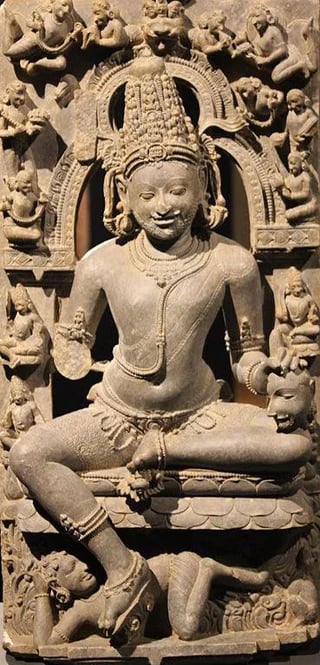
Mula means root.
Of all the names in the nakshatra system, this is the most direct, the most unambiguous, and in many ways the most philosophically pregnant: a single word that points simultaneously toward the most fundamental dimension of anything, toward what exists at the deepest layer of a structure and from which everything above it springs, and toward the act of pulling something out by the root, of going beneath the surface of what has accumulated above the ground and extracting, with a completeness and a violence that the word itself does not soften, the source from which everything that has grown above it draws its sustenance.
In Sanskrit, Mula is used across multiple domains in ways that all share this same essential quality of fundamental, original, generative source. In botany it is the root. In mathematics it is the square root. In grammar it is the root of a word, the most basic form from which all derived forms and all grammatical variations emerge.
In philosophy it is the foundational principle, the Mula Prakriti of Samkhya philosophy, the original, undifferentiated creative substance from which all manifest existence unfolds. In every usage, Mula describes not what is visible at the surface but what exists at the ground of things, what is most essentially there when everything secondary has been stripped away.
For the nakshatra that opens Sagittarius immediately after the completion of Scorpio’s most intense and most fully inhabited final degrees, the name Mula is describing something cosmologically precise: this is the nakshatra that goes to the root of what has accumulated through the entire span of Scorpio’s journey, that strips away everything that has been built above the ground level of the essential, and that leaves, in the clearing that the stripping away creates, the actual, genuine, irreducible root of what is most fundamentally true about the native’s life, their purpose, and their relationship with existence itself.
The Taittiriya Brahmana places Mula among the most powerful and most intense of the nakshatras in the system, and classical Jyotisha texts across the Parashari and the Nadi traditions treat it with a combination of profound respect and genuine wariness. Of all the nakshatras, Mula is the one most consistently associated with experiences that are not merely difficult but fundamentally uprooting: losses that do not merely reduce one’s circumstances but that strike at what one took to be the foundation of one’s identity, transformations that do not merely change the surface of a life but that require the complete reconstruction of the understanding of what one is and what one is here for >!
The Galactic Center: The Cosmic Root
Before any further discussion of Mula’s symbolism, its deity, or its character, there is an astronomical fact about this nakshatra that must be addressed directly because it is one of the most cosmologically significant features of any of the 27 nakshatras and because its implications for understanding Mula’s essential nature are genuinely profound.
The stars that form Mula nakshatra, the tip of the Scorpion’s tail as it points into the early degrees of Sagittarius, aim with an astronomical precision that no human design could have arranged, toward the Galactic Center of the Milky Way.
The Galactic Center is what its name states:
the gravitational heart of the galaxy, the central point around which the entire spiral structure of several hundred billion stars, including our own Sun, orbits. It is the most gravitationally massive and the most energetically intense point in the entire structure of our galaxy, the place from which an enormous black hole of millions of solar masses exerts the organisational force that gives the galaxy its shape and its coherence.
That Mula, the nakshatra whose name means root, whose presiding deity governs dissolution and the returning of things to their essential source, and whose planetary lord Ketu represents the dissolution of individual identity back into the undifferentiated absolute, should sit precisely at the point in the zodiac that points toward the gravitational and energetic root of the entire galaxy is not a coincidence that the Vedic astronomical tradition missed.
The ancient rishis, working with a sophistication of cosmic observation that modern scholarship is only beginning to fully appreciate, placed the nakshatra of the root at the root of the galaxy, and in doing so encoded in the nakshatra system itself the understanding that Mula’s experiences of dissolution and uprooting are not merely personal or psychological events but participations in the most fundamental cosmic processes, expressions in individual human lives of the same force that governs the structure of the galaxy itself.
This is why the dissolution that Mula brings is not chaos, not mere destruction without purpose, not the random violence of something that does not know what it is doing. It is the pull of the Galactic Center, the most fundamental of all gravitational forces, drawing back toward the root what has grown so far from the root that it can no longer sustain itself at the distance. Everything that Nirriti tears up, everything that Ketu dissolves, everything that the Mula native loses or surrenders or has stripped from them in the experiences that mark the most significant turning points of their lives, was something that had grown too far from its essential root to continue. The dissolution is the correction. The uprooting is the return to what is genuinely fundamental >!
Symbolism :
The primary symbol of Mula Nakshatra is a bunch of roots tied together, and this image carries within it the full complexity of the nakshatra’s character: not a single root but many, gathered and bound into a bundle, suggesting both the rootedness of something deeply established and the act of uprooting in which those roots are pulled from the earth and held up for examination. The bundle of roots is something that has been removed from the ground, that is no longer growing in its original soil but is exposed, visible, available for inspection in a way that it could never be while still in the earth.
This is the Mula experience in its most essential form:
the exposure of what was underground, the making visible of the roots that were previously invisible because everything appeared normal at the surface, and the confrontation with what is most fundamentally there now that the surface has been cleared away.
The elephant goad, the ankusha, is the second symbol attributed to Mula in the classical texts, and it introduces a dimension of the nakshatra that is less immediately obvious than the bundle of roots but equally important. The ankusha is the tool that the mahout uses to guide the elephant, the most powerful of domesticable animals, by the precise application of pressure at exactly the right point.
It is not a blunt instrument; it is a precisely calibrated tool that requires deep knowledge of the animal’s anatomy and psychology to use effectively. In Mula’s context, the ankusha speaks to the nakshatra’s capacity for finding the precise point of fundamental leverage in any situation, the specific root of the matter whose address makes everything else tractable.
The lion’s tail, a third symbol cited in some classical texts, introduces the quality of what is furthest from the head, the final sweeping motion at the end of the animal’s most essential expression of itself. The lion’s tail sweeps and clears the space behind the animal as it moves, and in Mula’s context this image speaks to the nakshatra’s role at the end of Scorpio’s full span and the beginning of Sagittarius: a clearing sweep, a final motion that prepares the space for what comes next by removing what belongs to what has just ended.
The male dog as Mula’s animal symbol introduces one of the nakshatra’s most misunderstood and most important qualities.
The dog in the Vedic tradition carries a complex set of associations. It is Bhairava’s companion, and Bhairava is one of the most intense manifestations of Shiva, associated with the cremation ground, with the dissolution of ego, with the terrifying and liberating face of the divine that refuses all comfortable domestication. The dog is also the most loyal of all animals, the one that accompanies the master through the most difficult and the most dangerous of journeys, that remains faithful when everything else has abandoned the one it has chosen to be faithful to. The male dog of Mula combines both of these dimensions: the fierce, boundary-violating quality of the Bhairava-associated dog and the absolute, unsentimental, through-everything loyalty of the companion who does not leave when the territory becomes genuinely difficult >!
Presiding Deity: Nirriti
Nirriti is one of the most ancient, most genuinely feared, and most philosophically important deities in the entire Vedic tradition, and her presence as the presiding deity of Mula nakshatra gives this nakshatra its most essential and its most difficult character. She is the goddess of dissolution, of calamity, of the southwest direction that is named Nairritya after her, of all forms of loss, destruction, catastrophic undoing, and the returning of things to the formless ground from which they originally arose.
The Atharva Veda contains more references to Nirriti, and more ritual prescriptions for warding off or propitiating her, than virtually any other deity, and the degree of attention the Atharva Veda pays to her is itself a measure of the Vedic tradition’s understanding of how fundamental and how unavoidable her function is. She is not a minor or peripheral deity whose effects can be easily avoided or whose influence is rarely felt. She is one of the most structurally important forces in the cosmic order, the counterpart of the creative and sustaining forces without whose work of dissolution the creative and sustaining forces would quickly run out of space and material to work with.
Her appearance in the Vedic texts is consistently dark: dark-complexioned, wearing dark garments, dwelling in the darkness of the south and the southwest, carrying the quality of what comes in the night, what arrives without announcement, what cannot be negotiated with or reasoned away but can only be received. She is not invoked for help. She is not asked to bestow blessings. She is propitiated in the hope that she will look elsewhere. And this quality of being the force that one hopes will pass one by is itself deeply instructive about the Mula native’s relationship with the world: they carry, in the nakshatra of dissolution’s presiding deity, something that others sense as potentially destabilising even when the native is doing nothing more than being genuinely present.
But the philosophical tradition of Vedanta and the Tantric traditions that grew from the same soil as the Vedic texts offer a reading of Nirriti that is not merely about avoidance and propitiation but about the genuine understanding of what dissolution is for and why it is cosmologically necessary. In the Tantric framework, Nirriti is one aspect of the Goddess in her destroying form, related to Kali and the other fierce manifestations of Shakti that destroy in order to create the conditions for genuine renewal.
Every great forest fire is a Nirriti event, and every great forest fire is followed, in time, by the most vigorous and the most biologically diverse renewal that the forest has seen in years. The fire burns what is dead and standing. It clears the undergrowth that has accumulated to the point of choking the new growth. And in the space it creates, the seeds that have been waiting for exactly this condition germinate with an abundance and a vitality that the pre-fire forest, for all its apparent density, could never have supported.
This is the understanding of Nirriti that transforms the Mula experience from a nakshatra of pure misfortune into one of the most profoundly initiatory nakshatras in the entire system: what she dissolves was blocking the root’s access to the light. What she strips away was covering the seed that needs to germinate. And the space she creates, however terrifying in the moment of its creation, is the space in which what is most essentially one’s own, what cannot be destroyed because it is the root rather than the growth above the root, finally has room to become fully what it is >!
Nakshatra Lord: Ketu
The planetary lord of Mula Nakshatra, in the Vimshottari Dasha system of the BPHS, is Ketu, the South Node of the Moon, the headless shadow planet of liberation, past-life karma, spiritual dissolution, sudden insight, and the inexorable pull of consciousness back toward its own essential source.
Ketu governs three nakshatras:
Ashwini | Magha | Mula
The pattern of Ketu’s three nakshatras, all at the opening degrees of the fire signs, was first noted in the Ashwini article and has deepened in significance with each subsequent encounter. Ashwini initiates Aries by cutting away the Piscean dissolution and establishing the first flash of individual consciousness. Magha initiates Leo by cutting away Cancer’s emotional entanglement and establishing the solar self’s ancestral authority. Mula initiates Sagittarius by cutting away Scorpio’s accumulated complexity and going all the way down to the root of what is most essentially present before Sagittarius’s philosophical expansion can genuinely begin.
In Mula, Ketu’s function is at its most dramatic and most unmistakable.
This is Ketu fully itself, in the most unmediated and the most consequential expression of its essential nature: the force that pulls individual consciousness back toward its source by dissolving the structures that have been built up around it and that have come to be mistaken for the self itself. The Ketu of Mula, operating through Nirriti’s dissolving force and pointing toward the Galactic Center, is the most cosmologically grounded expression of what Ketu means in the entire nakshatra system: the planet of liberation operating in the nakshatra of the root, at the point in the zodiac that faces the gravitational centre of the galaxy, generating in the lives of those born under its influence the force of the most fundamental return, the return to what is most essentially true about one’s nature before any of the accumulations of this life or previous lives were layered over it >!
Traits of Mula Nakshatra Natives :
(Applicable primarily when the Moon or the Lagna falls in Mula Nakshatra :
0°00’ to 13°20’ Sagittarius)
- The Investigator of Roots: Going to the Fundamental Source of Everything
The most consistently observable and most immediately characteristic feature of Mula nakshatra natives is their compulsive, constitutionally present need to go to the root of things. They are not satisfied with surface explanations.
They are not satisfied with conventional wisdom. They are not satisfied with the first layer of any investigation, nor the second, nor often the third. They want the Mula, the actual root, the thing that exists at the deepest level of the question being examined, before all the secondary structures were built on top of it.
This quality expresses across the full range of domains in which Mula natives engage:
they are often drawn to research, to philosophy, to investigative journalism, to archaeology, to depth psychology, to the foundational texts and the primary sources rather than the secondary literature, to the question of what was there at the very beginning before any of the interpretations were layered over it.
The Brihat Samhita notes Mula’s association with those who investigate the hidden and the fundamental, and the Parashari tradition consistently links this nakshatra to vocations that require going further beneath the surface than most people are willing or able to go >!
- The Nirriti Experience: Lives Marked by Catastrophic Uprooting
Of all the things that can be said about Mula nakshatra, the one that is most important to say honestly and most important to understand in its full complexity is this: the lives of Mula Moon and lagna natives tend to be marked by experiences of catastrophic uprooting that are genuinely, not merely metaphorically, devastating in the moment they occur. The loss may be of a relationship, a career, a financial position, a belief system, a sense of identity, a family structure, or a way of understanding the world that has been so fundamental to the native’s functioning that its removal leaves them, temporarily, without the ground they had been standing on. These are not ordinary setbacks.
They have the quality that the name suggests: a pulling out of the roots, a removal of what was most fundamental rather than merely what was most comfortable. The classical texts are consistent and practical observation is consistent: Mula is one of the nakshatras most associated with dramatic, apparently catastrophic disruptions that turn out, in the long view, to have been the necessary clearing away of what was blocking the genuine growth >!
- A Philosophical Depth That Can Only Be Earned, Not Taught:
The combination of Ketu’s past-life dissolution, Nirriti’s clearing of what is inessential, and the Galactic Center’s pull toward the cosmic root produces in Mula natives, particularly after the most significant of the nakshatra’s characteristic uprooting experiences, a philosophical depth that cannot be acquired through study alone. This is the understanding that comes from having genuinely had the ground pulled out from under you, from having discovered that what you took to be the foundation of your identity was actually just one of the many things growing above the real root, and from having been left, at least temporarily, with nothing between yourself and the most fundamental questions of existence. The Jyeshtha native has wisdom because they have been through everything.
The Mula native has a different kind of wisdom: the specific understanding of what remains when everything else has been removed, the direct knowledge of what the root actually is when all the growth above it has been stripped away >.
- The Ketu Paradox: Extraordinary Worldly Intelligence Combined With the Pull Toward Liberation
What makes Mula one of the most fascinating and most internally complex of the nakshatra system’s members is the combination, within the same consciousness, of an extremely sharp, extremely practical, extremely perceptive engagement with the world and its workings, courtesy of Sagittarius’s fire and Ketu’s penetrating past-life intelligence, with an equally powerful pull toward the dissolution of worldly engagement, toward the recognition that the world and all its structures are ultimately impermanent, toward a quality of detachment from outcomes that can look, from the outside, like either profound wisdom or profound disengagement depending on what the observer is expecting.
Many Mula natives live this paradox as a genuine, sustained tension: they are capable of extraordinary effectiveness in the world, and they are simultaneously drawn toward the recognition that the world’s most impressive achievements are also, from the perspective of the Galactic Center, among the most temporary of arrangements. Navigating this tension, finding the mode of engagement with the world that is fully present and fully effective while being simultaneously unattached to outcomes in the way that Ketu’s influence produces, is one of the most sophisticated and most genuinely demanding inner achievements available to the Mula character >!
- The Rakshasa Boundary-Crossing and the Engagement With the Taboo
Mula’s Rakshasa gana, combined with Nirriti’s governance of what is most feared and most avoided, and with Ketu’s fundamental indifference to the concerns that keep most people within the boundaries of socially comfortable territory, produces in these natives a genuine willingness to engage with what others find too dark, too dangerous, too fundamentally threatening to conventional comfort to approach directly. Mula natives are often drawn to what is most feared, most denied, most urgently avoided by the people around them: to death and what lies beyond it, to the psychological shadow, to the experience of the loss and the dissolution that most people spend their entire lives trying to prevent, and to the specific questions about existence that are most difficult to hold and most transformative when genuinely held.
This is not a morbid orientation. It is the natural consequence of being presided over by the goddess who governs dissolution and governed by the planet who governs liberation: they are, at some level, always already at the root, always already in the territory that the conventional world calls taboo because it is the territory where all the conventional structures come apart >!
- The Specific Intensity of Mula’s Creative and Intellectual Life
Sagittarius is the sign of the philosopher, the seeker of truth, the one whose arrow is aimed at the most distant horizon. Mula at Sagittarius’s opening degrees carries this Sagittarian quality but with a Ketu-Nirriti intensity that gives it a quality quite different from the more expansive and more sociable philosophical exploration of the middle Sagittarius nakshatras. Mula’s intellectual life tends toward the foundational, the primary, the question of what is most essentially there at the root of whatever field of knowledge they are engaging with.
They are drawn to the original texts rather than the commentaries, to the first principles rather than their derived applications, to the question that precedes all the questions that everyone else is asking. And the quality of their engagement with these foundational questions has a ferocity and a completeness, derived from Nirriti’s refusing-to-look-away quality and Ketu’s past-life intimacy with the most essential dimensions of existence, that gives even their most abstract intellectual work a charged, alive, genuinely urgent quality that more comfortable philosophical dispositions rarely produce >!
- The Specific Challenge of Intimate Relationships
One of the most honest things that can be said about Mula nakshatra’s relationship with intimate bonds is that the nakshatra’s tendency to uproot, to strip away, to return things to their essential foundation, does not confine itself to the native’s relationship with their own life structures. It extends, often painfully, into the intimate relationships themselves. Partners of Mula natives frequently experience, at some point in the relationship, the Nirriti dimension of the nakshatra in a very personal way: the pulling away of comfortable assumptions about who the partner is and what the relationship means, the dissolution of the roles and the narratives that had provided a comfortable framework for the bond, and the sometimes terrifying invitation to relate to each other from a place of much more essential and much more exposed honesty than the original relationship structure required.
The relationships that survive this process tend to be genuinely extraordinary in their depth and their authenticity. The ones that do not survive tend to have been depending on exactly the comfortable structures that Mula dissolves, and their dissolution, however painful, tends to have been, in the long view, exactly what was needed >!
- The Galactic Center’s Pull and the Spiritual Dimension
The Galactic Center’s proximity to Mula’s stellar position is not merely an astronomical curiosity. In the experience of those born under this nakshatra’s influence, there is often a quality of being pulled toward the cosmic root of things that expresses as a spiritual yearning of unusual intensity and unusual depth. This is not the devotional warmth of Anuradha or the philosophical expansiveness of the middle Sagittarius nakshatras.
It is something more fundamental and more difficult to name:
a sense of the Galactic Center’s gravitational pull operating at the level of the soul, a quality of being oriented, at the deepest level, not toward any particular spiritual tradition or practice or community but toward the thing that all traditions are ultimately pointing toward, the irreducible root of existence itself. Many Mula natives find, at some point in their lives, that the conventional forms of spiritual practice and spiritual community are insufficient containers for the quality of their yearning, and they begin to move toward approaches that are more direct, more stripped of intermediate structure, more willing to engage with the cosmic root without the comfortable intermediary of established form >!
- Areas of Struggle:
The Destruction That Does Not Know When to Stop, the Difficulty of Building, and the Fear of What the Root Reveals
The uprooting quality that is Mula’s most essential and most initiatory gift is also, when it operates without the wisdom to distinguish what genuinely needs to go from what genuinely needs to stay, its most destructive shadow. There is a version of Mula’s operation that does not know when the uprooting has reached the genuine root, that keeps pulling when what it is pulling is no longer the superficial growth but the thing that genuinely needs to remain. The native who has not integrated Nirriti’s wisdom, who is operating from the pulling impulse without the philosophical depth that tells them what they are pulling toward, can destroy relationships, structures, and opportunities that were genuinely worth preserving by applying the Mula force indiscriminately to everything that is present.
There is also the specific difficulty of building: the nakshatra that goes to the root is not, by its essential nature, the nakshatra that constructs the structure above the root, and many Mula natives find that the most difficult part of their developmental journey is learning to remain present through the construction phase of a project or a relationship long enough to let what they have started actually become something >!
- Core Life Themes: The Necessity of Dissolution, the Wisdom of the Root, and the Journey From Destruction to the Discovery of What Cannot Be Destroyed
The life of a Mula Moon or lagna native will be shaped, across all its many forms and through all its different seasons, by the themes that the nakshatra’s name and its presiding forces describe with an honesty that is sometimes difficult to hold and always ultimately true. There is the theme of the uprooting itself, of the experiences that pull away what was taken to be the foundation and reveal that the actual foundation is something far more essential and far more indestructible than what was lost.
There is the theme of the root, of the long investigation of what is most fundamentally there beneath the surface of whatever is being examined, and of the specific quality of knowledge that this investigation produces: not comfortable, not convenient, not easily shared with those who prefer the surface, but absolutely genuine and absolutely inalienable.
There is the theme of the Galactic Center, of the cosmic pull toward the most fundamental source, and of the spiritual journey that this pull inevitably initiates in those who feel it clearly enough to follow it. And there is, at the deepest level, the theme that Nirriti encodes in her most philosophically complete form: that what she destroys was never the self, that the root she exposes has always been there and has always been indestructible, and that the experience of dissolution, genuinely met and genuinely survived, is the most direct route available to the discovery of what cannot be dissolved because it is the ground of all dissolution itself >!
In the next article of this series, we move to the twentieth nakshatra :
Purva Ashadha –
spanning 13°20’ to 26°40’ Sagittarius, governed by Venus and presided over by Apas, the deity of cosmic waters, of the primordial, life-giving, invincible fluid that sustains and purifies all of existence >!
Om Shanti 🕉️ ☮️
https://i.redd.it/sfvdc0mp3vth1.jpeg
Source: r/Vedic_Astrology_Hub · by /u/JyotishGautami