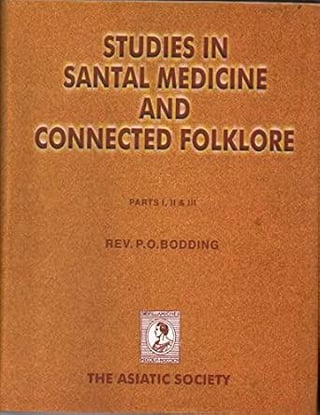
Studies in Santal Medicine and Connected Folklore is an ethnographic study of the medicine and disease beliefs of the Santals by the Norwegian missionary and folklorist P. O. Bodding (1865–1938). It was issued in three parts as Volume 10 of the Memoirs of the Asiatic Society of Bengal between 1925 and 1940: part 1, The Santals and disease (1925); part 2, Santal medicine (1927); and part 3, How the Santals live (1940).\1])#cite_note-Bodding1927-1) Compiled from notes Bodding set down over some three decades of residence among the Santals, it records Santal disease categories, the spirits held to cause illness, the medicine man who treated it and the prescriptions and rituals in use.
The first two parts were digitised by the Wellcome Collection; the third was published separately in 1940. The work is the principal documentary record of early-20th-century Santal ethnomedicine. Among the several hundred plants it catalogues is the Santal gã̄jã, which Bodding identifies as Cannabis sativa and which appears both as a medicinal ingredient and as an item demanded in a spirit-possession rite.
Its botanical content attracted little notice for some forty years, until in 1970 S. K. Jain and C. R. Tarafder published an indexed revival of it in Economic Botany, reorganising the plants into an alphabetical glossary keyed to the diseases each treats.\2])#cite_note-JainTarafder1970-2)
Composition and publication
Paul Olaf Bodding was a Norwegian missionary, linguist and folklorist who travelled to India in January 1890 to join the Norwegian Santal Mission and remained for some forty-four years.\3])#cite_note-NLN-Santali-3) Alongside his missionary duties he recorded the Santali language and Santal oral culture, work that also produced A Santal Dictionary (1932) and several collections of Santal folk tales.
Studies in Santal Medicine and Connected Folklore draws on notes Bodding set down between about 1890 and 1925.\2])#citenote-JainTarafder1970-2) It was issued in three parts as Volume 10 of the Memoirs of the Asiatic Society of Bengal, published at Calcutta by the Asiatic Society between 1925 and 1940: part 1 in 1925, part 2 in 1927 and part 3 in 1940.[\1])](https://landrace.wiki/wiki/Studies_in_Santal_Medicine_and_Connected_Folklore(1940)#cite_note-Bodding1927-1) Bodding wrote as an outside observer, and the disease beliefs and prescriptions the work sets out are his transcription of Santal practice.
Structure and content
The work is arranged in three parts. The first two are concerned with disease and its treatment; the third, published in 1940, turns to Santal social life.
The Santals and disease (part 1)
The first part sets out the Santal understanding of illness: beliefs about life and death, the spirits (bonga) held to cause disease, the standing and training of the medicine man (ojha), the initiation (sid) by which a disciple becomes a full practitioner and the propitiation of malevolent spirits through sacrifice and song.\4])#cite_note-Bodding1925-4)
Santal medicine (part 2)
The second and larger part treats disease by disease, moving roughly from head to foot across more than 300 numbered ailments, with a short closing section on veterinary complaints. Each entry gives the Santal name of the disease, an English rendering, the symptoms where Bodding could establish them and one or more prescriptions with instructions for preparing and administering the remedy. Ingredients are given by their Santal names, followed in most cases by a botanical identification, and a plant index keyed to the numbered prescriptions closes the part.\1])#cite_note-Bodding1927-1)
Cannabis in the text
Bodding records the Santal gã̄jã (ganja), identifying it as Cannabis sativa, and it appears in the work in two registers.
As a medicine, ganja is an ingredient in a number of the part 2 prescriptions, which Bodding's plant index lists under the prescription numbers 101, 103, 110, 111, 113, 123, 136, 173, 250 and 251.\5])#citenote-Bodding1927-Cannabis-5) In the readings of Jain and Tarafder these are remedies for epilepsy, convulsions and cramps, tongue paralysis, tetanus, convulsions with fever-delirium (delirium febris), sores and cough and colds.[\2])](https://landrace.wiki/wiki/Studies_in_Santal_Medicine_and_Connected_Folklore(1940)#citenote-JainTarafder1970-2) The plant is variously ground into small pills and taken with honey, given to be licked or applied to the fontanel.[\5])](https://landrace.wiki/wiki/Studies_in_Santal_Medicine_and_Connected_Folklore(1940)#cite_note-Bodding1927-Cannabis-5)
In a ritual register, ganja appears in Bodding's account of an ojha séance in part 1. As the mediums are possessed in turn by different bonga, those speaking for the spirits call for offerings, the demands including "gã̄jã dao" ("give ganja").\6])#cite_note-Bodding1925-Ritual-6) The episode places cannabis among the items solicited in Santal spirit-possession practice, a context the medicinal index alone does not record.
The text also records the hookah in Santal material culture, stale hookah water (huka dak) recurring as a liquid for grinding and applying medicines.\1])#cite_note-Bodding1927-1)
Reception and afterlife
Bodding's study was passed over by the major economic-botany compendia of its period, and Jain and Tarafder observed that it had remained almost unnoticed for some forty years after publication.\2])#citenote-JainTarafder1970-2) Their 1970 paper in Economic Botany reorganised its botanical content into an alphabetical glossary of 377 plant species keyed to the diseases each treats, which made the material accessible to botanists and pharmacologists for the first time.[\2])](https://landrace.wiki/wiki/Studies_in_Santal_Medicine_and_Connected_Folklore(1940)#cite_note-JainTarafder1970-2) The work remains a standard reference for Santal ethnomedicine.
Editions and availability
The first edition was issued in three parts by the Asiatic Society of Bengal at Calcutta between 1925 and 1940. The Society reprinted the work in 1986.\)better source needed\) The first two parts were digitised from a Wellcome Collection copy and are available under a Public Domain Mark at the Internet Archive; the third part is not included in that scan.\1])#citenote-Bodding1927-1) For the botanical content specifically, the indexed revival by Jain and Tarafder in Economic Botany (1970) is openly accessible through its DOI.[\2])](https://landrace.wiki/wiki/Studies_in_Santal_Medicine_and_Connected_Folklore(1940)#cite_note-JainTarafder1970-2)
- Bodding, P. O., Studies in Santal Medicine and Connected Folklore, Memoirs of the Asiatic Society of Bengal, Vol. 10, Asiatic Society of Bengal, Calcutta, 1925–1940. Part 2, Santal medicine (1927), pp. 133–426; digitised copy (parts 1–2) from the Wellcome Collection.
- Jain, S.K. and Tarafder, C.R., "Medicinal plant-lore of the Santals (A revival of P.O. Bodding's work)", Economic Botany Vol. 24 (1970), pp. 241–278. doi:10.1007/BF02860661
- National Library of Norway, "Santali manuscripts and cultural heritage", research feature (accessed 2026).
- Bodding, P. O., Studies in Santal Medicine and Connected Folklore, Memoirs of the Asiatic Society of Bengal, Vol. 10, Asiatic Society of Bengal, Calcutta, 1925–1940. Part 1, The Santals and disease (1925), pp. 1–132; digitised copy from the Wellcome Collection.
- Bodding, P. O., Studies in Santal Medicine and Connected Folklore, Memoirs of the Asiatic Society of Bengal, Vol. 10, Asiatic Society of Bengal, Calcutta, 1925–1940. Part 2, Santal medicine (1927), the gã̄jã (Cannabis sativa) prescriptions at pp. 229, 231, 235–237, 241, 246, 264 and 341 (index nos. 101, 103, 110, 111, 113, 123, 136, 173, 250, 251).
- Bodding, P. O., Studies in Santal Medicine and Connected Folklore, Memoirs of the Asiatic Society of Bengal, Vol. 10, Asiatic Society of Bengal, Calcutta, 1925–1940. Part 1, The Santals and disease (1925), p. 53.
Further reading
- Jain, S.K. and Tarafder, C.R. (1970). "Medicinal plant-lore of the Santals (A revival of P.O. Bodding's work)." Economic Botany 24(3): 241–278.
https://i.redd.it/6u9oh6woq3rh1.jpeg
Source: r/landrace_wiki · by /u/Zomia_Seeds